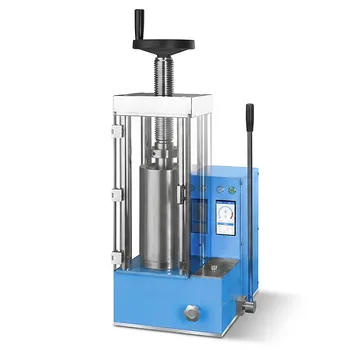
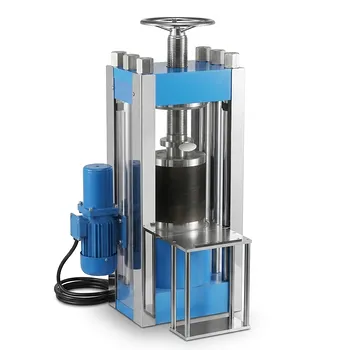
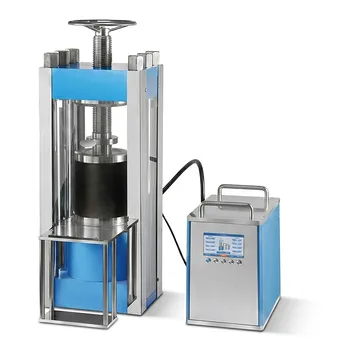
The two distinct categories of Cold Isostatic Pressing (CIP) technology are Wet Bag and Dry Bag processing. The fundamental difference between them lies in how the mold interacts with the pressure vessel: in Wet Bag technology, the mold is submerged freely into the fluid, whereas in Dry Bag technology, the mold is permanently fixed within the pressure vessel structure.
The choice between these two methods generally comes down to production volume and geometric complexity. Wet Bag serves low-volume, complex shaping needs, while Dry Bag is engineered specifically for high-volume mass production.
Operational Differences
Wet Bag Technology
In the Wet Bag process, the mold is an independent component. It is filled with powder, sealed tightly, and then physically submerged into a pressure fluid inside a pressure vessel.
Because the mold is not attached to the vessel, this method allows for handling widely varying shapes and sizes in a single vessel. It is typically a batch process, requiring the mold to be loaded and unloaded manually or via external handling systems.
Dry Bag Technology
Dry Bag technology integrates the mold directly into the pressure vessel. The mold is fixed inside the unit, and the powder is loaded directly into this fixed cavity.
Pressure is applied by fluid flowing through channels within the vessel wall to compress the mold from the surrounding area. This integration eliminates the need to submerge and retrieve the mold, significantly streamlining the cycle time.
The Underlying Mechanism
Regardless of the specific bag type, both methods utilize isostatic pressure. This ensures that pressure is applied equally from all directions, resulting in uniform powder density and predictable compression.
This approach minimizes the distortion or cracking often seen in uniaxial pressing, making CIP essential for achieving high-integrity billets and high green strength.
Understanding the Trade-offs
Production Speed vs. Flexibility
Dry Bag technology is the standard for mass production. Because the mold is fixed, the process can be highly automated with rapid loading, pressurization, and unloading cycles.
Wet Bag technology is inherently slower due to the manual or batch-style handling of the molds. However, it offers superior flexibility, allowing operators to change mold shapes or press multiple different components simultaneously in the same cycle.
Tooling Constraints
In Wet Bag pressing, the tooling is relatively simple and inexpensive to modify, as it is just a sealed bag submerged in fluid.
In Dry Bag pressing, the tooling is more complex and expensive because the flexible mold must be integrated into the rigid pressure vessel structure. This makes it less ideal for prototyping or short runs where mold designs change frequently.
Making the Right Choice for Your Goal
To select the correct CIP technology, you must evaluate your throughput requirements against your need for geometric flexibility.
- If your primary focus is Mass Production: Choose Dry Bag technology to leverage automated loading and faster cycle times for high-volume output.
- If your primary focus is R&D or Large Parts: Choose Wet Bag technology for the flexibility to press large, complex, or varying shapes without expensive tooling changes.
Ultimately, the correct method aligns the pressing speed with the scale of your manufacturing operation.
Summary Table:
| Feature | Wet Bag Technology | Dry Bag Technology |
|---|---|---|
| Mold Placement | Submerged freely in fluid | Permanently fixed in vessel |
| Production Volume | Low-volume / Batch processing | High-volume / Mass production |
| Geometric Flexibility | High (supports complex/various shapes) | Lower (fixed mold cavity) |
| Cycle Speed | Slower (manual handling) | Faster (automated loading) |
| Tooling Cost | Relatively low and simple | Higher (integrated design) |
| Best For | R&D and large, unique components | Standardized industrial parts |
Maximize Material Density with KINTEK’s Isostatic Solutions
Whether you are scaling up for high-volume manufacturing or conducting specialized battery research, KINTEK provides the precision equipment you need. We specialize in comprehensive laboratory pressing solutions, including manual and automatic models, as well as Cold and Warm Isostatic Presses tailored for high-integrity results.
Our value to you:
- Versatility: From glovebox-compatible units to multifunctional heated presses.
- Expertise: Specialized support for complex shaping and material R&D.
- Efficiency: Streamlined Dry Bag solutions for rapid industrial output.
Ready to enhance your lab's performance? Contact our technical experts today to find the perfect pressing solution for your application.
Related Products
- Automatic Lab Cold Isostatic Pressing CIP Machine
- Electric Split Lab Cold Isostatic Pressing CIP Machine
- Electric Lab Cold Isostatic Press CIP Machine
- Manual Cold Isostatic Pressing CIP Machine Pellet Press
- Electric Isostatic Pressing Machine 40 Tons Automatic Laboratory Powder Compacting Press
People Also Ask
- What are the key features of automated laboratory Cold Isostatic Press (CIP) systems? Achieve Precise, High-Pressure Powder Consolidation
- Why is an Isostatic Press (CIP) Necessary After Uniaxial Pressing? Achieve Transparency in Nd:Y2O3 Ceramics
- How does a Cold Isostatic Press (CIP) increase Bi-2223/Ag current density? Boost Superconductivity with Uniform Pressure
- What is the primary function of a Cold Isostatic Press (CIP) in NASICON preparation? Achieve 96% Theoretical Density
- How does a Cold Isostatic Press (CIP) facilitate the preparation of CaO-doped silicon carbide (SiC) green bodies?