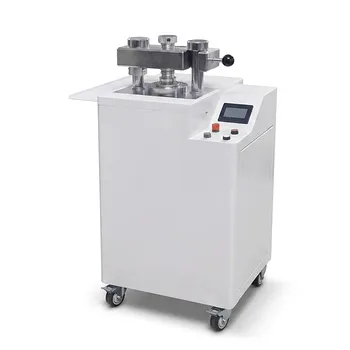
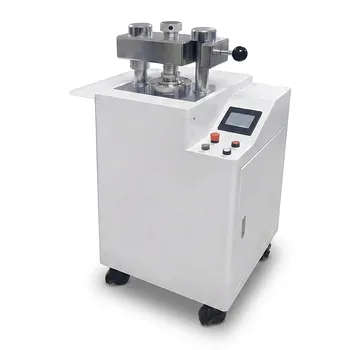
The essential equipment required to create a KBr pellet for FTIR analysis includes a pellet press die set, a hydraulic press, and a pestle and mortar. For optimal results, an agate pestle and mortar is strongly recommended to minimize sample loss and prevent contamination during the grinding process.
The goal of this process is to produce a thin, transparent disc where your sample is suspended within an infrared-transparent medium. The quality of your spectral data relies on using non-contaminating tools to grind the mixture and applying precise, uniform pressure to fuse it into a solid optic.
The Core Equipment Suite
To successfully prepare a sample for transmission FTIR spectroscopy, you must assemble a toolkit that allows for fine grinding and high-pressure compression.
The Grinding Apparatus
The first step requires thoroughly mixing the sample with potassium bromide (KBr) powder. An agate pestle and mortar is the industry standard for this task. Agate is preferred because its extreme hardness prevents the tool itself from shedding material into your sample (contamination), and its smooth surface ensures you can recover the maximum amount of your mixture.
The Compression Assembly
You require a Pellet Press Die Set of a specific diameter (commonly 13mm or 1/2 inch). This assembly includes a base plate, a die sleeve, and a plunger. This equipment dictates the geometry of the final pellet, ensuring it creates a cylindrical disc with flat ends and uniform thickness, which is critical for reproducible transmission data.
The Force Generator
While the die set holds the powder, a hydraulic press is required to apply the necessary force. To fuse the KBr and sample into a transparent disc, the press must be capable of generating a pressure of approximately 8,000 to 10,000 psi (55-69 MPa). This uniform force transforms the opaque powder mixture into a clear solid.
Critical Consumables and Support Items
Beyond the hardware, specific materials and environments are necessary to ensure the chemical integrity of the pellet.
The Optical Matrix
You must have high-purity Potassium Bromide (KBr) powder. This acts as the matrix for your sample; it is transparent to infrared radiation, allowing the instrument to analyze only your sample without interference. The typical ratio is 1 part sample to 100 parts KBr.
Cleaning and Drying Tools
Contamination is a major issue in trace analysis. You need suitable solvents and deionized water to clean the die set and mortar. Furthermore, a warm oven is essential for drying the tools after cleaning to ensure no moisture—which absorbs strong IR signals—remains on the equipment.
Understanding the Trade-offs
Creating KBr pellets is a classic technique, but it comes with specific challenges regarding moisture and sample preparation.
Moisture Sensitivity
KBr is hygroscopic, meaning it absorbs water from the air, which creates broad interference bands in your spectrum. If you are working in a humid environment, you may need a glove box to perform the grinding and loading steps in a dry atmosphere.
The Risk of Over-Grinding
While mixing is essential, over-grinding the KBr mixture should be avoided. Excessive grinding increases the surface area of the powder, which accelerates moisture absorption and can lead to cloudy, opaque pellets that yield poor data.
Optical Clarity vs. Sample Concentration
The final pellet must be approximately 2 mm thick and transparent. If the pellet appears opaque, it is often due to an incorrect ratio of sample to KBr (usually too much sample) or insufficient pressure from the hydraulic press.
Making the Right Choice for Your Goal
The equipment you select impacts the reproducibility and accuracy of your FTIR spectra.
- If your primary focus is sample purity: Prioritize an agate pestle and mortar over glass or ceramic alternatives to eliminate the risk of cross-contamination from the tool's surface.
- If your primary focus is quantitative analysis: Ensure your Pellet Press Die Set is well-maintained and free of scratches to guarantee uniform pellet thickness, which is vital for accurate pathlength calculations.
- If your primary focus is removing moisture interference: Integrate a glove box into your workflow and store your KBr powder in a desiccator to prevent water bands from obscuring your sample's peaks.
By combining the right compression hardware with contamination-resistant grinding tools, you ensure the production of clear, high-quality pellets for reliable characterization.
Summary Table:
| Equipment Component | Function in FTIR Prep | Key Specification |
|---|---|---|
| Pellet Press Die Set | Houses powder for compression | Commonly 13mm diameter |
| Hydraulic Press | Applies high-pressure force | 8,000 - 10,000 psi (55-69 MPa) |
| Agate Pestle & Mortar | Grinds sample and KBr matrix | High hardness to prevent contamination |
| KBr Powder | Infrared-transparent matrix | High purity, spectroscopy grade |
| Oven / Glovebox | Moisture control | Removes water interference for clear data |
Optimize Your FTIR Results with KINTEK Precision
Achieving transparent, high-quality KBr pellets requires the right balance of pressure and purity. KINTEK specializes in comprehensive laboratory pressing solutions, offering a versatile range of equipment to elevate your material characterization:
- Manual & Automatic Presses: Reliable force for uniform pellet thickness.
- Heated & Multifunctional Models: Specialized options for diverse sample needs.
- Glovebox-Compatible & Isostatic Presses: Advanced solutions for battery research and moisture-sensitive analysis.
Don't let sample preparation compromise your spectral data. Let our experts help you select the perfect press for your lab's specific needs.
Contact KINTEK for Your Pressing Solution Today
Related Products
- Laboratory Hydraulic Press 2T Lab Pellet Press for KBR FTIR
- XRF KBR Plastic Ring Lab Powder Pellet Pressing Mold for FTIR
- Laboratory Hydraulic Pellet Press for XRF KBR FTIR Lab Press
- Automatic Laboratory Hydraulic Press for XRF and KBR Pellet Pressing
- Lab Infrared Press Mold for No Demolding
People Also Ask
- What is the role of a laboratory pressure machine and KBr in FTIR? Master Sample Preparation for Flame Retardants
- What is the role of a laboratory hydraulic press in high-loading NCM811 cathode prep for solid-state batteries?
- Why is a laboratory hydraulic press necessary for sample preparation? Precise Pelleting for Spiro Heterocyclic Analysis
- What role does a laboratory hydraulic press play in reaction pellets? Optimizing Lunar Soil and Metal Fuel Density
- What is the typical pressure capacity of a laboratory hydraulic press and what materials can it process?