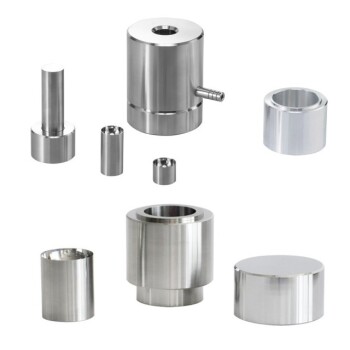
Laboratory standard compaction equipment and steel molds function as precision instruments for establishing a consistent physical baseline. They apply a strictly defined amount of compaction energy—using specific drop heights and blow counts—to a soil mixture confined within a rigid steel geometry. This process forces the modified soil to reach a preset maximum dry density and optimum moisture content, eliminating structural variability between test specimens.
The primary purpose of this equipment is to isolate the variable of interest. By standardizing the initial density and porosity, researchers ensure that any observed changes in water flow or volume are caused solely by the biopolymer dosage, not by inconsistent sample preparation.
Establishing a Controlled Physical State
The Role of Standardized Energy
To evaluate modified soils effectively, you must eliminate the "human factor" in packing the soil. Standard compaction equipment applies a uniform amount of kinetic energy to the mixture.
This is achieved through regulated drop heights and a specific number of blows per soil layer. This consistency allows you to achieve a target maximum dry density repeatedly across multiple samples.
Regulating Moisture and Density
The interaction between soil and additives like biopolymers is highly sensitive to the void ratio (porosity). Standard equipment ensures the soil reaches its optimum moisture content during the densification process.
This provides a known, repeatable starting point for analyzing complex behaviors such as hydraulic conductivity and volumetric shrinkage or swelling.
Defining Volume with Steel Molds
The steel mold serves as the boundary condition for the experiment. By rigidly defining the volume, it translates the applied compaction energy directly into internal densification rather than lateral deformation.
This confinement is necessary to produce cylindrical specimens with the precise geometric dimensions required for subsequent testing protocols.
Simulating Real-World Engineering Conditions
Replicating Field Compaction
Laboratory compaction is not an abstract exercise; it is a simulation of construction reality. The impact delivered by the equipment mimics the rolling and tamping effects of heavy machinery at an engineering site.
By controlling the energy to achieve a relative compaction degree of roughly 90%, these tools produce samples that reflect the internal structure and porosity expected in actual foundation engineering.
Preparing for Mechanical Testing
Once the sample is compacted within the mold, it serves as a standardized artifact for performance testing. The resulting specimen provides the structural integrity needed for unconfined compressive strength tests.
This ensures that the mechanical data derived from the sample is relevant to the specifications required for roadbeds or structural fill.
Understanding the Trade-offs
The Risk of Density Gradients
While standard impact compaction (hammers) is the industry norm, it can introduce inconsistencies within a single sample. The impact force can sometimes create layers that are denser at the top than at the bottom.
In scenarios requiring extreme homogeneity, such as thermal conductivity testing, static compaction using a laboratory press (as noted in supplementary contexts) may be superior to standard impact tools for minimizing these internal density gradients.
Manual vs. Automated Variance
If the standard equipment relies on manual operation, operator fatigue or technique variation can skew results. Slight deviations in the angle of the blow or the height of the drop can alter the final void ratio.
For high-precision studies involving sensitive additives, automated or strictly controlled mechanical presses are often preferred to reduce experimental error.
Making the Right Choice for Your Goal
To select the correct preparation method, you must align your tooling with your specific testing objectives.
- If your primary focus is hydraulic behavior or volume change: strict adherence to standard impact compaction is critical to establish a recognized maximum dry density and optimum moisture content baseline.
- If your primary focus is unconfined compressive strength: ensure your compaction energy simulates field rolling conditions (90% relative compaction) to generate data relevant to foundation engineering.
- If your primary focus is microscopic pore structure or thermal properties: consider using static pressure control rather than impact compaction to eliminate internal density gradients and ensure homogeneity.
Precision in sample preparation is the only way to guarantee that your data reflects the chemistry of the soil, rather than the inconsistency of the compaction.
Summary Table:
| Component | Primary Function | Engineering Value |
|---|---|---|
| Standard Compaction Tools | Apply uniform kinetic energy (blows/height) | Eliminates 'human factor' & ensures repeatable density |
| Rigid Steel Molds | Define fixed volume & boundary conditions | Prevents lateral deformation; ensures precise geometry |
| Energy Regulation | Achieve Max Dry Density & Opt. Moisture | Replicates field conditions like rolling and tamping |
| Static Press Options | Minimize internal density gradients | Superior for homogeneity in thermal/microscopic studies |
Precision Compaction for Unbeatable Research Accuracy
Don't let inconsistent sample preparation skew your laboratory results. KINTEK specializes in comprehensive laboratory pressing solutions, offering manual, automatic, heated, multifunctional, and glovebox-compatible models, as well as cold and warm isostatic presses.
Whether you are conducting battery research or stabilizing modified soils, our equipment ensures the structural integrity and homogeneity your mechanical testing demands.
Ready to elevate your lab's efficiency? Contact us today to find the perfect press for your research!
References
- Ahmed Bukhary, Shahid Azam. Flow through and Volume Change Behavior of a Compacted Expansive Soil Amended with Natural Biopolymers. DOI: 10.3390/geotechnics4010017
This article is also based on technical information from Kintek Solution Knowledge Base .
Related Products
- Lab Round Bidirectional Press Mold
- Lab Polygon Press Mold
- XRF KBR Steel Ring Lab Powder Pellet Pressing Mold for FTIR
- Square Lab Press Mold for Laboratory Use
- Special Shape Lab Press Mold for Laboratory Applications
People Also Ask
- What is the purpose of incorporating cartridge heaters into a lab press mold for MLCC block compression? Optimize Results
- What is the function of a pressing tool in thermoplastic panels? Master Precision Shaping & Fusion Bonding
- Why is precise cooling management of the lab press mold necessary? Protect Core Integrity in Thermoforming
- Why is a high-performance laboratory molding press critical for in-situ electrolyte formation? Unlock Battery Success
- How do the design and geometric precision of pressing molds and mandrels affect the quality of PTFE composite samples?