
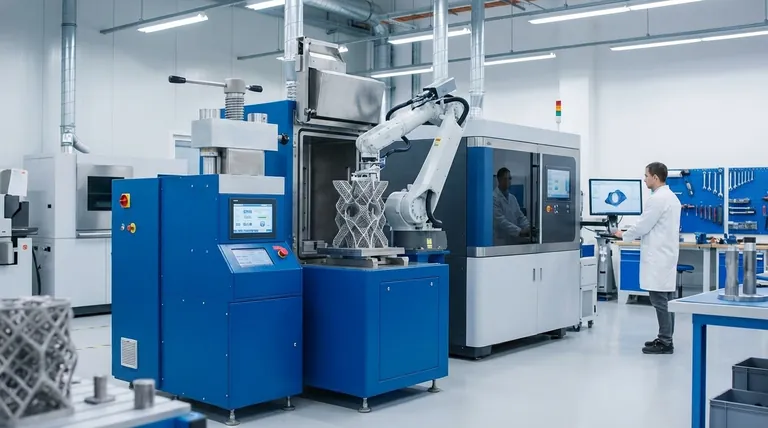
A distinct and evolving trend in advanced manufacturing is the strategic integration of Cold Isostatic Pressing (CIP) with Additive Manufacturing (AM). This hybrid approach utilizes CIP as a critical post-processing step to significantly enhance the density and material properties of parts originally created through 3D printing.
While Additive Manufacturing offers unparalleled design freedom, it often yields parts with residual porosity. Coupling these technologies allows manufacturers to achieve the geometric complexity of printing with the superior structural integrity typically associated with traditional forging or casting.
The Synergy Between CIP and Additive Manufacturing
Overcoming the Limitations of 3D Printing
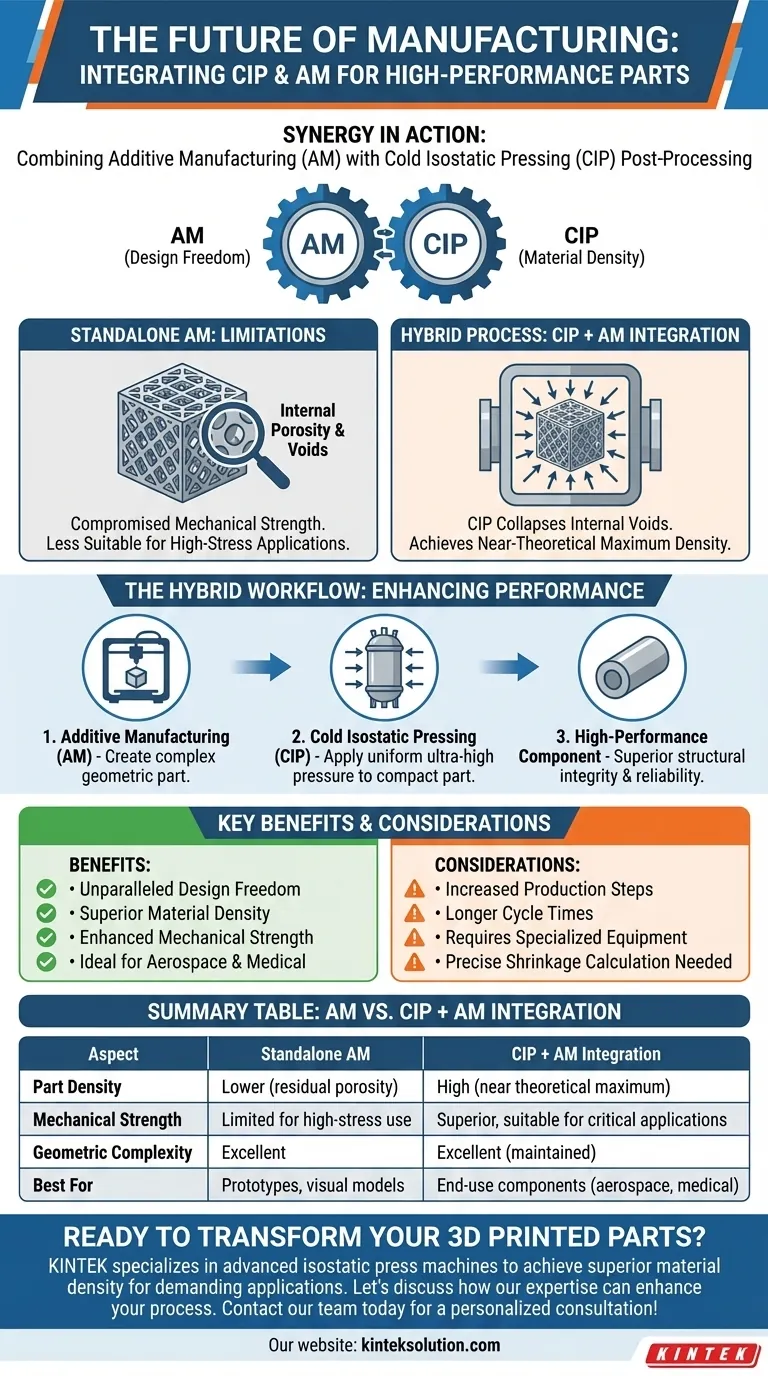
Additive Manufacturing (AM) excels at producing complex geometries that are impossible to create with subtractive methods. However, a common drawback of AM is internal porosity.
Microscopic voids left during the printing process can compromise the mechanical strength and fatigue life of the component. This makes untreated AM parts less suitable for high-stress applications.
How CIP Enhances Material Density
By integrating CIP, manufacturers subject the pre-formed AM part to uniform, ultra-high pressure from all directions.
This process acts to collapse internal voids and compact the microstructure. The result is a component that approaches its theoretical maximum density, drastically improving its durability and reliability.
Leveraging Strengths of Both Processes
This integration allows engineers to stop choosing between shape and strength.
You gain the rapid prototyping and customization benefits of AM while utilizing CIP to ensure the final product meets rigorous industrial standards. This is particularly relevant for sectors like aerospace and medical devices, where material failure is not an option.
Understanding the Trade-offs
Increased Production Complexity
Integrating CIP introduces an additional step into the manufacturing workflow.
This increases the total cycle time and requires access to specialized high-pressure equipment. It moves the process away from the "print and go" simplicity often promised by AM proponents.
Managing Dimensional Change
Because CIP functions by compacting material to increase density, the part will inevitably undergo shrinkage.
Designers must calculate this volume reduction precisely. The initial 3D print must be scaled up to account for the compression that occurs during the isostatic pressing phase to ensure the final dimensions are accurate.
Making the Right Choice for Your Goal
To determine if this hybrid workflow suits your production needs, evaluate your performance requirements against cost constraints.
- If your primary focus is Geometric Complexity with High Load Bearing: Utilize the CIP-AM integration to ensure your complex designs have the internal density required to prevent structural failure.
- If your primary focus is Rapid Prototyping or Visual Models: Stick to standalone Additive Manufacturing, as the improved density from CIP is likely unnecessary for non-functional parts.
By bridging the gap between design flexibility and material solidity, this integration transforms 3D printed parts from prototypes into high-performance end-use components.
Summary Table:
| Aspect | Standalone AM | CIP + AM Integration |
|---|---|---|
| Part Density | Lower (residual porosity) | High (near theoretical maximum) |
| Mechanical Strength | Limited for high-stress use | Superior, suitable for critical applications |
| Geometric Complexity | Excellent | Excellent (maintained) |
| Best For | Prototypes, visual models | End-use components (aerospace, medical) |
Ready to transform your 3D printed prototypes into high-performance, production-ready parts?
By integrating Cold Isostatic Pressing (CIP) technology, you can overcome the limitations of porosity in additive manufacturing. KINTEK specializes in advanced lab press machines, including isostatic presses, to help you achieve the superior material density and structural integrity required for demanding applications in aerospace, medical devices, and more.
Let's discuss how our expertise can enhance your manufacturing process. Contact our team today for a personalized consultation!
Visual Guide
Related Products
- Automatic Lab Cold Isostatic Pressing CIP Machine
- Electric Lab Cold Isostatic Press CIP Machine
- Electric Split Lab Cold Isostatic Pressing CIP Machine
- Manual Cold Isostatic Pressing CIP Machine Pellet Press
- Lab Isostatic Pressing Molds for Isostatic Molding
People Also Ask
- What are the key features of automated laboratory Cold Isostatic Press (CIP) systems? Achieve Precise, High-Pressure Powder Consolidation
- Why is an Isostatic Press (CIP) Necessary After Uniaxial Pressing? Achieve Transparency in Nd:Y2O3 Ceramics
- What is the primary function of a Cold Isostatic Press (CIP) in NASICON preparation? Achieve 96% Theoretical Density
- How does a Cold Isostatic Press (CIP) facilitate the preparation of CaO-doped silicon carbide (SiC) green bodies?
- How does a Cold Isostatic Press (CIP) increase Bi-2223/Ag current density? Boost Superconductivity with Uniform Pressure








