
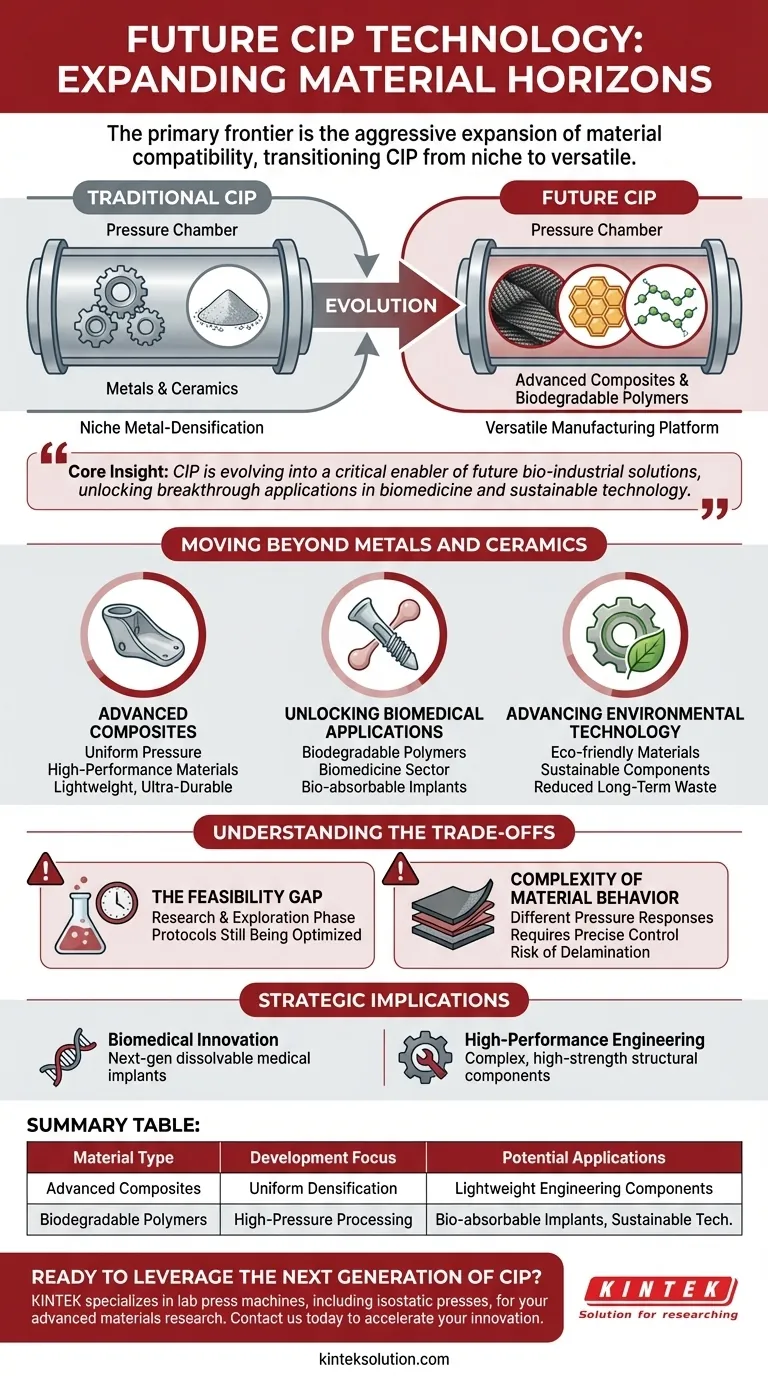
The primary frontier in future Cold Isostatic Pressing (CIP) technology is the aggressive expansion of material compatibility. While the industry has historically relied on CIP for densifying metal and ceramic powders, current development is focused on validating the process for advanced composites and biodegradable polymers.
Core Insight: The evolution of CIP is transitioning from a niche metal-densification process to a versatile manufacturing platform. By expanding compatibility to biodegradable polymers and complex composites, CIP is poised to unlock breakthrough applications in biomedicine and sustainable technology.
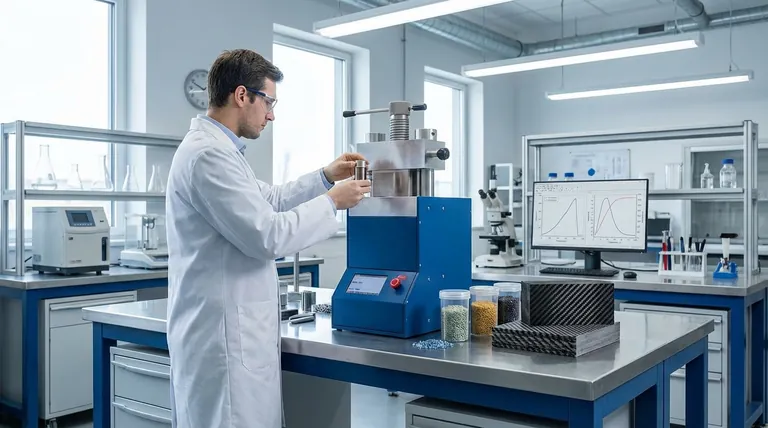
Expanding the Material Horizon
The drive to modernize CIP technology centers on moving beyond the limitations of rigid, inorganic materials. Research is actively redefining what can be successfully processed under isostatic pressure.
Moving Beyond Metals and Ceramics
Traditionally, CIP has been the standard for consolidating metal and ceramic powders into near-net shapes.
However, the future utility of the technology depends on its ability to handle a broader spectrum of chemical structures without compromising material integrity.
The Rise of Advanced Composites
A major area of research involves the feasibility of processing advanced composites.
This development aims to leverage the uniform pressure application of CIP to create high-performance materials that combine the properties of multiple substances.
Successful integration of composites could revolutionize industries requiring lightweight yet ultra-durable components.
Unlocking Biomedical Applications
Perhaps the most significant leap in material compatibility is the inclusion of biodegradable polymers.
This capability is opening new doors in the biomedicine sector, where materials must interact safely with biological systems.
Potential applications include bio-absorbable implants or scaffolds for tissue engineering that were previously difficult to manufacture with uniform density.
Advancing Environmental Technology
The shift toward polymers also has profound implications for environmental technology.
By enabling the processing of eco-friendly and biodegradable materials, CIP can support the manufacturing of sustainable components that reduce long-term waste.
Understanding the Trade-offs
While the expansion of material compatibility is promising, it introduces new complexities that early adopters must navigate.
The Feasibility Gap
References indicate that much of this expansion is currently in the research and exploration phase.
Unlike the established protocols for metals, the parameters for processing polymers and composites are still being optimized for commercial reliability.
Complexity of Material Behavior
Advanced composites behave differently under high pressure than uniform metal powders.
Achieving consistent density and preventing delamination in multi-material composites requires far more precise pressure control than traditional applications.
Strategic Implications for Future Manufacturing
As CIP technology matures to accommodate these new materials, your adoption strategy should depend on your specific industry targets.
- If your primary focus is Biomedical Innovation: Monitor developments in biodegradable polymer processing to enable the production of next-generation, dissolvable medical implants.
- If your primary focus is High-Performance Engineering: Track the feasibility studies regarding advanced composites to leverage CIP for creating complex, high-strength structural components.
By diversifying material compatibility, CIP is evolving from a traditional metallurgical tool into a critical enabler of future bio-industrial solutions.
Summary Table:
| Material Type | Development Focus | Potential Applications |
|---|---|---|
| Advanced Composites | Uniform densification of multi-material structures | High-performance, lightweight engineering components |
| Biodegradable Polymers | Processing under high pressure without integrity loss | Bio-absorbable medical implants, sustainable technology |
Ready to leverage the next generation of CIP technology for your advanced materials? KINTEK specializes in lab press machines, including isostatic presses, designed to meet the evolving needs of laboratory research and development. Whether you're working with advanced composites or biodegradable polymers, our equipment provides the precision and reliability required for groundbreaking applications. Contact us today to discuss how our solutions can accelerate your innovation in biomedicine and sustainable technology!
Visual Guide
Related Products
- Automatic Lab Cold Isostatic Pressing CIP Machine
- Electric Lab Cold Isostatic Press CIP Machine
- Electric Split Lab Cold Isostatic Pressing CIP Machine
- Manual Cold Isostatic Pressing CIP Machine Pellet Press
- Lab Isostatic Pressing Molds for Isostatic Molding
People Also Ask
- What are the key features of automated laboratory Cold Isostatic Press (CIP) systems? Achieve Precise, High-Pressure Powder Consolidation
- Why is an Isostatic Press (CIP) Necessary After Uniaxial Pressing? Achieve Transparency in Nd:Y2O3 Ceramics
- What is the primary function of a Cold Isostatic Press (CIP) in NASICON preparation? Achieve 96% Theoretical Density
- How does a Cold Isostatic Press (CIP) increase Bi-2223/Ag current density? Boost Superconductivity with Uniform Pressure
- How does a Cold Isostatic Press (CIP) facilitate the preparation of CaO-doped silicon carbide (SiC) green bodies?








