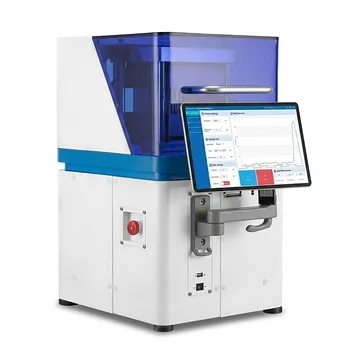
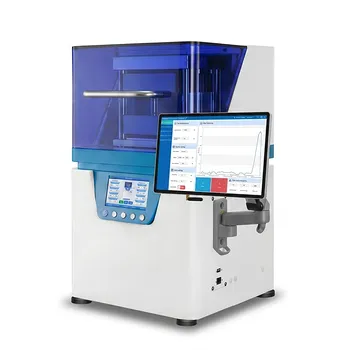
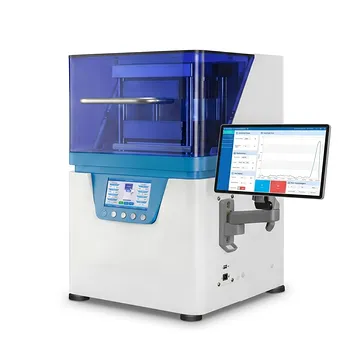
A laboratory press is a precision instrument designed to apply controlled force to compress or compact materials for testing and preparation. Typically powered by a hydraulic system, these devices generate significant pressure—often up to 1,000 pounds per square inch (psi)—to manipulate samples. They are fundamental tools used to study material properties or prepare substances like powders, sheet materials, and polymer beads for downstream analysis.
The Core Takeaway While the mechanism is simple compression, the goal is scientific consistency. By converting loose or irregular materials into uniform, dense forms, a laboratory press ensures that subsequent analytical data—whether in spectroscopy, durability testing, or synthesis—is accurate and reproducible.
Why Compression Matters for Data Accuracy
The primary function of a laboratory press extends beyond mere compaction; it is about creating a standardized physical state for analysis.
Standardization for Analytical Instruments
Many precision instruments, such as X-ray fluorescence (XRF) and infrared spectroscopy (IR), require samples to be in a specific form to yield accurate results.
Loose powders often cause measurement deviations due to irregular surfaces and air gaps.
A laboratory press compresses these powders into pellets with a smooth surface and consistent density, which is a prerequisite for accurate elemental decomposition analysis.
Eliminating Structural Variables
In chemical research and soil analysis, internal pores and voids can skew experimental data.
By applying static compression, the press eliminates these internal pores, ensuring the sample has a uniform density distribution.
This creates a consistent "green body" or specimen, providing a reliable physical foundation for testing properties like mechanical strength or swelling volume.
Key Applications Across Industries
The versatility of the laboratory press allows it to serve critical roles in various sectors, from pharmaceuticals to advanced manufacturing.
Solid-State Synthesis and Chemistry
In solid-state synthesis, reactants must be in close proximity to react efficiently.
A laboratory press compacts precursor powders into dense pellets before heat treatment (sintering).
This increases the contact area between particles, promoting uniform chemical reactions and helping synthesize high-purity phases with desired properties, such as high ionic conductivity.
Material Engineering and Battery Development
In the development of composites and batteries, the press is used to fuse different layers.
For example, it can apply uniform pressure and temperature to fuse a piezoelectric layer with a matrix layer.
This eliminates interlaminar voids, creating a seamless interface that enhances mechanical integrity and ensures continuous ion transmission in multi-layered electrolytes.
R&D and Lean Manufacturing
Beyond pure research, these presses are utilized for short production runs and limited manufacturing.
Industries involving rubber, polymers, and laminates use them for prototyping and testing durability.
This allows for the creation of samples that mimic full-scale production conditions without the waste of a large manufacturing run.
Understanding the Trade-offs
While laboratory presses are essential, understanding their operational constraints is vital for valid results.
The Risk of Over-Compaction
More pressure is not always better.
The goal is often to achieve a specific "nominal height" or "initial void ratio," particularly in soil or clay testing.
Applying pressure beyond the target parameters can crush the material structure rather than just compacting it, leading to a sample that no longer represents the material's true properties.
Specificity of Application
A press designed for making XRF pellets may not be suitable for hot-pressing battery laminates.
Different applications require specific capabilities, such as heated platens for laminating or extreme pressure precision for rheological testing.
Using a general-purpose hydraulic press for highly specialized composite fusing may result in uneven bonding if temperature controls are not precise.
Making the Right Choice for Your Goal
To get the most out of a laboratory press, align the machine's capabilities with your specific analytical requirements.
- If your primary focus is Analytical Chemistry (XRF/IR): Prioritize a press capable of high-pressure consistency to create perfectly smooth, dense pellets that eliminate signal noise.
- If your primary focus is Material Synthesis: Ensure the press can create high-density "green bodies" to maximize particle contact area for efficient sintering and heat transfer.
- If your primary focus is Composites or Battery R&D: Look for a press that offers precise control over both pressure and temperature to eliminate voids between laminated layers.
A laboratory press is not just a crushing tool; it is the gatekeeper of sample integrity, ensuring your raw materials are physically prepared to tell the truth during analysis.
Summary Table:
| Application | Primary Use Case | Key Benefit |
|---|---|---|
| Analytical Chemistry | Pelleting for XRF/IR spectroscopy | Eliminates air gaps and surface noise |
| Material Synthesis | Creating dense "green bodies" | Maximizes particle contact for sintering |
| Battery R&D | Fusing multi-layered electrolytes | Ensures seamless ion transmission and integrity |
| Material Engineering | Prototyping and durability testing | Simulates full-scale production conditions |
Optimize Your Research with KINTEK Pressing Solutions
Don’t let poor sample preparation compromise your data accuracy. KINTEK specializes in comprehensive laboratory pressing solutions designed to meet the rigorous demands of modern science. Whether you are conducting cutting-edge battery research or precise material analysis, our expertise ensures your samples are perfectly compacted every time.
Our Versatile Range Includes:
- Manual & Automatic Presses: For reliable, repeatable pelletizing.
- Heated & Multifunctional Models: Ideal for laminating composites and polymers.
- Glovebox-Compatible Designs: Specialized solutions for air-sensitive battery chemistry.
- Isostatic Presses (CIP/WIP): For uniform density in complex structural materials.
Ready to enhance your lab's efficiency and reproducibility?
Contact KINTEK today to find the perfect press for your application!
Related Products
- Laboratory Hydraulic Press Lab Pellet Press Button Battery Press
- Laboratory Hydraulic Press Lab Pellet Press Machine for Glove Box
- Laboratory Split Manual Heated Hydraulic Press Machine with Hot Plates
- Laboratory Hydraulic Pellet Press for XRF KBR FTIR Lab Press
- Laboratory Hydraulic Split Electric Lab Pellet Press
People Also Ask
- How is a laboratory hydraulic press used for HAP composite gels? Master Mineral Substrate Standardization
- What role does a laboratory hydraulic press play in reaction pellets? Optimizing Lunar Soil and Metal Fuel Density
- What role does a laboratory hydraulic press play in the preparation of piezoelectric ceramic discs for DC-PG? | KINTEK
- Why is a laboratory hydraulic press required for PBAT and PLA sample preparation? Achieve Flawless Characterization
- What role does a laboratory hydraulic press play in the assembly of all-solid-state battery test cells? Expert Guide