
The primary disadvantage of Cold Isostatic Pressing (CIP) regarding geometric accuracy is the inability to produce precise, "net-shape" components. This limitation stems directly from the use of flexible elastomeric molds (such as rubber or polyurethane) which deform during the pressing process. Unlike rigid dies used in uniaxial pressing, flexible molds cannot enforce tight dimensional tolerances or perfectly smooth surface finishes on the "green" (unfired) part.
The Core Takeaway CIP trades initial geometric precision for internal structural perfection. While the as-pressed part will lack tight tolerances and require machining, the process delivers superior density uniformity, ensuring the part does not warp or crack internally during the final sintering phase.
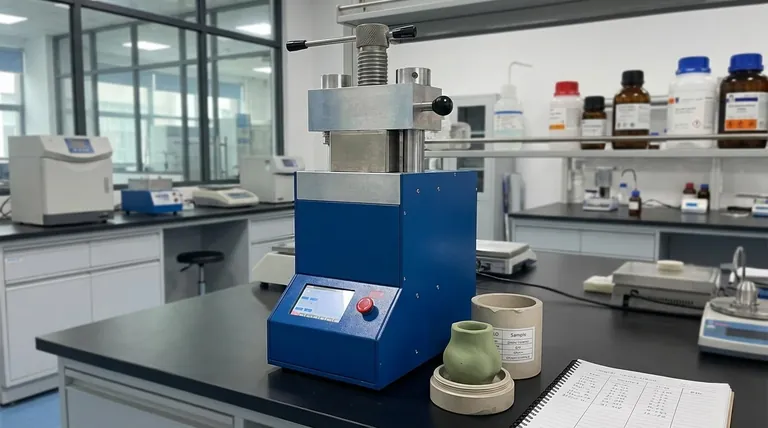
The Mechanics of Geometric Inaccuracy
The Flexible Mold Limitation
In standard pressing, a rigid metal die dictates the final shape. In CIP, the powder is encased in a flexible elastomer sheath or mold.
When hydraulic pressure is applied, this mold compresses inward. Because the mold itself is pliable, it cannot provide a hard reference surface. This makes it challenging to control the exact final dimensions of the pressed part.
Challenges in Dimensional Control
Even under ideal conditions, achieving high precision is difficult. To maximize accuracy, operators often use molds that are very thin and of uniform thickness to minimize the influence of the mold material itself.
However, even with these precautions, the resulting "green body" usually requires subsequent processing to meet engineering tolerances.
The Trade-off: Accuracy vs. Uniformity
It is critical to distinguish between external geometric accuracy and internal structural consistency. This is where CIP provides its value.
Sacrificing Shape for Density
While a rigid die (uniaxial pressing) creates a precise shape, friction often causes density gradients—meaning the top and bottom of the part are denser than the center. This leads to unpredictable distortion when the part is fired.
CIP applies pressure uniformly from all directions (isostatic). This results in a "green body" with uniform density throughout, often reaching 60% to 80% of theoretical density.
Predictable Shrinkage
Because the density is consistent, the shrinkage that occurs during sintering is highly predictable.
Although the initial shape may be geometrically rough, the lack of internal stress gradients means the part will retain its general proportions without the warping or cracking associated with other methods.
Operational Considerations and Costs
Mandatory Post-Processing
Because CIP cannot produce net-shape parts with high geometric accuracy, you must account for machining costs.
CIP parts are typically produced as "near-net-shape" billets or preforms. These must be machined or ground after pressing (and sometimes after partial sintering) to achieve the final required geometry and surface finish.
Material Preparation Requirements
To mitigate filling irregularities that could further harm geometric accuracy, the powder used in CIP must have excellent flowability.
This often requires additional upstream processes, such as spray drying or mold vibration, which can increase the overall complexity and cost of the production line.
Making the Right Choice for Your Goal
To determine if the geometric limitations of CIP are acceptable for your project, weigh the following:
- If your primary focus is High-Performance or Large Complex Parts: Accept the lower geometric accuracy. The uniform density and lack of internal defects provided by CIP are essential for reliability, even if it requires subsequent machining.
- If your primary focus is High-Volume Production of Simple Shapes: Avoid CIP. Uniaxial pressing is likely a better choice, as rigid dies can produce parts to final tolerances rapidly, eliminating the need for secondary machining.
Summary: CIP is the superior choice for material integrity and complex preforms, provided you have the budget and process capability to machine the part to its final geometric specifications.
Summary Table:
| Aspect | Cold Isostatic Pressing (CIP) | Uniaxial Pressing |
|---|---|---|
| Geometric Accuracy | Low (requires post-machining) | High (net-shape possible) |
| Density Uniformity | Excellent (uniform from all sides) | Variable (risk of gradients) |
| Sintering Outcome | Predictable shrinkage, less warping | Potential for distortion |
| Ideal For | Complex shapes, high-performance parts | Simple shapes, high-volume production |
Need a lab press that balances precision and performance? KINTEK specializes in automatic lab presses, isostatic presses, and heated lab presses designed for laboratory R&D and production. Whether you're developing complex ceramic preforms or testing material integrity, our equipment ensures uniform density and reliable results. Contact us today to find the perfect press for your application and achieve superior material quality with minimal post-processing!
Visual Guide

Related Products
- Electric Lab Cold Isostatic Press CIP Machine
- Automatic Lab Cold Isostatic Pressing CIP Machine
- Electric Split Lab Cold Isostatic Pressing CIP Machine
- Manual Cold Isostatic Pressing CIP Machine Pellet Press
- Lab Isostatic Pressing Molds for Isostatic Molding
People Also Ask
- What role do electric lab cold isostatic presses play in industrial contexts? Bridge R&D and Manufacturing with Precision
- What are the applications of electric lab cold isostatic presses in research settings? Advance Material R&D with High-Pressure CIPs
- How does electrical Cold Isostatic Pressing (CIP) contribute to cost savings? Unlock Efficiency and Reduce Expenses
- What are some research applications of electric lab CIPs? Unlock Uniform Powder Densification for Advanced Materials
- What are the characteristics of standard off-the-shelf electric lab CIP solutions? Achieve Immediate, Cost-Effective Processing









