
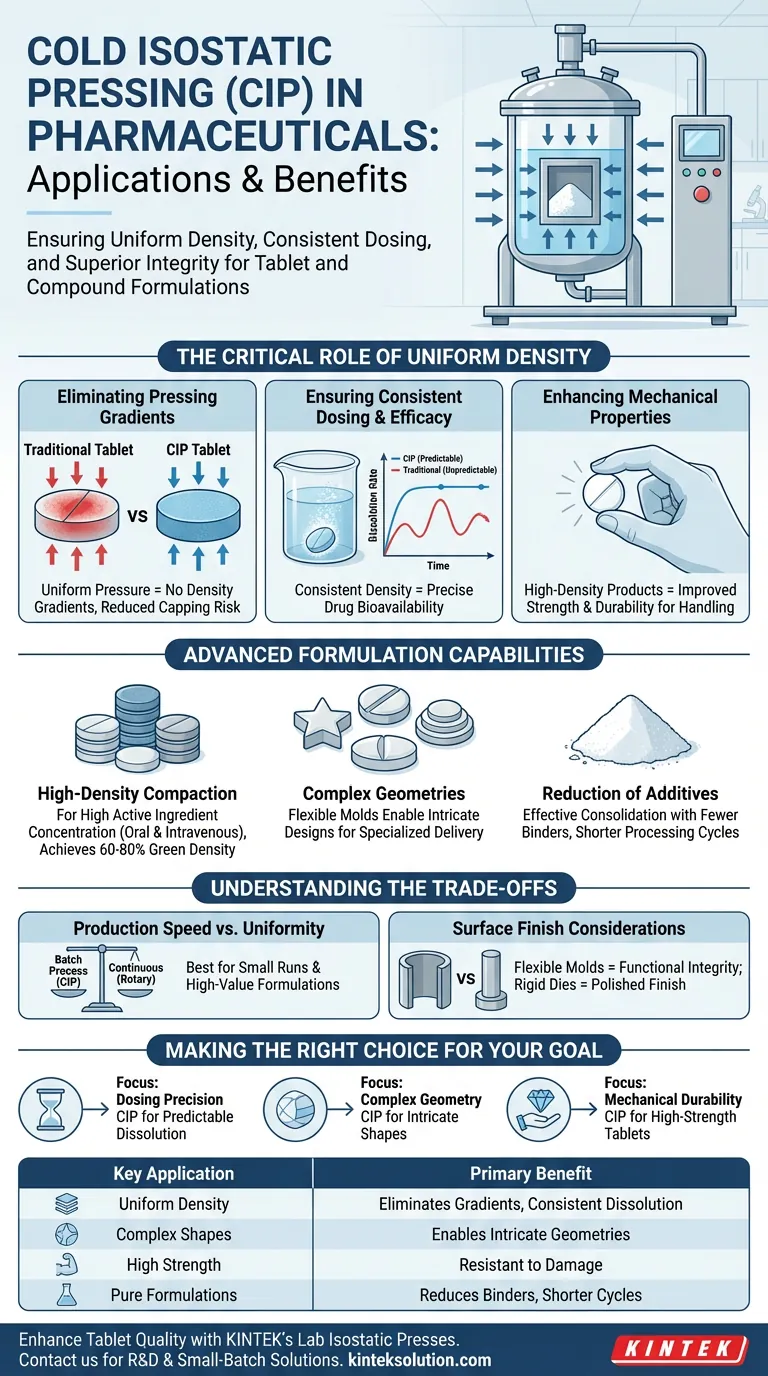
In the pharmaceutical industry, Cold Isostatic Pressing (CIP) is primarily applied to compact powder formulations into tablets and medical compounds with exceptional density uniformity. Unlike traditional pressing methods that apply force from one direction, CIP applies equal pressure from all sides via a fluid medium, ensuring consistent dosing, enhanced efficacy, and superior mechanical integrity for oral and intravenous drugs.
The core value of CIP in pharmaceuticals is the elimination of density gradients within the tablet. By ensuring the material is packed uniformly, manufacturers guarantee that the drug dissolves at a predictable rate and maintains its physical structure during handling.
The Critical Role of Uniform Density
Eliminating Pressing Gradients
Standard uniaxial pressing often results in density variations, creating tablets that are harder on the edges and softer in the center.
Cold Isostatic Pressing submerges the formulation in a pressurized fluid, applying force equally from every direction.
This eliminates internal stress and density gradients, resulting in a homogeneous product that reduces the risk of capping or lamination.
Ensuring Consistent Dosing and Efficacy
The physical density of a tablet directly influences how it breaks down in the body.
Inconsistent density leads to unpredictable dissolution rates, which can alter the bioavailability of the drug.
CIP ensures that every tablet in a batch has the exact same density profile, guaranteeing that the patient receives the precise intended dose and efficacy.
Enhancing Mechanical Properties
Pharmaceutical tablets must withstand packaging, transport, and handling without crumbling.
CIP produces high-density products with significantly improved strength and resistance to wear compared to standard compaction.
This creates a robust final product that maintains its integrity from the manufacturing line to the patient.
Advanced Formulation Capabilities
High-Density Compaction
Certain drug formulations require a high concentration of active ingredients in a small volume.
CIP allows for the creation of high-density drug formulations used for both oral and intravenous administration.
The process achieves 60% to 80% of theoretical density in the "green" state, maximizing the amount of material consolidated into the dosage form.
Complex Geometries
Traditional steel dies limit tablets to simple shapes to avoid uneven pressure distribution.
Because CIP uses flexible molds and hydrostatic pressure, it can produce intricate shapes that conventional presses cannot achieve.
This flexibility allows for specialized tablet designs that may be required for specific drug delivery mechanisms or branding purposes.
Reduction of Additives
The CIP process is highly effective at consolidating powder without relying heavily on binders.
References indicate this method can eliminate steps like binder burnout or drying, leading to shorter processing cycle times for complex parts.
This results in a purer final product with fewer chemical additives required to hold the tablet together.
Understanding the Trade-offs
Production Speed vs. Uniformity
While CIP offers superior quality, it is generally a batch process, distinct from the continuous high-speed output of rotary tablet presses.
It is often most cost-effective for small production runs or high-value formulations where quality supersedes volume.
Surface Finish Considerations
CIP typically utilizes flexible elastomeric molds to contain the powder.
While this allows for complex shapes, the surface finish may differ from the polished sheen achieved by rigid steel dies.
Manufacturers must weigh the need for internal structural integrity against the aesthetic requirements of the tablet surface.
Making the Right Choice for Your Goal
To determine if Cold Isostatic Pressing is the correct solution for your pharmaceutical application, consider your specific constraints:
- If your primary focus is Dosing Precision: CIP is the superior choice for ensuring predictable dissolution rates and strictly uniform density.
- If your primary focus is Complex Geometry: CIP provides the flexibility to mold intricate shapes without sacrificing structural stability.
- If your primary focus is Mechanical Durability: CIP creates high-strength tablets that resist wear and breakage during logistics and handling.
CIP transforms pharmaceutical manufacturing by prioritizing the internal quality and consistency of the dosage form over simple speed.
Summary Table:
| Key Application | Primary Benefit |
|---|---|
| Uniform Density | Eliminates density gradients, ensures consistent drug dissolution |
| Complex Shapes | Enables intricate tablet geometries not possible with traditional presses |
| High Strength | Produces durable tablets resistant to handling and transport damage |
| Pure Formulations | Reduces need for binders and additives, shorter processing cycles |
Ready to enhance your pharmaceutical tablet quality with precise isostatic pressing? KINTEK specializes in laboratory isostatic press machines, including cold isostatic presses (CIP) designed for R&D and small-batch production of pharmaceutical formulations. Our equipment helps you achieve superior density uniformity, complex geometries, and consistent dosing for oral and intravenous drugs. Contact us today to discuss how our lab press solutions can optimize your pharmaceutical development and manufacturing processes.
Visual Guide
Related Products
- Electric Lab Cold Isostatic Press CIP Machine
- Automatic Lab Cold Isostatic Pressing CIP Machine
- Electric Split Lab Cold Isostatic Pressing CIP Machine
- Manual Cold Isostatic Pressing CIP Machine Pellet Press
- Lab Isostatic Pressing Molds for Isostatic Molding
People Also Ask
- What are the applications of electric lab cold isostatic presses in research settings? Advance Material R&D with High-Pressure CIPs
- What role do electric lab cold isostatic presses play in industrial contexts? Bridge R&D and Manufacturing with Precision
- How does electrical Cold Isostatic Pressing (CIP) contribute to cost savings? Unlock Efficiency and Reduce Expenses
- What are some research applications of electric lab CIPs? Unlock Uniform Powder Densification for Advanced Materials
- What are the characteristics of standard off-the-shelf electric lab CIP solutions? Achieve Immediate, Cost-Effective Processing









