
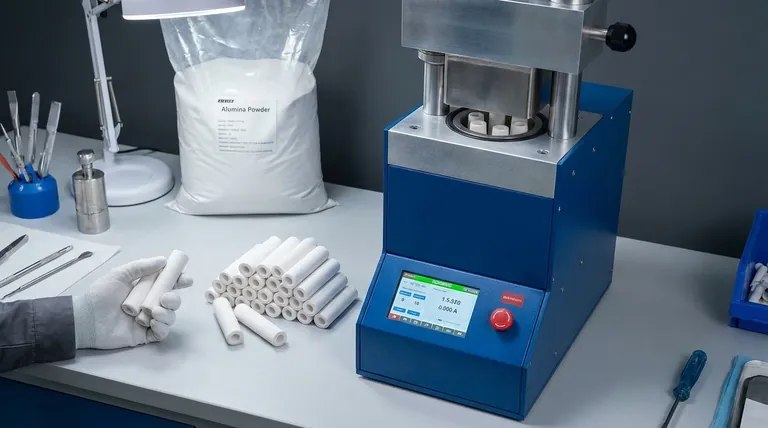
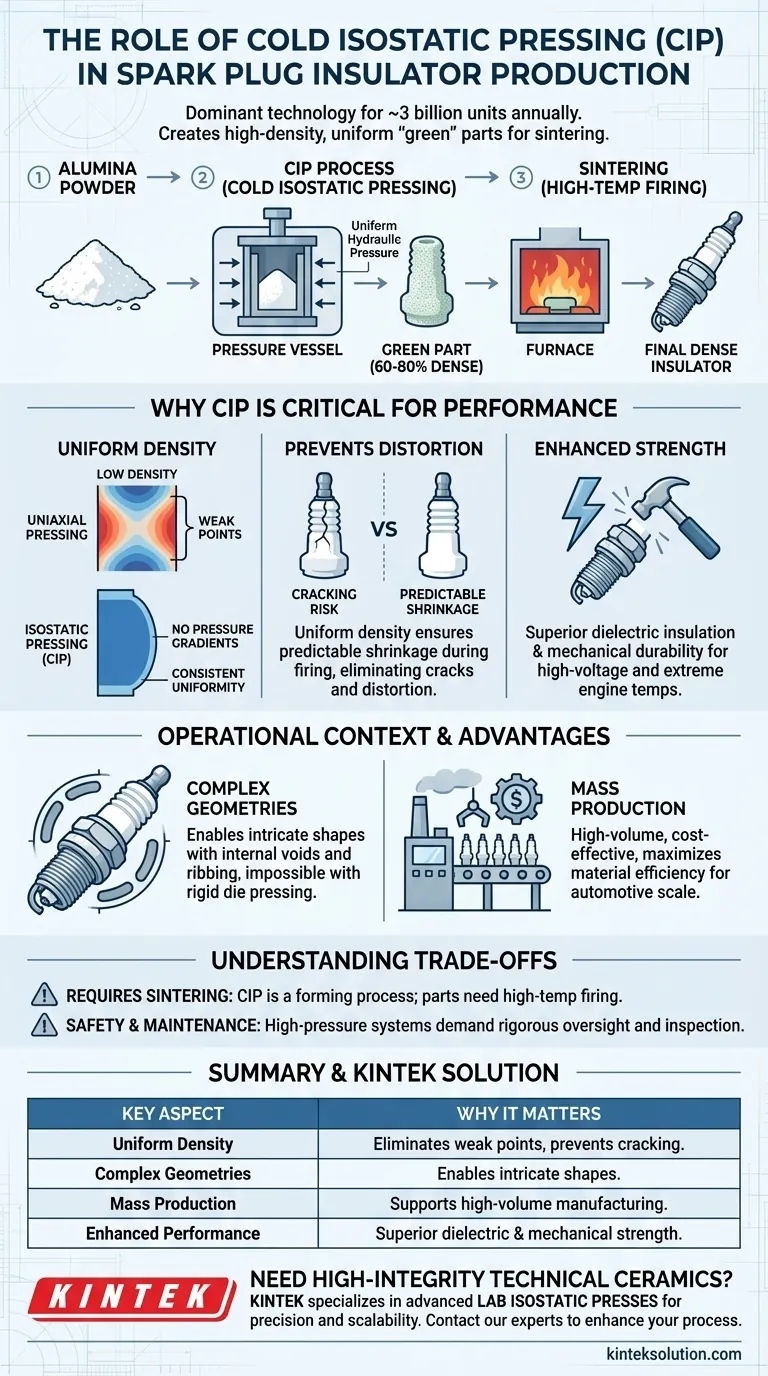
Cold Isostatic Pressing (CIP) is the dominant manufacturing technology used to produce the alumina ceramic insulators found in spark plugs, accounting for an estimated annual production volume of 3 billion units. In this application, CIP is used to consolidate alumina powders into high-density "green" parts by applying uniform hydraulic pressure from all sides, creating a preform that is ready for sintering.
By eliminating the pressure gradients common in other pressing methods, CIP ensures the insulator achieves a uniform microstructure and consistent density. This uniformity is strictly required to prevent cracking and distortion during firing, ensuring the final component can withstand high-voltage electricity and extreme engine temperatures.
Why CIP is Critical for Spark Plug Performance
Achieving Uniform Density
The primary challenge in manufacturing ceramic insulators is avoiding internal stress. Traditional uniaxial pressing applies force from one direction, creating density gradients that lead to weak points.
CIP applies pressure isostatically—meaning equally from all directions via a fluid medium. This results in a completely uniform powder density throughout the part.
Preventing Distortion During Firing
Spark plug insulators must adhere to tight dimensional tolerances to fit into the engine cylinder head and house the central electrode.
Because the density is uniform, the compression and shrinkage that occur during the subsequent sintering (heating) process are highly predictable. This minimizes distortion and virtually eliminates the risk of cracks forming during the firing stage.
Enhancing Dielectric and Mechanical Strength
The insulator serves a dual purpose: it must mechanically withstand the physical shock of combustion and electrically insulate high-voltage current.
The CIP process compacts the alumina powder to a high "green" density (60% to 80% of theoretical density). This dense, defect-free structure translates into superior electrical insulation and mechanical durability in the finished product.
The Operational Context
Handling Complex Geometries
Spark plug insulators are not simple solid cylinders; they require complex internal cavities to hold the electrode and specific external ribbing to prevent flashover.
CIP is uniquely suited for these complex shapes. It allows for the production of high-integrity billets or preforms that maintain their intricate geometry without the limitations imposed by rigid die pressing.
Enabling Mass Production
The automotive industry demands massive scale. The ability of CIP to consistently produce high-quality preforms with minimal waste drives its adoption.
The process maximizes raw material efficiency, reducing the amount of expensive high-purity alumina needed per unit and lowering overall production costs for high-volume runs.
Understanding the Trade-offs
The Necessity of Post-Processing
It is important to note that CIP is a forming process, not a finishing process. It yields a "green" part that achieves only 60% to 80% of final density.
The components must still undergo high-temperature sintering to achieve full hardness and final properties. Therefore, CIP is part of a larger manufacturing chain, not a standalone solution.
Maintenance and Safety Requirements
Operating high-pressure hydraulic systems requires rigorous oversight. As noted in industry best practices, regular inspection of pressure vessels and seals is non-negotiable.
Failures in the pressure system can lead to production downtime or safety hazards, requiring a robust maintenance schedule to ensure the longevity of the equipment.
Making the Right Choice for Your Manufacturing Goal
If you are evaluating manufacturing methods for technical ceramics, consider the specific requirements of your component.
- If your primary focus is component reliability: CIP is the superior choice for parts subjected to high thermal or electrical stress, as it eliminates the internal density gradients that cause failure.
- If your primary focus is geometric complexity: CIP enables the production of parts with internal voids or high aspect ratios that are difficult or impossible to achieve with uniaxial pressing.
Ultimately, for critical applications like internal combustion engines, CIP provides the necessary balance of precision, structural integrity, and scalability.
Summary Table:
| Key Aspect | Why It Matters for Spark Plug Insulators |
|---|---|
| Uniform Density | Eliminates internal stress and weak points, preventing cracking during sintering. |
| Complex Geometries | Enables production of intricate shapes with internal cavities and ribbing. |
| Mass Production | Supports high-volume, cost-effective manufacturing for the automotive industry. |
| Enhanced Performance | Results in superior dielectric strength and mechanical durability in the final part. |
Need to produce high-integrity technical ceramics like spark plug insulators?
KINTEK specializes in advanced lab isostatic presses that deliver the uniform density and complex geometry capabilities essential for reliable ceramic components. Our equipment is designed for precision and scalability, helping R&D and production teams achieve superior results.
Contact our experts today to discuss how our isostatic pressing solutions can enhance your manufacturing process and product performance.
Visual Guide
Related Products
- Automatic Lab Cold Isostatic Pressing CIP Machine
- Electric Lab Cold Isostatic Press CIP Machine
- Electric Split Lab Cold Isostatic Pressing CIP Machine
- Manual Cold Isostatic Pressing CIP Machine Pellet Press
- Lab Isostatic Pressing Molds for Isostatic Molding
People Also Ask
- What are the key features of automated laboratory Cold Isostatic Press (CIP) systems? Achieve Precise, High-Pressure Powder Consolidation
- Why is an Isostatic Press (CIP) Necessary After Uniaxial Pressing? Achieve Transparency in Nd:Y2O3 Ceramics
- How does a Cold Isostatic Press (CIP) facilitate the preparation of CaO-doped silicon carbide (SiC) green bodies?
- What is the primary function of a Cold Isostatic Press (CIP) in NASICON preparation? Achieve 96% Theoretical Density
- How does a Cold Isostatic Press (CIP) increase Bi-2223/Ag current density? Boost Superconductivity with Uniform Pressure









