
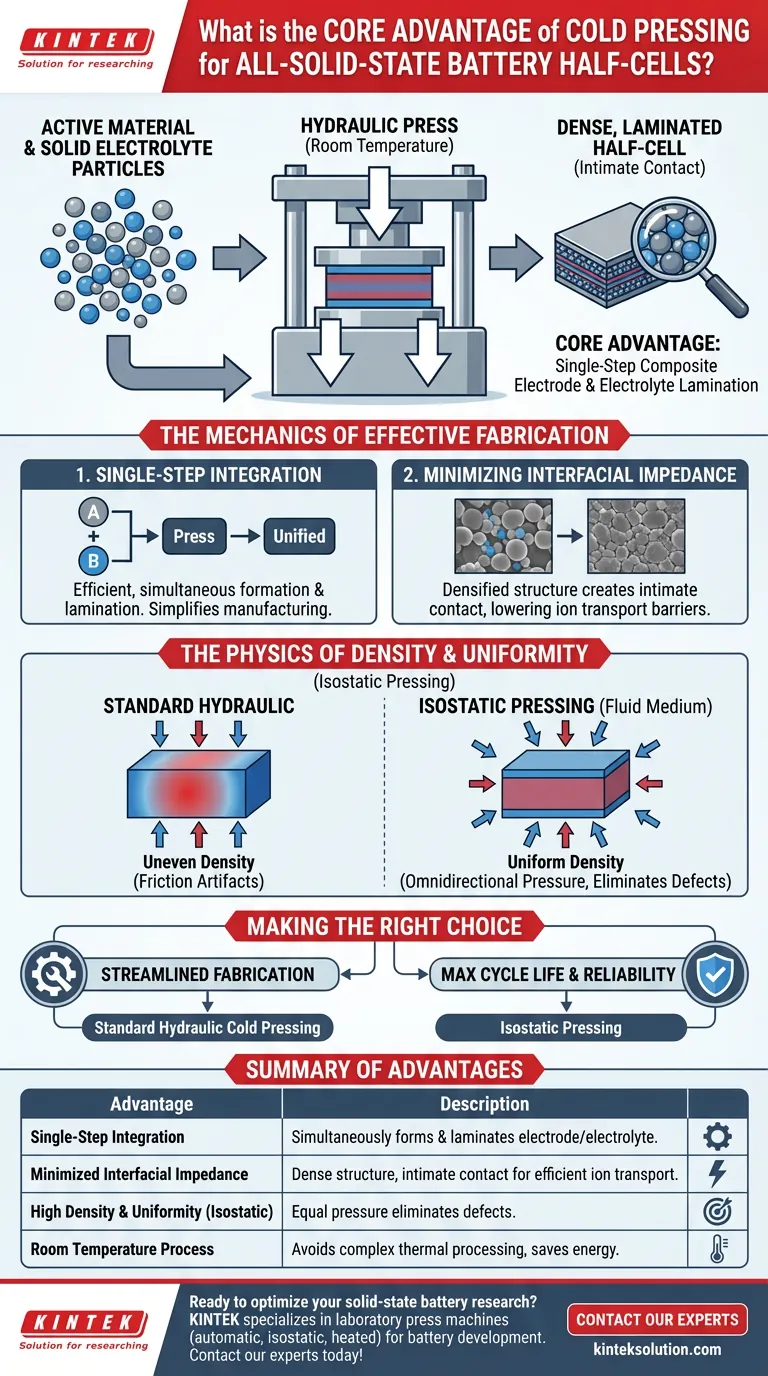
The core advantage of using a cold pressing method for fabricating an all-solid-state battery half-cell is the ability to form a composite electrode and laminate it with a solid electrolyte sheet in a single processing step.
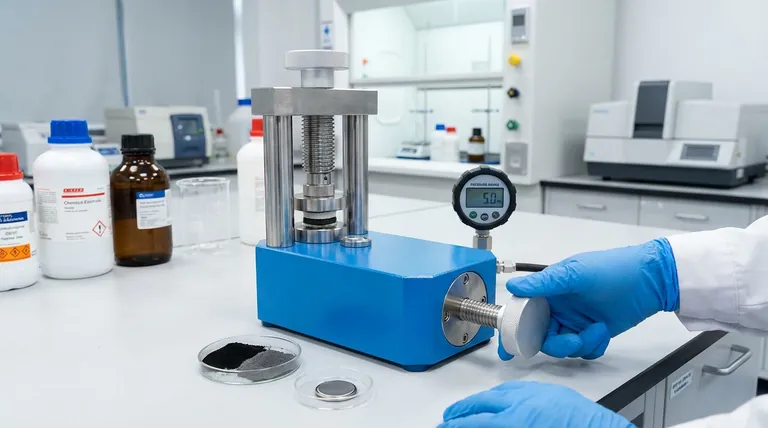
By utilizing a hydraulic press at room temperature, this method mechanically forces the active material and electrolyte particles together. This creates a dense structure with intimate interfacial contact, which is the prerequisite for establishing the low-impedance ion transport pathways required for high electrochemical performance.
Cold pressing acts as a mechanical bridge, overcoming the inherent resistance of solid-solid interfaces by ensuring particle connectivity without the need for complex thermal processing.
The Mechanics of Effective Fabrication
Single-Step Integration
The primary logistical benefit of cold pressing is efficiency. Rather than manufacturing the electrode and electrolyte components separately and attempting to bond them later, cold pressing allows for simultaneous formation and lamination.
This creates a unified, multi-layered structure immediately. It simplifies the manufacturing flow while ensuring the structural integrity of the half-cell.
Minimizing Interfacial Impedance
In solid-state batteries, the movement of ions is often hindered by poor contact between solid particles. Cold pressing mitigates this by applying substantial force to densify the material.
This densification ensures that active materials (such as Li2.07Ni0.62N) and electrolyte particles (like argyrodite) are pressed into "intimate contact." This physical proximity lowers the energy barrier for ions to move between materials, directly improving battery performance.
The Physics of Density and Uniformity
The Role of Isostatic Pressing
While standard hydraulic pressing is effective, utilizing isostatic pressing introduces a distinct advantage regarding density uniformity. This method uses a fluid (liquid or gas) as the pressure-transmitting medium.
Following Pascal’s law, the fluid applies pressure equally from all directions. This omnidirectional force is critical for eliminating internal defects that can lead to battery failure.
Eliminating Friction Artifacts
Traditional die pressing can result in density gradients due to friction between the powder and the die walls. Isostatic cold pressing bypasses this limitation.
By removing these frictional forces, the method achieves exceptionally high density uniformity. This consistency is vital for ensuring that the battery performs reliably over many cycles, rather than failing prematurely due to a weak, low-density spot in the cell.
Understanding the Trade-offs
Pressure Distribution Limits
It is important to distinguish between standard hydraulic cold pressing and isostatic pressing. Standard die pressing is simpler but often suffers from non-uniform pressure distribution caused by wall friction.
This can lead to a half-cell that is dense in the center but less dense at the edges (or vice versa), potentially creating uneven current distribution during operation.
Complexity vs. Performance
Isostatic pressing offers superior uniformity and defect reduction compared to uniaxial hydraulic pressing. However, it generally requires more complex equipment and handling of fluid media compared to the straightforward mechanical force of a standard hydraulic press.
Making the Right Choice for Your Goal
The choice of pressing method depends on whether your priority is process simplicity or maximum structural homogeneity.
- If your primary focus is streamlined fabrication: Utilize standard hydraulic cold pressing to achieve single-step lamination and rapid electrode formation.
- If your primary focus is maximizing cycle life and reliability: Prioritize isostatic pressing to ensure uniform density and eliminate internal defects caused by uneven pressure distribution.
Cold pressing is not merely a shaping step; it is the critical process that defines the ionic conductivity and structural longevity of the solid-state cell.
Summary Table:
| Advantage | Description |
|---|---|
| Single-Step Integration | Simultaneously forms composite electrode and laminates it with the solid electrolyte sheet. |
| Minimized Interfacial Impedance | Creates dense structure with intimate particle contact for efficient ion transport. |
| High Density & Uniformity (Isostatic) | Isostatic pressing applies equal pressure from all directions to eliminate defects. |
| Room Temperature Process | Avoids complex thermal processing, simplifying fabrication and reducing energy costs. |
Ready to optimize your solid-state battery research with precise cold pressing?
KINTEK specializes in laboratory press machines, including automatic lab presses, isostatic presses, and heated lab presses, designed to meet the exacting demands of battery development. Our equipment ensures the uniform density and intimate interfacial contact critical for high-performance, long-lasting all-solid-state batteries.
Contact our experts today to discuss how our pressing solutions can enhance your fabrication process and accelerate your R&D.
Visual Guide
Related Products
- Electric Lab Cold Isostatic Press CIP Machine
- Manual Cold Isostatic Pressing CIP Machine Pellet Press
- Automatic Lab Cold Isostatic Pressing CIP Machine
- Electric Split Lab Cold Isostatic Pressing CIP Machine
- Laboratory Hydraulic Pellet Press for XRF KBR FTIR Lab Press
People Also Ask
- What role do electric lab cold isostatic presses play in industrial contexts? Bridge R&D and Manufacturing with Precision
- What are the applications of electric lab cold isostatic presses in research settings? Advance Material R&D with High-Pressure CIPs
- How does electrical Cold Isostatic Pressing (CIP) contribute to cost savings? Unlock Efficiency and Reduce Expenses
- What are some research applications of electric lab CIPs? Unlock Uniform Powder Densification for Advanced Materials
- What are the characteristics of standard off-the-shelf electric lab CIP solutions? Achieve Immediate, Cost-Effective Processing



















