
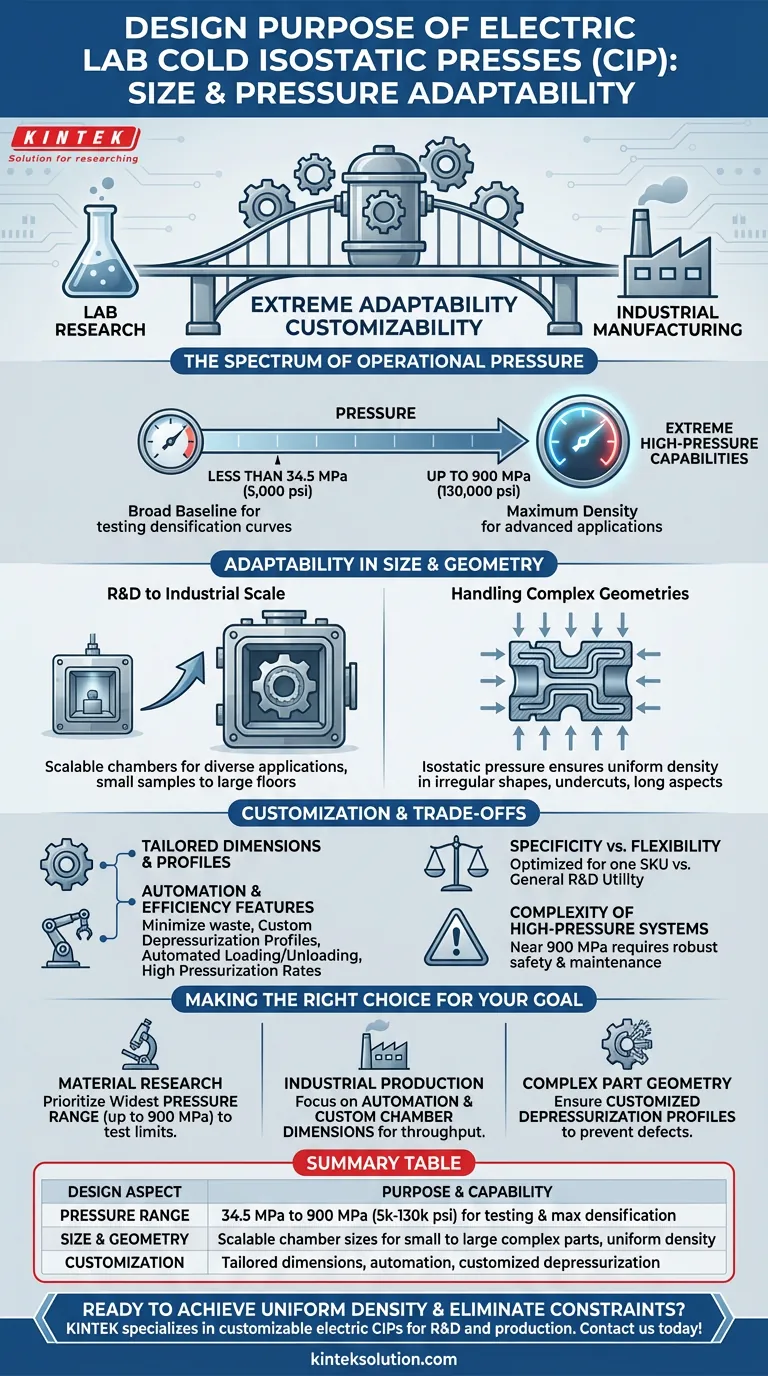
The primary design purpose of electric lab cold isostatic presses (CIP) is to deliver extreme adaptability regarding material densification and component geometry. These systems are engineered to span a massive operational range—from as low as 34.5 MPa (5,000 psi) to as high as 900 MPa (130,000 psi)—allowing them to bridge the gap between initial laboratory research and full-scale industrial manufacturing of complex parts.
Core Insight: The value of an electric CIP lies in its customizability. By decoupling size constraints from pressure capabilities, these units allow engineers to achieve uniform density in complex shapes where traditional uniaxial pressing methods fail or become cost-prohibitive.
The Spectrum of Operational Pressure
Establishing a Broad Baseline
The standard design of electric CIP units covers a vast pressure spectrum to suit varied material needs.
Typical operational levels range from less than 5,000 psi (34.5 MPa) to over 100,000 psi (690 MPa). This allows researchers to test densification curves across a wide data set using a single piece of equipment.
Extreme High-Pressure Capabilities
For advanced applications requiring maximum density, specific units are designed to withstand extreme forces.
High-pressure configurations can reach up to 900 MPa (130,000 psi). This capability is critical in industries where achieving specific material properties depends entirely on subjecting the "green body" (unfired part) to immense, uniform force.
Adaptability in Size and Geometry
From R&D to Industrial Scale
The physical footprint and chamber size of these presses are not static; they are designed to scale.
Manufacturers build these units to accommodate diverse applications, ranging from small-scale research laboratories testing minute samples to large-scale industrial floors. This ensures that a process developed in the lab can be replicated on larger equipment without fundamental changes to the physics involved.
Handling Complex Geometries
A key design driver for CIP technology is the ability to process parts that possess irregular shapes.
In industrial contexts, these presses are essential for producing complex parts where traditional pressing is impractical. The isostatic (uniform) pressure ensures that even parts with undercuts or long aspect ratios achieve uniform density.
Customization Beyond Basic Specs
Tailored Dimensions and Profiles
The design purpose extends to optimizing the unit for the specific product being manufactured.
Units can be customized regarding chamber dimensions to minimize waste and cycle time. Furthermore, engineers can program customized depressurization profiles, which is vital for preventing cracks in sensitive materials during the pressure release phase.
Automation and Efficiency Features
Modern electric CIP designs often integrate features to support higher throughput.
Customization options include fully automated loading and unloading systems and high pressurization rates. These features transition the equipment from a purely experimental tool to a viable production asset.
Understanding the Trade-offs
Specificity vs. Flexibility
While these presses are highly customizable, designing a unit for a specific, complex product may limit its general utility for other tasks.
Optimizing dimensions for a specific industrial part maximizes efficiency for that SKU but may reduce the machine's versatility for general R&D work.
Complexity of High-Pressure Systems
Operating at the upper limits of the pressure range (near 900 MPa) requires robust safety protocols and maintenance.
While the capability exists, routine operation at extreme pressures imposes greater stress on components compared to standard 300-400 MPa operations. Users must balance the need for extreme density against the operational demands of high-pressure machinery.
Making the Right Choice for Your Goal
To select the correct electric CIP configuration, you must align the design specifications with your primary objective.
- If your primary focus is Material Research: Prioritize a unit with the widest possible pressure range (up to 900 MPa) to test material limits and densification behaviors.
- If your primary focus is Industrial Production: Focus on automation features and customized chamber dimensions to maximize throughput and minimize cycle times.
- If your primary focus is Complex Part Geometry: Ensure the unit offers customized depressurization profiles to prevent structural defects in intricate shapes during venting.
The ultimate goal of electric CIP design is to provide a precise, scalable solution that eliminates the geometry constraints of traditional pressing methods.
Summary Table:
| Design Aspect | Purpose & Capability |
|---|---|
| Pressure Range | From 34.5 MPa (5,000 psi) to 900 MPa (130,000 psi) for material testing and maximum densification. |
| Size & Geometry | Scalable chamber sizes to handle small samples or large, complex industrial parts with uniform density. |
| Customization | Tailored dimensions, automated loading, and customized depressurization profiles to prevent defects. |
Ready to eliminate geometry constraints and achieve uniform density in your lab? KINTEK specializes in lab press machines, including automatic, isostatic, and heated lab presses. Our electric CIPs are designed to bridge your R&D and production needs with customizable pressure and size options. Contact us today to explore how our solutions can enhance your material research or industrial manufacturing process!
Visual Guide
Related Products
- Electric Lab Cold Isostatic Press CIP Machine
- Electric Split Lab Cold Isostatic Pressing CIP Machine
- Automatic Lab Cold Isostatic Pressing CIP Machine
- Manual Cold Isostatic Pressing CIP Machine Pellet Press
- Cylindrical Lab Electric Heating Press Mold for Laboratory Use
People Also Ask
- What role do electric lab cold isostatic presses play in industrial contexts? Bridge R&D and Manufacturing with Precision
- What are the applications of electric lab cold isostatic presses in research settings? Advance Material R&D with High-Pressure CIPs
- How does electrical Cold Isostatic Pressing (CIP) contribute to cost savings? Unlock Efficiency and Reduce Expenses
- What are some research applications of electric lab CIPs? Unlock Uniform Powder Densification for Advanced Materials
- What are the characteristics of standard off-the-shelf electric lab CIP solutions? Achieve Immediate, Cost-Effective Processing



















