
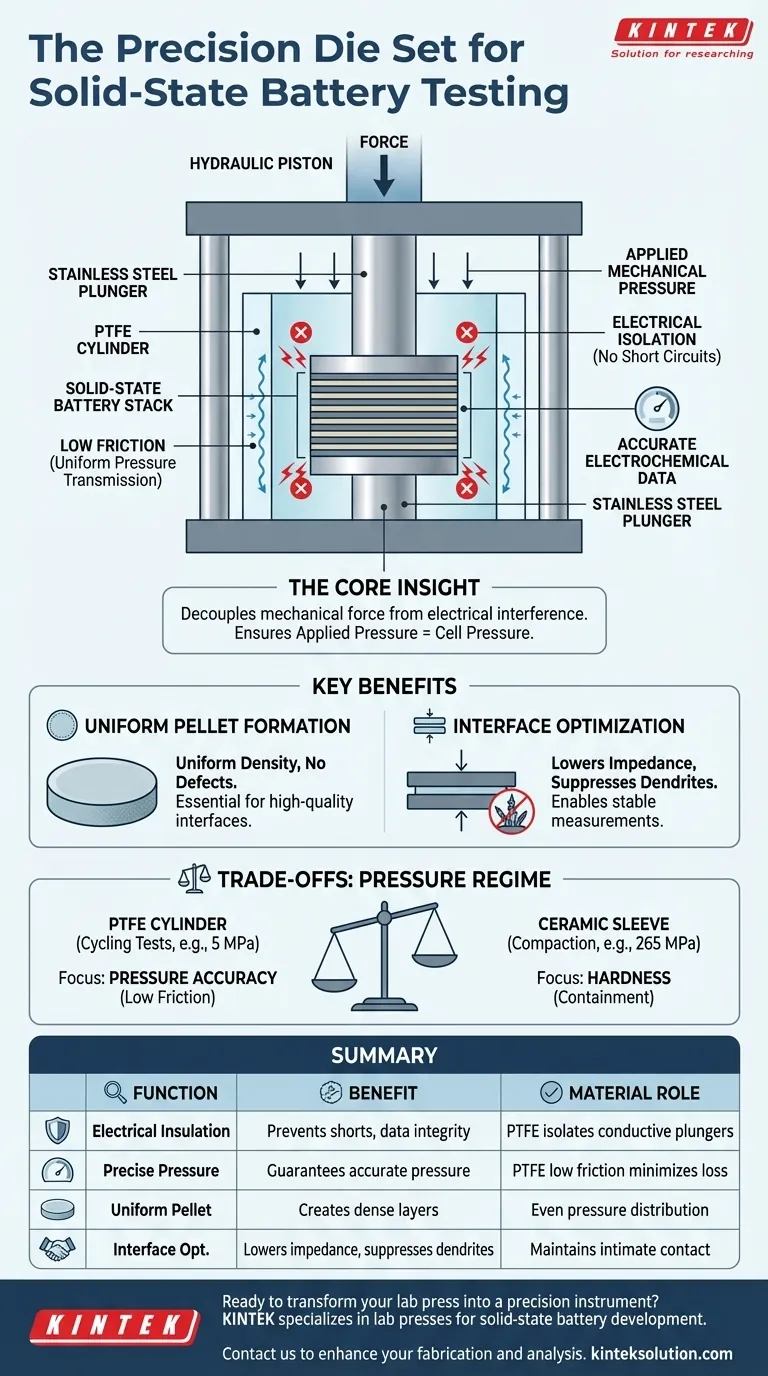
A die set combining a PTFE cylinder with stainless steel plungers serves as a specialized apparatus for simultaneously applying precise mechanical pressure and ensuring electrical isolation. This configuration prevents short circuits between the conductive plungers while utilizing the low-friction properties of PTFE to transmit external force uniformly to the battery materials.
The Core Insight: The value of this die set lies in its ability to decouple mechanical forces from electrical interference. By minimizing wall friction, it ensures that the pressure reading on your hydraulic press is exactly what the battery stack experiences, guaranteeing data validity during electrochemical testing.

The Dual Role of Material Selection
To understand the function of this die set, one must look at how the specific properties of Polytetrafluoroethylene (PTFE) and stainless steel interact during operation.
Electrical Insulation and Circuit Integrity
The stainless steel plungers in this setup perform two duties: they apply force and act as the current collectors for the battery cell. Because they conduct electricity, they must never come into direct contact with each other.
The PTFE cylinder acts as a robust electrical insulator between these upper and lower plungers. This prevents internal short circuits, ensuring that the electrical measurements taken during testing reflect the battery's chemistry, not a hardware fault.
Frictionless Pressure Transmission
In solid-state battery testing, you often apply a constant external stack pressure (e.g., 5 MPa) to maintain contact between layers. A major challenge in die cells is friction between the plunger and the die wall, which can absorb some of that applied force.
PTFE is selected specifically for its low friction coefficient. This property ensures that the load applied by the press is transmitted without significant loss to the battery components, guaranteeing that the mechanical boundary conditions are accurate and consistent.
Impact on Battery Fabrication and Performance
Beyond simple containment, the die set actively influences the physical quality of the solid-state battery cell and the reliability of the resulting data.
Creating Uniform Electrolyte Pellets
The solid-state die serves as a forming container that determines the structural integrity of the electrolyte. When pressure is distributed evenly—thanks to the low friction of the PTFE—the resulting solid electrolyte pellet achieves uniform density.
This uniformity eliminates macroscopic defects within the pellet. A defect-free, dense pellet is a prerequisite for constructing high-quality solid-solid interfaces that are essential for battery performance.
Optimizing Interfacial Contact
A laboratory hydraulic press uses this die set to ensure "intimate," void-free physical contact between the lithium metal electrode and the solid electrolyte. This physical connection is critical for minimizing interfacial impedance.
By maintaining this high-quality contact, the setup enables stable electrochemical measurements. It also allows researchers to systematically investigate complex phenomena, such as how varying mechanical pressure helps suppress lithium dendrite growth.
Understanding the Trade-offs: Pressure vs. Containment
While the PTFE and stainless steel combination is excellent for testing, it is important to recognize the distinct roles materials play based on the pressure regime.
The Limits of Material Hardness
References indicate that for extremely high-pressure compaction (e.g., 265 MPa) used in initial powder pressing, a ceramic sleeve is often utilized due to its high hardness.
In contrast, the PTFE cylinder is highlighted specifically for cycling tests at lower pressures (e.g., 5 MPa) where friction loss is the primary concern. Therefore, while PTFE offers superior pressure accuracy due to low friction, it may not be suitable for the extreme loads required for the initial cold sintering of ceramic electrolytes, where harder die bodies are necessary to contain the powder.
Making the Right Choice for Your Goal
Selecting the correct die set configuration is dependent on the specific stage of your battery research and development.
- If your primary focus is Accurate Electrochemical Cycling: Rely on the PTFE cylinder configuration to ensure the pressure applied by the press is exactly what the cell experiences, minimizing friction errors.
- If your primary focus is Avoiding Short Circuits: Ensure the PTFE sleeve is intact and completely isolates the stainless steel plungers, which are acting as your active current collectors.
- If your primary focus is Interface Optimization: Use this setup to maintain void-free contact, which is essential for lowering impedance and suppressing dendrites during operation.
Ultimately, the PTFE-stainless steel die set is the standard for transforming a mechanical press into a precision instrument for electrochemical analysis.
Summary Table:
| Function | Key Benefit | Material Role |
|---|---|---|
| Electrical Insulation | Prevents short circuits, ensures data integrity | PTFE cylinder isolates conductive stainless steel plungers |
| Precise Pressure Transmission | Guarantees applied pressure equals cell pressure | PTFE's low friction minimizes force loss to die walls |
| Uniform Pellet Formation | Creates dense, defect-free solid electrolyte layers | Even pressure distribution ensures uniform density |
| Interface Optimization | Lowers impedance, suppresses dendrite growth | Maintains intimate contact between battery layers |
Ready to transform your lab press into a precision instrument for battery research?
KINTEK specializes in lab press machines, including automatic lab presses and heated lab presses, designed to meet the exacting demands of solid-state battery development. Our equipment ensures the precise pressure control and reliability your testing requires.
Contact us today via our [#ContactForm] to discuss how our solutions can enhance your battery fabrication and electrochemical analysis, ensuring accurate and reproducible results for your laboratory.
Visual Guide
Related Products
- Lab Button Battery Tablet Press Sealing Mold
- Warm Isostatic Press for Solid State Battery Research Warm Isostatic Press
- Lab Button Battery Disassembly and Sealing Mold
- Carbide Lab Press Mold for Laboratory Sample Preparation
People Also Ask
- How does a sealed battery mold facilitate the assembly and testing of asymmetric supercapacitors using VO2?
- Why use standardized CR2032 components & high-precision presses? Ensure reliability in lithium metal battery research.
- Why is a laboratory battery sealing press essential for desolvation energy testing? Ensure Reliable Kinetic Data
- What is the function of specialized battery molds and sealing consumables? Optimize Your In-situ XRD Testing Today
- What role does a laboratory sealing press play in thermal analysis of solid dispersion films? Ensure Data Integrity



