
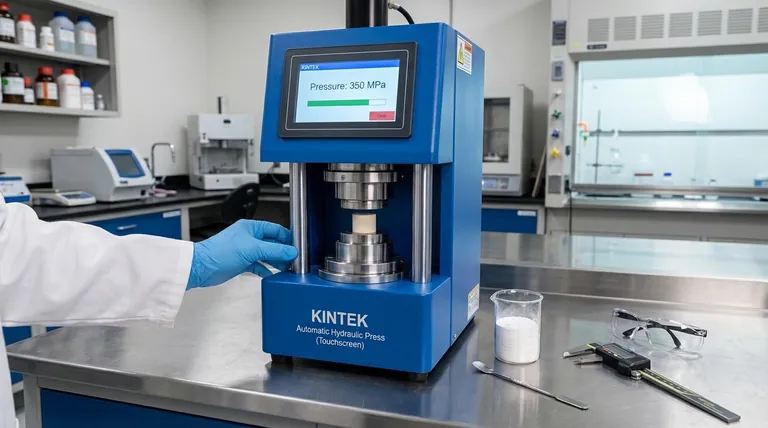
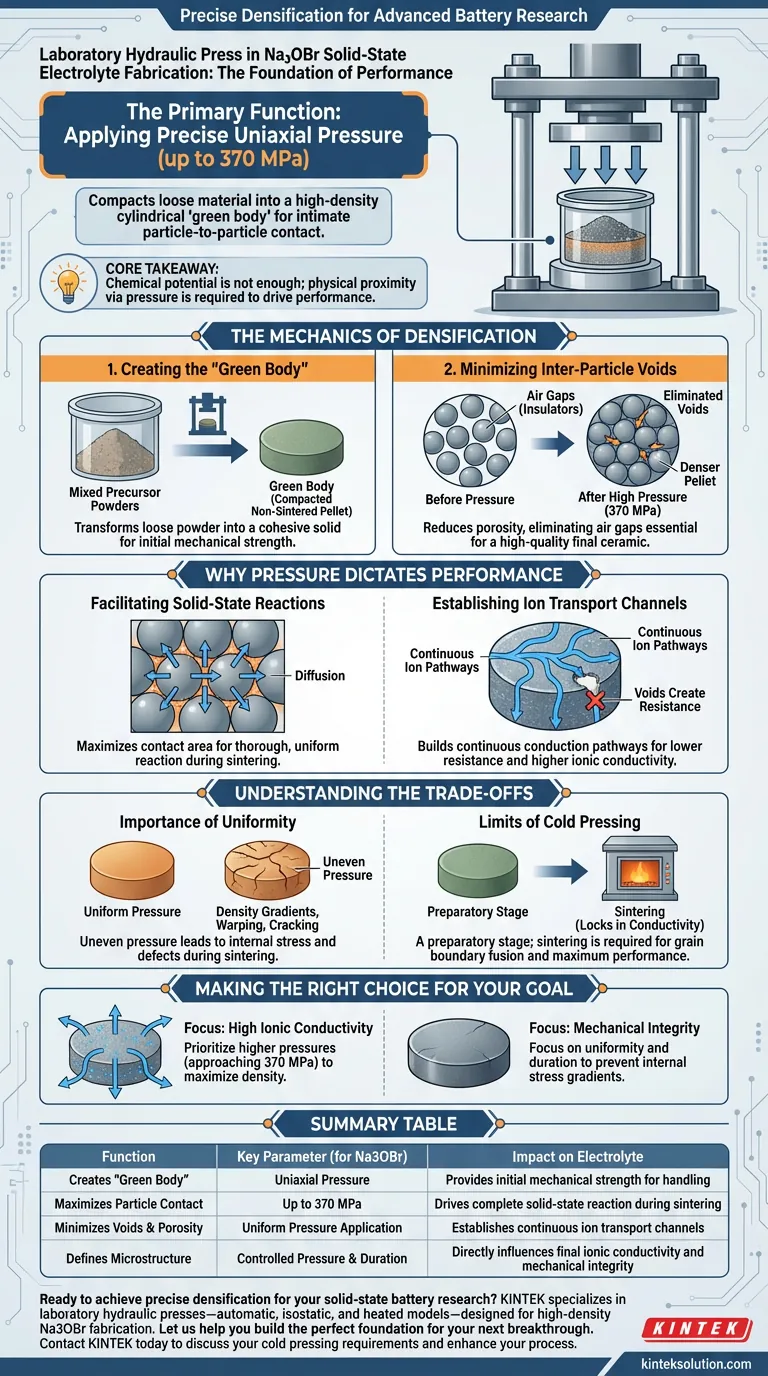
The primary function of a laboratory hydraulic press in fabricating Na3OBr solid-state electrolytes is to apply precise, uniaxial pressure—specifically up to 370 MPa—to mixed precursor powders. This mechanical force compacts the loose material into a high-density cylindrical "green body," ensuring the intimate particle-to-particle contact required for a complete solid-state reaction during subsequent sintering stages.
Core Takeaway: In solid-state battery research, chemical potential alone is often insufficient; physical proximity is required to drive performance. The hydraulic press eliminates microscopic voids to create a continuous material framework, serving as the foundational step for both ionic conductivity and mechanical structural integrity.
The Mechanics of Densification
Creating the "Green Body"
The immediate output of the cold pressing process is a "green body," which is a compacted, non-sintered pellet. The hydraulic press transforms loose, mixed powder into this cohesive solid form. This stage is critical for giving the electrolyte the initial mechanical strength needed to withstand handling before the final heating process.
Minimizing Inter-Particle Voids
The application of high pressure (up to 370 MPa for Na3OBr) significantly reduces the porosity within the material. By forcing particles closer together, the press eliminates air gaps that would otherwise act as insulators. A denser pellet is the prerequisite for a high-quality final ceramic product.
Why Pressure Dictates Performance
Facilitating Solid-State Reactions
For Na3OBr electrolytes, the synthesis often involves a solid-state reaction where different precursors must chemically combine. This reaction relies on diffusion, which can only occur effectively at points of physical contact. The hydraulic press maximizes the contact area between reactant particles, ensuring the reaction is thorough and uniform during sintering.
Establishing Ion Transport Channels
The ultimate goal of a solid-state electrolyte is to transport ions efficiently. Voids and gaps create resistance, blocking the movement of sodium ions. By densifying the pellet, the press helps build continuous conduction pathways, directly contributing to lower interfacial resistance and higher ionic conductivity.
Understanding the Trade-offs
The Importance of Uniformity
While high pressure is necessary, it must be applied uniformly. If the hydraulic press applies pressure unevenly, density gradients will form across the pellet. This can lead to warping, internal stress, or cracking during the subsequent sintering phase, rendering the electrolyte useless.
The Limits of Cold Pressing
Cold pressing is rarely the final step for ceramic electrolytes like Na3OBr; it is a preparatory stage. Relying solely on cold pressing without adequate sintering often results in a pellet that, while dense, lacks the grain boundary fusion required for maximum performance. It creates the potential for conductivity, but heat usually locks it in.
Making the Right Choice for Your Goal
To maximize the effectiveness of your cold pressing stage, you must align your pressure parameters with your specific research outcomes.
- If your primary focus is High Ionic Conductivity: Prioritize higher pressures (approaching the 370 MPa limit) to maximize density and eliminate void space, ensuring the shortest possible path for ion travel.
- If your primary focus is Mechanical Integrity: Focus on the uniformity and duration of the pressure application to prevent internal stress gradients that cause the pellet to fracture during handling or sintering.
The hydraulic press is not merely a shaping tool; it is a critical instrument for defining the microstructure that ultimately determines the success of your solid-state battery.
Summary Table:
| Function | Key Parameter (for Na3OBr) | Impact on Electrolyte |
|---|---|---|
| Creates "Green Body" | Uniaxial Pressure | Provides initial mechanical strength for handling |
| Maximizes Particle Contact | Up to 370 MPa | Drives complete solid-state reaction during sintering |
| Minimizes Voids & Porosity | Uniform Pressure Application | Establishes continuous ion transport channels |
| Defines Microstructure | Controlled Pressure & Duration | Directly influences final ionic conductivity and mechanical integrity |
Ready to achieve precise densification for your solid-state battery research?
The cold pressing stage is foundational to your electrolyte's performance. KINTEK specializes in laboratory hydraulic presses—including automatic, isostatic, and heated models—designed to deliver the exact, uniform pressure required to fabricate high-density Na3OBr and other advanced material pellets.
Let us help you build the perfect foundation for your next breakthrough. Our presses are engineered to provide the reliability and control your laboratory needs to eliminate voids and ensure uniform density, directly contributing to higher ionic conductivity and stronger mechanical integrity in your final product.
Contact KINTEK today to discuss your specific cold pressing requirements and how our solutions can enhance your solid-state electrolyte fabrication process.
Visual Guide
Related Products
- Laboratory Hydraulic Press 2T Lab Pellet Press for KBR FTIR
- Automatic Laboratory Hydraulic Press for XRF and KBR Pellet Pressing
- Automatic Laboratory Hydraulic Press Lab Pellet Press Machine
- Manual Laboratory Hydraulic Press Lab Pellet Press
- Laboratory Hydraulic Pellet Press for XRF KBR FTIR Lab Press
People Also Ask
- What is the role of a laboratory pressure machine and KBr in FTIR? Master Sample Preparation for Flame Retardants
- What is the role of a laboratory hydraulic press in high-loading NCM811 cathode prep for solid-state batteries?
- What role does a laboratory hydraulic press play in reaction pellets? Optimizing Lunar Soil and Metal Fuel Density
- Why is a laboratory hydraulic press necessary for sample preparation? Precise Pelleting for Spiro Heterocyclic Analysis
- Why is precise load control from laboratory pressure equipment necessary for soil bulk density? Ensure Data Integrity



















