
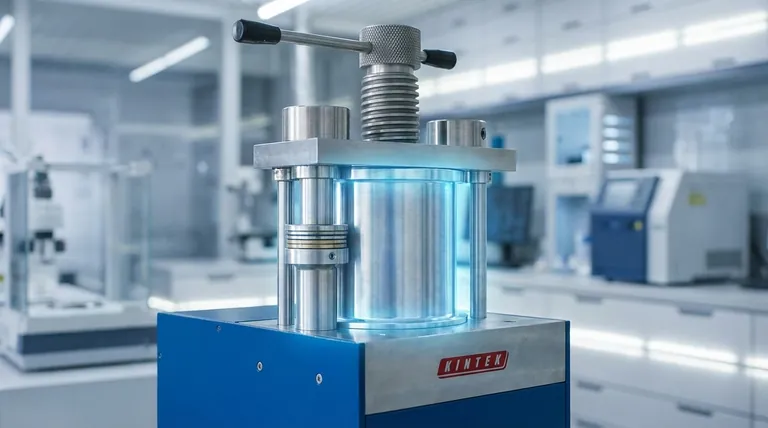
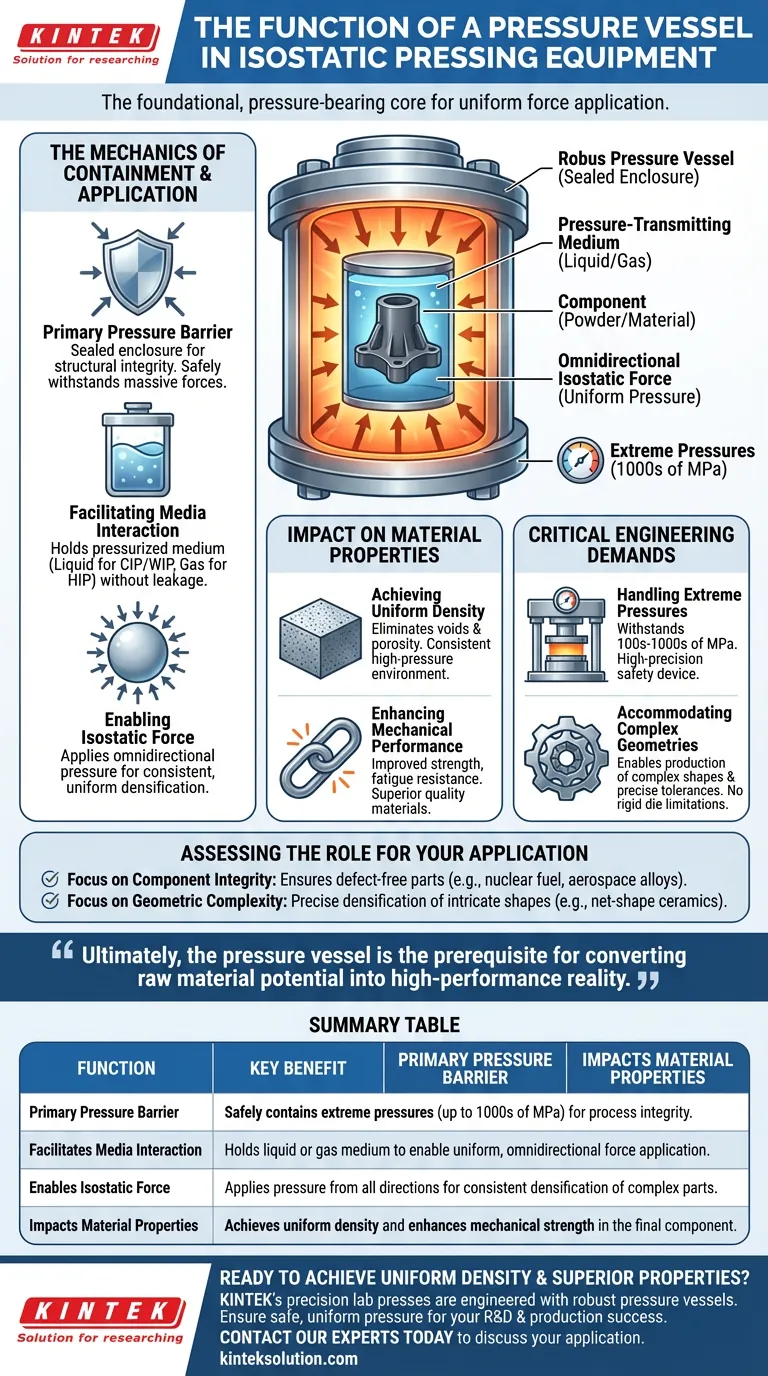
The pressure vessel serves as the foundational, pressure-bearing core of isostatic pressing equipment. Its primary function is to provide a robust, sealed enclosure that contains the pressure-transmitting medium (liquid or gas) and sustains extreme internal pressures—often reaching thousands of megapascals—to apply uniform force to the material within.
The pressure vessel acts as the critical interface between extreme energy and your material. By safely containing high-pressure media, it enables the uniform application of force necessary to achieve consistent density and superior mechanical properties in complex components.
The Mechanics of Containment and Application
The Primary Pressure Barrier
The fundamental role of the vessel is structural integrity. It is engineered to act as a sealed enclosure capable of withstanding massive forces.
Without this containment, the system could not reach or maintain the pressure levels required for effective processing. It is the physical boundary that makes the process safe and feasible.
Facilitating Media Interaction
Within the vessel, the pressure-transmitting medium is pressurized.
Depending on the specific process, this medium is either a liquid (for Cold or Warm Isostatic Pressing—CIP/WIP) or a gas (for Hot Isostatic Pressing—HIP). The vessel is designed to hold this medium without leakage, even under extreme stress.
Enabling Isostatic Force
The design of the vessel allows the medium to surround the component completely.
This ensures that pressure is applied uniformly from all directions. This omnidirectional force is the defining characteristic of "isostatic" pressing, distinguishing it from other compression methods.
Impact on Material Properties
Achieving Uniform Density
By maintaining a consistent high-pressure environment, the vessel enables the consolidation of powder materials.
This results in uniform density throughout the part, eliminating voids and porosity. This consistency is critical for high-performance applications where material failure is not an option.
Enhancing Mechanical Performance
The vessel’s ability to sustain high pressures directly correlates to the quality of the final product.
Materials processed in these vessels, such as high-performance alloys, ceramics, and composites, exhibit improved mechanical properties. This includes greater strength and fatigue resistance.
Critical Engineering Demands
Handling Extreme Pressures
The engineering requirements for these vessels are substantial.
They must withstand pressures reaching hundreds or even thousands of megapascals. The vessel is not just a container; it is a high-precision safety device designed to manage immense potential energy.
Accommodating Complex Geometries
One of the key trade-offs in manufacturing is often between complexity and strength.
However, the pressure vessel enables the production of parts with complex shapes and precise tolerances. Because the pressure is applied via a fluid medium rather than a rigid die, the vessel facilitates the densification of intricate geometries that other methods cannot handle.
Assessing the Role for Your Application
The pressure vessel is not merely a passive container; it is the active enabler of material transformation. Depending on your specific manufacturing goals, the vessel's function supports different outcomes:
- If your primary focus is Component Integrity: The vessel's ability to apply uniform pressure ensures parts, such as nuclear fuel pellets or aerospace alloys, are free from internal defects and voids.
- If your primary focus is Geometric Complexity: The vessel allows for the precise densification of intricate shapes, such as net-shape ceramics, without the limitations of uniaxial pressing.
Ultimately, the pressure vessel is the prerequisite for converting raw material potential into high-performance reality.
Summary Table:
| Function | Key Benefit |
|---|---|
| Primary Pressure Barrier | Safely contains extreme pressures (up to 1000s of MPa) for process integrity. |
| Facilitates Media Interaction | Holds liquid or gas medium to enable uniform, omnidirectional force application. |
| Enables Isostatic Force | Applies pressure from all directions for consistent densification of complex parts. |
| Impacts Material Properties | Achieves uniform density and enhances mechanical strength in the final component. |
Ready to achieve uniform density and superior mechanical properties in your materials?
KINTEK's precision lab press machines, including our isostatic presses, are engineered with robust pressure vessels at their core. Whether you are consolidating advanced ceramics, high-performance alloys, or complex composite parts, our equipment ensures the safe application of extreme, uniform pressure essential for your R&D and production success.
Contact our experts today to discuss how our isostatic pressing solutions can transform your material potential into high-performance reality.
Visual Guide
Related Products
- Lab Isostatic Pressing Molds for Isostatic Molding
- Automatic Lab Cold Isostatic Pressing CIP Machine
- Electric Lab Cold Isostatic Press CIP Machine
- Warm Isostatic Press for Solid State Battery Research Warm Isostatic Press
- Manual Cold Isostatic Pressing CIP Machine Pellet Press
People Also Ask
- What is the purpose of incorporating cartridge heaters into a lab press mold for MLCC block compression? Optimize Results
- How do laboratory press machines resolve increased impedance in solid-state batteries? Achieve Low-Resistance Interfaces
- What is the function of an isostatic lab press in energy storage research? Achieve Superior Material Standardization
- How does controlling the parameters of a laboratory isostatic press contribute to reducing deformation in LTCC channels?
- Why is achieving high green density critical for stable nitride crystals? Unlock Superior Particle Diffusion



















