
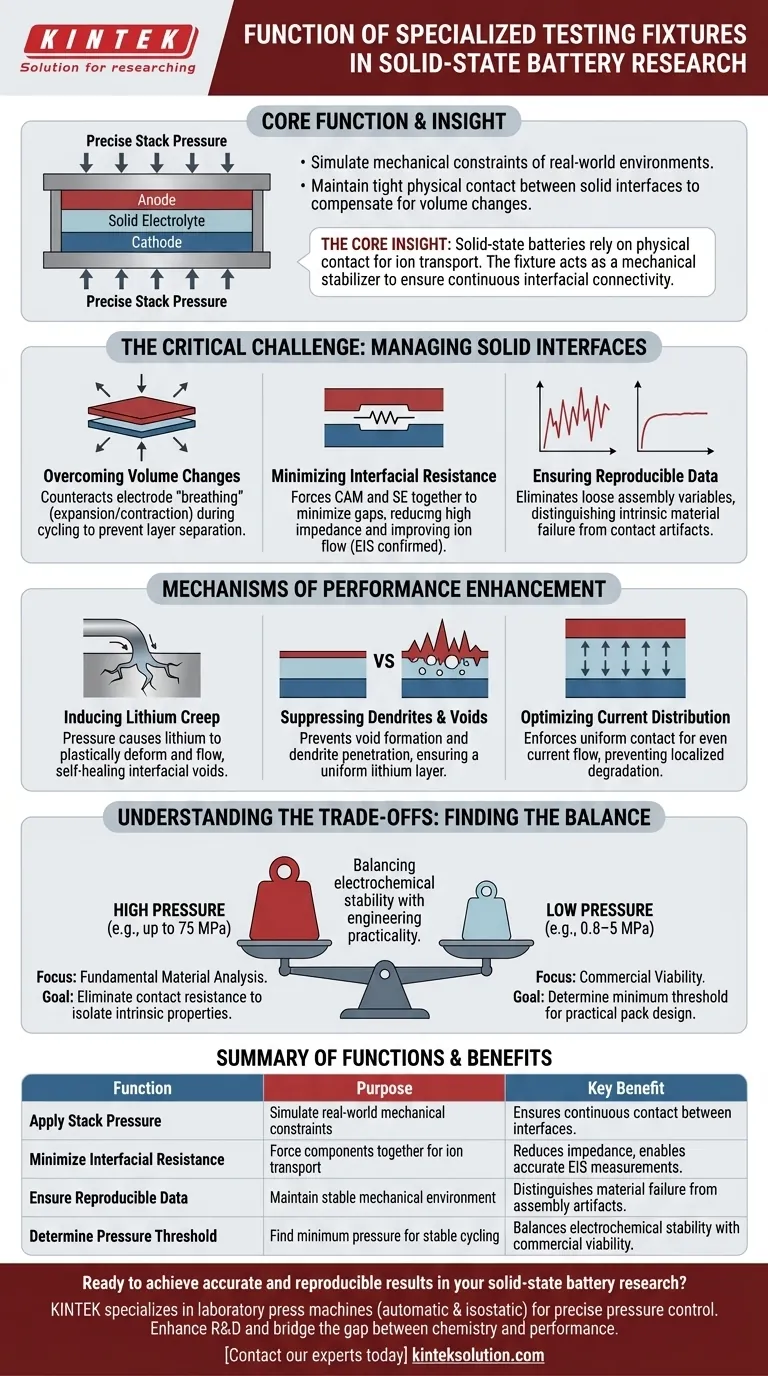
The primary function of a specialized testing fixture in solid-state battery research is to simulate the mechanical constraints of a real-world operating environment by applying precise, controllable stack pressure. This apparatus actively maintains tight physical contact between solid interfaces—specifically the cathode, solid-state electrolyte, and anode—to compensate for volume changes and prevent physical separation during electrochemical cycling.
The Core Insight In the absence of liquid electrolytes to fill voids, solid-state batteries rely entirely on physical contact for ion transport. The specialized fixture acts as a mechanical stabilizer, applying external pressure to ensure continuous interfacial connectivity, thereby minimizing resistance and enabling the accurate characterization of the battery's true performance limits.
The Critical Challenge: Managing Solid Interfaces
Overcoming Volume Changes
During charge and discharge cycles, electrode materials undergo significant volume expansion and contraction. In a rigid solid-state system, this "breathing" can cause layers to physically separate.
The testing fixture applies a constant or variable uniaxial pressure to counteract these fluctuations. This ensures that even as the active materials swell or shrink, the stack remains mechanically integrated (Ref 1, 8).
Minimizing Interfacial Resistance
The primary bottleneck in solid-state batteries is often the high impedance at the junction between the Cathode Active Material (CAM) and the Solid-State Electrolyte (SE).
By forcing these components together, the fixture minimizes the gaps where ions cannot flow. Diagnostics like Electrochemical Impedance Spectroscopy (EIS) confirm that increasing stack pressure directly reduces this specific cathode interfacial resistance (Ref 1, 5).
Ensuring Reproducible Data
Without controlled pressure, a battery's performance might degrade simply due to loose assembly rather than chemical failure.
The fixture eliminates this variable by maintaining a stable mechanical environment. This allows researchers to distinguish between intrinsic material failure and artifacts caused by poor contact, ensuring data is authentic and reproducible (Ref 4).
Mechanisms of Performance Enhancement
Inducing Lithium Creep
Applying appropriate pressure does more than just hold parts together; it changes the behavior of the lithium metal anode.
Pressure induces creep in the lithium metal, causing it to plastically deform and actively flow into interfacial voids. This self-healing mechanism creates a more continuous contact patch between the anode and the electrolyte (Ref 3).
Suppressing Dendrites and Voids
In anode-free configurations or lithium metal cells, voids can form during the "stripping" (discharge) phase, leading to hot spots.
The fixture’s pressure prevents these voids from forming and helps suppress the penetration of lithium dendrites. This ensures the lithium layer remains uniform, which is critical for preventing short circuits and extending cycle life (Ref 6, 7).
Optimizing Current Distribution
When contact is patchy, current rushes through the few points that are touching, leading to localized degradation.
By enforcing uniform contact via stack pressure, the fixture ensures a uniform current distribution. This improves the battery's critical current density, allowing it to charge and discharge at higher rates without failing (Ref 3).
Understanding the Trade-offs
Determining the Minimum Pressure Threshold
While pressure improves performance, utilizing excessive force in a laboratory fixture can produce results that are unrealistic for commercial applications.
High pressure requires heavy, bulky packaging in a real vehicle, which reduces energy density. Therefore, a key function of the fixture is to help researchers find the minimum pressure threshold required for stable cycling (Ref 7). The goal is to balance electrochemical stability (which favors high pressure) with engineering practicality (which favors low pressure).
Making the Right Choice for Your Goal
The utility of a pressure-controlled fixture depends on what specific aspect of the battery you are trying to validate.
- If your primary focus is Fundamental Material Analysis: Use the fixture to apply high pressure (e.g., up to 75 MPa) to eliminate contact resistance entirely, isolating the intrinsic chemical properties of your new electrolyte or cathode material.
- If your primary focus is Commercial Viability: Use the fixture to test lower pressure ranges (e.g., 0.8–5 MPa) to determine if your cell design can survive the modest mechanical constraints of a practical battery pack.
Ultimately, the testing fixture bridges the gap between theoretical material chemistry and the mechanical realities of a functioning solid-state device.
Summary Table:
| Function | Purpose | Key Benefit |
|---|---|---|
| Apply Stack Pressure | Simulate real-world mechanical constraints | Ensures continuous contact between solid interfaces |
| Minimize Interfacial Resistance | Force components together for ion transport | Reduces impedance, enables accurate EIS measurements |
| Ensure Reproducible Data | Maintain stable mechanical environment | Distinguishes material failure from assembly artifacts |
| Determine Pressure Threshold | Find minimum pressure for stable cycling | Balances electrochemical stability with commercial viability |
Ready to achieve accurate and reproducible results in your solid-state battery research?
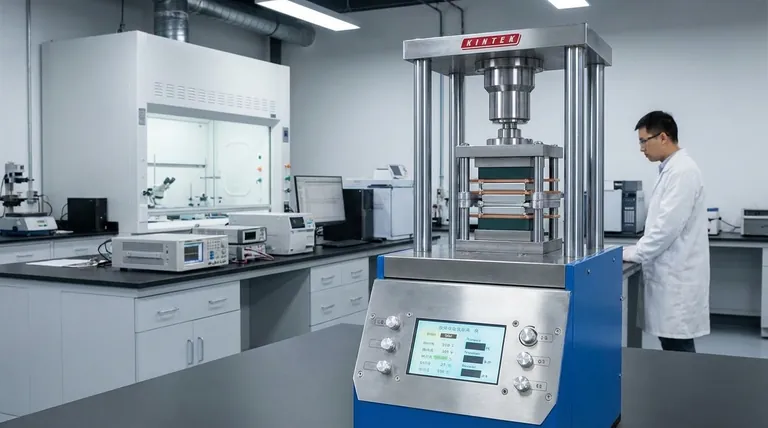
KINTEK specializes in laboratory press machines, including automatic lab presses and isostatic presses, designed to provide the precise, controllable pressure required for testing solid-state battery cells. Our equipment helps you simulate real-world conditions, minimize interfacial resistance, and determine the critical pressure thresholds for your materials.
Contact our experts today to discuss how our lab press solutions can enhance your R&D and bridge the gap between material chemistry and practical device performance.
Visual Guide
Related Products
- Warm Isostatic Press for Solid State Battery Research Warm Isostatic Press
- Laboratory Hydraulic Press Lab Pellet Press Button Battery Press
- Lab Button Battery Tablet Press Sealing Mold
- Lab Infrared Press Mold for Laboratory Applications
- Lab Cylindrical Press Mold for Laboratory Use
People Also Ask
- Why must composite cathodes be sealed in vacuum lamination bags for WIP? Ensure Battery Stability and Density
- What is the function of elastic molds in warm isostatic pressing? Achieve Uniform Density in Composite Particles
- How do sacrificial volume materials (SVM) maintain microchannels in isostatic pressing? Ensure Structural Integrity
- What is the process involved in warm isostatic pressing? Mastering Uniform Density with WIP Technology
- What is the function of hydraulic pressure in warm isostatic pressing? Achieve Uniform Material Density





