
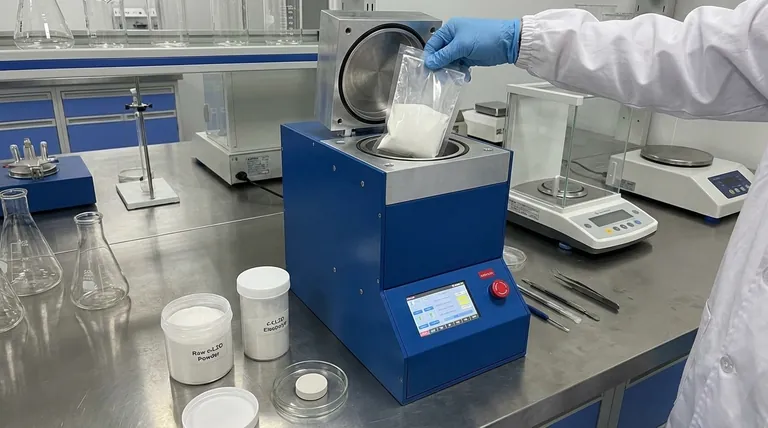
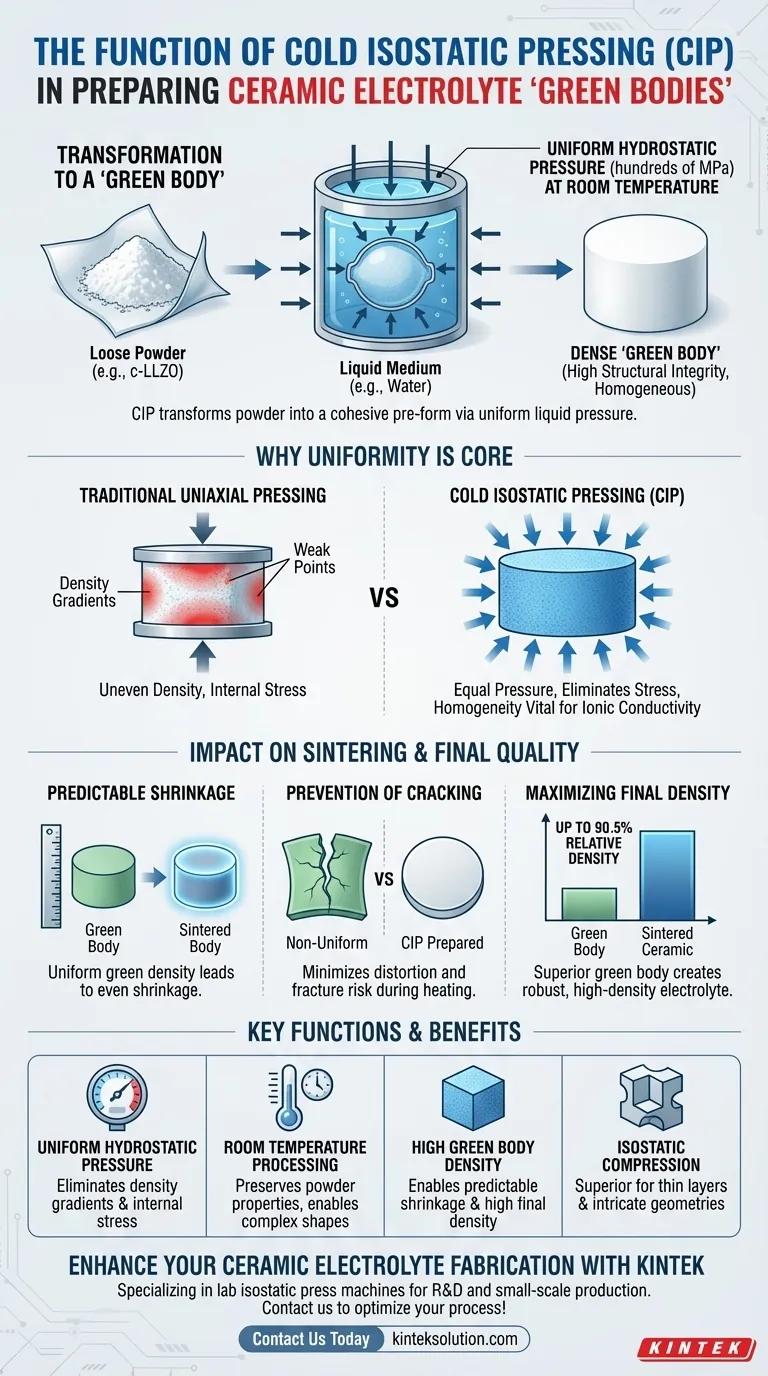
Cold Isostatic Pressing (CIP) serves as the definitive pre-compaction technique for preparing ceramic electrolytes, transforming loose powder into a dense, cohesive solid known as a "green body." By applying uniform liquid pressure from every direction at room temperature, CIP creates a pre-form with significantly higher structural integrity and density homogeneity than standard pressing methods.
A high-quality green body is the mandatory foundation for a high-performance electrolyte. CIP does not just shape the powder; it eliminates internal density gradients, which is essential for minimizing shrinkage, preventing cracks, and achieving maximum density during the final high-temperature sintering stage.
The Mechanics of Green Body Formation
The Encapsulation Process
To begin the process, the ceramic electrolyte powder—such as Li7La3Zr2O12 (c-LLZO)—is sealed within a flexible membrane or hermetic container. This isolation is critical to prevent contact between the powder and the liquid medium.
Application of Hydrostatic Pressure
The sealed container is submerged in a liquid, typically water, within the pressure vessel. The system then applies massive hydrostatic pressure (often hundreds of megapascals) uniformly to the entire surface area of the container.
Creation of the Compact
Because the liquid applies force equally from all directions, the powder is compressed into a solid form. This results in a "green body" that holds its shape and allows for handling before the ceramic is fired (sintered).
Why Uniformity is the Core Objective
Eliminating Density Gradients
In traditional pressing, friction often causes uneven density, leading to weak points. CIP utilizes isostatic pressure to ensure the powder is compressed equally across the entire geometry.
Reducing Internal Stress
The uniform distribution of pressure effectively eliminates stress concentrations within the material. For ceramic electrolytes, this homogeneity is vital to ensure consistent ionic conductivity across the material layer.
Precision for Complex Geometries
The process allows for the creation of intricate shapes and very thin, dense layers. This is particularly valuable for solid-state batteries, which require thin, defect-free solid electrolyte layers to function effectively.
The Impact on Sintering and Final Quality
Predictable Shrinkage
The "green body" sets the stage for the final firing. Because the density is uniform in the green state, the shrinkage that occurs during sintering is predictable and even.
Prevention of Cracking
Non-uniform green bodies tend to warp or crack under high heat due to differential shrinkage. CIP minimizes distortion, significantly reducing the risk of the ceramic electrolyte fracturing during fabrication.
Maximizing Final Density
A superior green body leads to a superior final product. For materials like c-LLZO, CIP preparation can enable the production of pellets with relative densities up to 90.5%, creating a robust barrier for battery applications.
Understanding the Advantages Over Uniaxial Pressing
Isostatic vs. Uniaxial
Uniaxial pressing applies force from only one or two axes, creating a density gradient where the material is denser near the press rams and less dense in the center.
Superior Material Efficiency
CIP systems often allow for more efficient use of raw materials compared to conventional methods. This reduces waste, which is a significant factor given the cost of high-purity ceramic electrolyte powders.
Making the Right Choice for Your Goal
To optimize your ceramic electrolyte fabrication, consider how CIP aligns with your specific requirements:
- If your primary focus is maximizing ionic conductivity: CIP is essential because it produces the high-density, crack-free microstructure required for efficient ion transport.
- If your primary focus is geometric complexity: CIP allows you to form complex shapes, such as tubes or thin layers, without the density variations inherent in mechanical die pressing.
- If your primary focus is process reliability: CIP provides the highest consistency in "green" strength, ensuring your pre-forms survive handling and sinter uniformly without warping.
Ultimately, CIP is not merely a shaping step; it is a quality assurance measure that ensures the structural integrity of the ceramic before heat ever touches the material.
Summary Table:
| Key Function | Benefit for Ceramic Electrolytes |
|---|---|
| Uniform Hydrostatic Pressure | Eliminates density gradients and internal stress |
| Room Temperature Processing | Preserves powder properties and enables complex shapes |
| High Green Body Density | Enables predictable shrinkage and up to 90.5% final density |
| Isostatic Compression | Superior to uniaxial pressing for thin layers and intricate geometries |
Ready to enhance your ceramic electrolyte fabrication with reliable, high-density green bodies? KINTEK specializes in lab isostatic press machines, including advanced Cold Isostatic Pressing (CIP) systems designed for laboratory R&D and small-scale production. Our presses ensure uniform compaction, maximize final density, and support the development of high-performance solid-state batteries.
Contact us today to discuss how our CIP solutions can optimize your ceramic electrolyte preparation process!
Visual Guide
Related Products
- Automatic Lab Cold Isostatic Pressing CIP Machine
- Electric Split Lab Cold Isostatic Pressing CIP Machine
- Electric Lab Cold Isostatic Press CIP Machine
- Manual Cold Isostatic Pressing CIP Machine Pellet Press
- Lab Isostatic Pressing Molds for Isostatic Molding
People Also Ask
- What are the key features of automated laboratory Cold Isostatic Press (CIP) systems? Achieve Precise, High-Pressure Powder Consolidation
- Why is an Isostatic Press (CIP) Necessary After Uniaxial Pressing? Achieve Transparency in Nd:Y2O3 Ceramics
- How does a Cold Isostatic Press (CIP) increase Bi-2223/Ag current density? Boost Superconductivity with Uniform Pressure
- What is the primary function of a Cold Isostatic Press (CIP) in NASICON preparation? Achieve 96% Theoretical Density
- How does a Cold Isostatic Press (CIP) facilitate the preparation of CaO-doped silicon carbide (SiC) green bodies?










