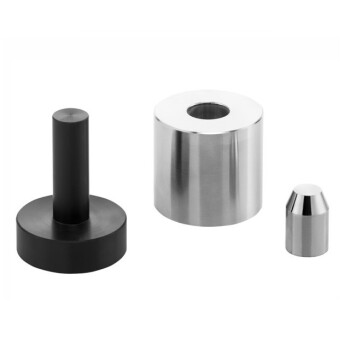
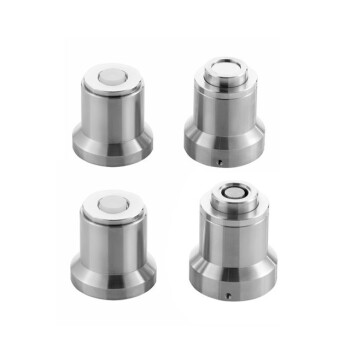
High-strength hardened steel mold sets function as the rigid, precision-engineered boundaries required to compress loose powder into dense, functional all-solid-state battery cells. By acting as a containment vessel that resists plastic deformation, these molds allow hydraulic presses to apply massive axial loads directly to the battery materials. Their specific design ensures the resulting battery laminates achieve uniform thickness and structural integrity without collapsing during removal.
The Core Takeaway Achieving high energy density in solid-state batteries requires eliminating microscopic voids through immense pressure. Hardened steel molds provide the non-deformable constraints necessary to translate this pressure into perfect atomic-level contact between electrolytes and electrodes.
The Role of Mechanical Rigidity in Densification
Withstanding Extreme Axial Loads
The primary function of the steel mold is to remain static while the battery material changes state. All-solid-state battery powders often require pressures exceeding several hundred megapascals to achieve proper density. Hardened steel is selected specifically because it can support these massive loads without undergoing plastic deformation or warping.
Converting Force to Density
If a mold flexes under pressure, the applied force dissipates rather than compacting the powder. The rigidity of hardened steel ensures that the hydraulic energy is directed entirely into the powder. This compression creates the dense physical connections required for efficient ion transport channels.
Ensuring Dimensional Precision
Steel mold sets are engineered with extremely tight tolerance alignments. This precision prevents the pressing plunger from shifting or tilting during the compression cycle. Consequently, the battery layers maintain a uniform thickness across the entire surface area, which is critical for consistent electrochemical performance.
Preserving Integrity During Demolding
The Importance of Surface Finish
The interior surfaces of high-quality steel molds feature a mirror-like finish. This smoothness minimizes friction between the compressed battery pellet and the mold walls. A rough surface would cause the delicate compacted powder to snag or shear during extraction.
Preventing Structural Collapse
The most critical moment in cell fabrication is often the demolding process. Because steel molds maintain their shape and offer low-friction surfaces, they allow for the gentle ejection of the battery laminate. This prevents delamination (layers separating) or the total collapse of the fragile cell structure.
Understanding the Trade-offs
Electrical Conductivity
While hardened steel offers superior mechanical strength compared to alternatives like PEEK, it is electrically conductive. This makes steel molds unsuitable for direct in-situ electrochemical testing (impedance or cycling) unless insulating sleeves are used. For experiments requiring the mold to act as the testing housing, an insulating material like PEEK is often preferred despite its lower maximum pressure threshold.
Chemical Compatibility Risks
Steel is generally robust, but direct contact with certain sulfide-based solid electrolytes can occasionally lead to side reactions or contamination if the steel is not chemically compatible or coated. While PEEK offers excellent chemical stability and inertness, steel relies primarily on its mechanical superiority. Users must verify that the specific steel alloy does not react with their active materials during high-pressure contact.
Making the Right Choice for Your Goal
To maximize the effectiveness of your pressing process, align your tooling choice with your specific stage of development:
- If your primary focus is achieving maximum density and compaction: Prioritize hardened steel molds to apply pressures exceeding 500 MPa without risking mold deformation.
- If your primary focus is in-situ electrochemical testing: Consider using PEEK molds or steel molds with insulating liners to prevent short circuits during impedance analysis.
- If your primary focus is preventing sample breakage: Ensure your steel molds have a polished high-surface finish to minimize wall friction during the ejection of the pellet.
The quality of your data is ultimately defined by the structural integrity of your sample; the mold is not just a container, but the guarantor of that integrity.
Summary Table:
| Feature | Function in Pressing Process | Benefit to Battery Cell |
|---|---|---|
| Mechanical Rigidity | Withstands loads >500 MPa without warping | Ensures full force is used for densification |
| Dimensional Precision | Tight tolerance plunger alignment | Guarantees uniform layer thickness & performance |
| Mirror Surface Finish | Minimizes wall friction during ejection | Prevents structural collapse or delamination |
| High Hardness | Resists plastic deformation | Extends mold lifespan and maintains accuracy |
Elevate Your Battery Research with KINTEK Precision Tooling
Achieving the perfect atomic-level contact in solid-state batteries requires more than just pressure—it requires precision engineering. KINTEK specializes in comprehensive laboratory pressing solutions tailored for the most demanding research environments.
Whether you need high-strength hardened steel molds for maximum densification or insulating PEEK options for in-situ testing, our equipment is designed to ensure your battery laminates achieve superior structural integrity and energy density. Our range includes:
- Manual & Automatic Presses for versatile lab workflows.
- Heated & Multifunctional Models for advanced material synthesis.
- Glovebox-Compatible Systems for air-sensitive battery chemistry.
- Cold & Warm Isostatic Presses (CIP/WIP) for uniform multi-axial compaction.
Ready to optimize your cell fabrication? Contact KINTEK today to find the ideal pressing solution for your battery research.
References
- Tommi Hendrik Aalto, Jonas Jacobs. Gas evolution in Ruddlesden–Popper-type intercalation cathodes in all-solid-state fluoride-ion-batteries: implications on battery performance and synthesis of highly oxidized oxyfluorides. DOI: 10.1039/d5ta07033c
This article is also based on technical information from Kintek Solution Knowledge Base .
Related Products
- Lab Button Battery Tablet Press Sealing Mold
- Warm Isostatic Press for Solid State Battery Research Warm Isostatic Press
- Lab Cylindrical Press Mold for Laboratory Use
- Carbide Lab Press Mold for Laboratory Sample Preparation
- Lab Infrared Press Mold for Laboratory Applications
People Also Ask
- How does a sealed battery mold facilitate the assembly and testing of asymmetric supercapacitors using VO2?
- Why use standardized CR2032 components & high-precision presses? Ensure reliability in lithium metal battery research.
- Why is a laboratory battery sealing press essential for desolvation energy testing? Ensure Reliable Kinetic Data
- What is the function of specialized battery molds and sealing consumables? Optimize Your In-situ XRD Testing Today
- What role does a laboratory sealing press play in thermal analysis of solid dispersion films? Ensure Data Integrity