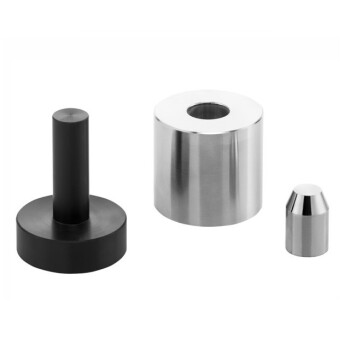
Precision stainless steel spacers serve two primary functions in coin cell assembly: filling internal void space and facilitating the uniform distribution of mechanical pressure. By effectively bridging the physical gap between the electrode stack and the casing, they ensure the tight contact required for optimal electrical performance.
Core Insight: Coin cell casings have fixed dimensions, but electrode stacks vary in thickness. Precision spacers act as the critical adjustment mechanism, translating external sealing force into the specific internal pressure required to minimize resistance and maintain structural integrity.
Managing Internal Mechanics
Bridging the Geometric Gap
A standard coin cell case (e.g., CR2032) has a fixed internal volume. However, the thickness of your active materials, separators, and lithium foil will vary by experiment.
Precision spacers are used to fill this remaining void space. Without them, the components would sit loosely inside the sealed can, preventing the cell from functioning.
Ensuring Uniform Pressure Distribution
During the sealing (crimping) process, the cell is subjected to external force. The spacer acts as a rigid medium to transfer this force evenly across the surface of the electrodes.
This uniformity is vital. It creates tight physical contact between the electrodes, the separator, and the current collector.
Reducing Contact Resistance
The primary electrochemical goal of this mechanical pressure is to lower interfacial impedance.
By pressing the components firmly together, spacers reduce contact resistance. This ensures that electrons can flow freely between the chemical components and the external circuit.
Material Compatibility
Chemical Stability
The internal environment of a lithium battery is chemically harsh. The spacer is in direct or indirect contact with the electrolyte during electrochemical cycling.
Stainless steel is selected for its high chemical stability. It resists corrosion, preventing the leaching of metal ions that could contaminate the electrolyte or degrade the cell's performance over time.
The Role in Research and Development
Tunable Compression
For researchers, spacers are more than just fillers; they are tools for variable analysis.
By adjusting the thickness or the number of spacers, you can precisely control the compression of the electrode assembly. This allows for the quantitative evaluation of how mechanical stress affects cycle life and electrochemical polarization.
Structural Integrity Testing
Different electrode materials (such as SiO/C) react differently to pressure.
Using spacers to set specific initial mechanical stresses allows scientists to study the structural integrity of these materials under load. This helps identify the optimal pressure required to maintain performance without crushing the active material.
Understanding the Trade-offs
The Risk of Excessive Pressure
While contact is necessary, "more" is not always "better."
If the spacer stack is too thick, the resulting pressure can be excessive. This may lead to the destruction of the separator's microporous structure, causing internal short circuits or mechanical failure of the electrode material.
The Risk of Insufficient Pressure
Conversely, if the spacer stack is too thin, the internal components will not make sufficient contact.
This lack of pressure leads to high interfacial impedance. In experimental settings, this results in fluctuating data and poor repeatability, making it impossible to distinguish between bad chemistry and bad assembly.
Making the Right Choice for Your Goal
To achieve reliable data, you must select spacer thickness based on your specific assembly stack and research objectives.
- If your primary focus is standardizing baseline performance: Use a consistent spacer thickness that fills the void without deformation to ensure high repeatability of electrochemical test data.
- If your primary focus is stress-testing electrode materials: Vary the spacer thickness systematically to quantify how external pressure impacts polarization and structural degradation.
- If your primary focus is long-term cycling stability: Ensure the chosen spacer provides enough compression to prevent loose contact over time, but not enough to damage the separator.
Ultimately, the spacer is the component that harmonizes the fixed volume of the hardware with the variable requirements of the chemistry.
Summary Table:
| Function | Primary Benefit | Research Impact |
|---|---|---|
| Gap Filling | Fills void space in CR2032/CR2450 cases | Ensures structural integrity of the electrode stack |
| Pressure Distribution | Uniformly transfers crimping force | Prevents localized stress and component shifting |
| Resistance Reduction | Minimizes interfacial impedance | Improves electron flow and electrochemical data accuracy |
| Chemical Stability | Resists electrolyte corrosion | Prevents contamination and extends cycle life performance |
Elevate Your Battery Research with KINTEK Precision Solutions
Don't let inconsistent assembly pressure compromise your experimental data. KINTEK specializes in comprehensive laboratory pressing solutions designed for precision battery research. We offer a full range of manual, automatic, heated, and glovebox-compatible models, alongside our industry-leading cold and warm isostatic presses.
Whether you are refining lithium-ion chemistries or testing next-generation solid-state materials, KINTEK provides the tools needed to ensure uniform compression and repeatable results.
Ready to optimize your lab's performance? Contact us today to find the perfect pressing solution for your specific application.
References
- Rajesh Rajasekharan, Manikoth M. Shaijumon. Bifunctional Current Collectors for Lean‐Lithium Metal Batteries. DOI: 10.1002/adfm.202502473
This article is also based on technical information from Kintek Solution Knowledge Base .
Related Products
People Also Ask
- How does a sealed battery mold facilitate the assembly and testing of asymmetric supercapacitors using VO2?
- Why use standardized CR2032 components & high-precision presses? Ensure reliability in lithium metal battery research.
- Why is a laboratory battery sealing press essential for desolvation energy testing? Ensure Reliable Kinetic Data
- What is the function of specialized battery molds and sealing consumables? Optimize Your In-situ XRD Testing Today
- What role does a laboratory sealing press play in thermal analysis of solid dispersion films? Ensure Data Integrity