
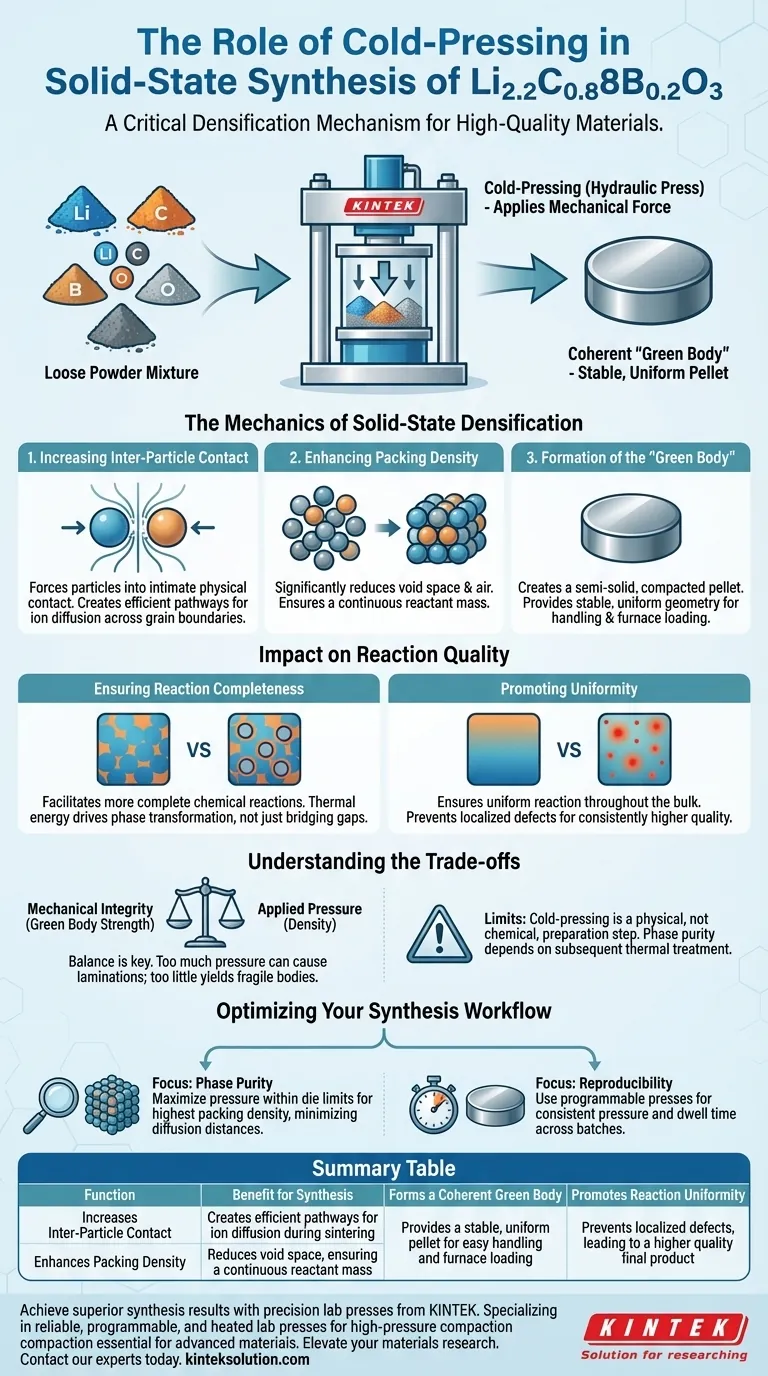
The cold-pressing step serves as a critical densification mechanism in the solid-state synthesis of Li2.2C0.8B0.2O3, transforming loose powder mixtures into a coherent "green body." By applying mechanical force via a hydraulic press, this process eliminates void space and forces reactant particles into intimate physical contact prior to thermal treatment.
By maximizing packing density and inter-particle contact area, cold pressing overcomes the diffusion limitations inherent in solid-state chemistry. This physical proximity is the prerequisite for a complete, uniform reaction during sintering, ensuring the final product achieves high structural and chemical quality.
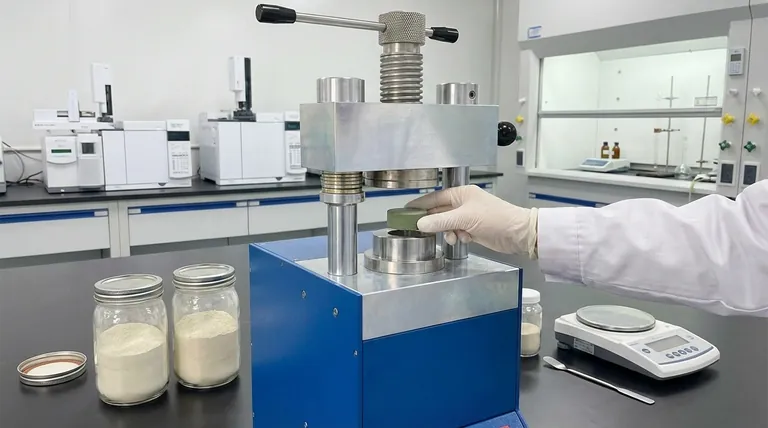
The Mechanics of Solid-State Densification
Increasing Inter-Particle Contact
In solid-state synthesis, reactions rely on the diffusion of atoms between different solid phases.
Cold pressing drastically increases the contact area between the ground raw materials. By mechanically forcing particles together, you create the necessary physical pathways for ions to diffuse across grain boundaries efficiently.
Enhancing Packing Density
Loose mixed powders contain a significant volume of air and void space, which acts as an insulator against chemical interaction.
Using a hydraulic press compacts these powders, significantly boosting the packing density. This reduction in volume ensures that the reactant mass is continuous, rather than a collection of isolated clusters.
Formation of the "Green Body"
The immediate output of this step is an electrolyte green body.
This is a semi-solid, compacted pellet that retains the shape of the die. It provides a stable, uniform geometry that can be easily handled and loaded into a furnace for the subsequent heat treatment.
Impact on Reaction Quality
Ensuring Reaction Completeness
Without sufficient contact, solid-state reactions often remain incomplete, leaving unreacted precursors in the final matrix.
The high density achieved through cold pressing facilitates a more complete chemical reaction. It ensures that the thermal energy applied during sintering is used to drive phase transformation rather than just bridging gaps between particles.
Promoting Uniformity
Homogeneity is vital for the performance of complex electrolytes like Li2.2C0.8B0.2O3.
Cold pressing helps ensure a uniform reaction throughout the bulk of the material. This prevents the formation of "hot spots" or localized defects, resulting in a synthesized product of consistently higher quality.
Understanding the Trade-offs
Mechanical Integrity vs. Pressure
While high pressure is desirable for density, there is a balance to be struck regarding the mechanical integrity of the green body.
Applying pressure that is too high or unevenly distributed can cause laminations or capping in the pellet. Conversely, insufficient pressure yields a fragile body that creates poor diffusion pathways.
The Limits of Cold Pressing
It is important to recognize that cold pressing is a physical preparation step, not a chemical one.
It does not induce the chemical reaction itself; it only sets the stage. The ultimate phase purity still depends heavily on the accuracy of the subsequent furnace heat treatment profile.
Optimizing Your Synthesis Workflow
To ensure the highest quality synthesis of Li2.2C0.8B0.2O3, consider your specific experimental goals when performing the cold-pressing step.
- If your primary focus is Phase Purity: Maximize the applied pressure within the limits of your die to ensure the highest possible packing density, minimizing the distance atoms must diffuse.
- If your primary focus is Reproducibility: Use a programmable hydraulic press to apply the exact same pressure and dwell time for every sample to ensure consistent green body density across batches.
The cold-pressing step is not merely a shaping procedure; it is the fundamental enabler of diffusion that dictates the final efficiency and quality of your solid-state reaction.
Summary Table:
| Function | Benefit for Synthesis |
|---|---|
| Increases Inter-Particle Contact | Creates efficient pathways for ion diffusion during sintering. |
| Enhances Packing Density | Reduces void space, ensuring a continuous reactant mass. |
| Forms a Coherent Green Body | Provides a stable, uniform pellet for easy handling and furnace loading. |
| Promotes Reaction Uniformity | Prevents localized defects, leading to a higher quality final product. |
Achieve superior synthesis results with precision lab presses from KINTEK.
The quality of your solid-state reaction starts with the quality of your green body. KINTEK specializes in manufacturing reliable lab press machines, including automatic and heated lab presses, designed to deliver the consistent, high-pressure compaction essential for synthesizing advanced materials like Li2.2C0.8B0.2O3.
Our presses help you:
- Maximize Reproducibility: Programmable controls ensure every pellet has the exact same density.
- Optimize for Phase Purity: Achieve the high packing densities required for complete reactions.
- Streamline Your Workflow: Robust and easy-to-use equipment built for laboratory demands.
Elevate your materials research. Contact our experts today to find the perfect press for your synthesis needs!
Visual Guide
Related Products
- Electric Lab Cold Isostatic Press CIP Machine
- Manual Cold Isostatic Pressing CIP Machine Pellet Press
- Automatic Lab Cold Isostatic Pressing CIP Machine
- Electric Split Lab Cold Isostatic Pressing CIP Machine
- Laboratory Hydraulic Pellet Press for XRF KBR FTIR Lab Press
People Also Ask
- What role do electric lab cold isostatic presses play in industrial contexts? Bridge R&D and Manufacturing with Precision
- What are the applications of electric lab cold isostatic presses in research settings? Advance Material R&D with High-Pressure CIPs
- How does electrical Cold Isostatic Pressing (CIP) contribute to cost savings? Unlock Efficiency and Reduce Expenses
- What are some research applications of electric lab CIPs? Unlock Uniform Powder Densification for Advanced Materials
- What are the characteristics of standard off-the-shelf electric lab CIP solutions? Achieve Immediate, Cost-Effective Processing



















