
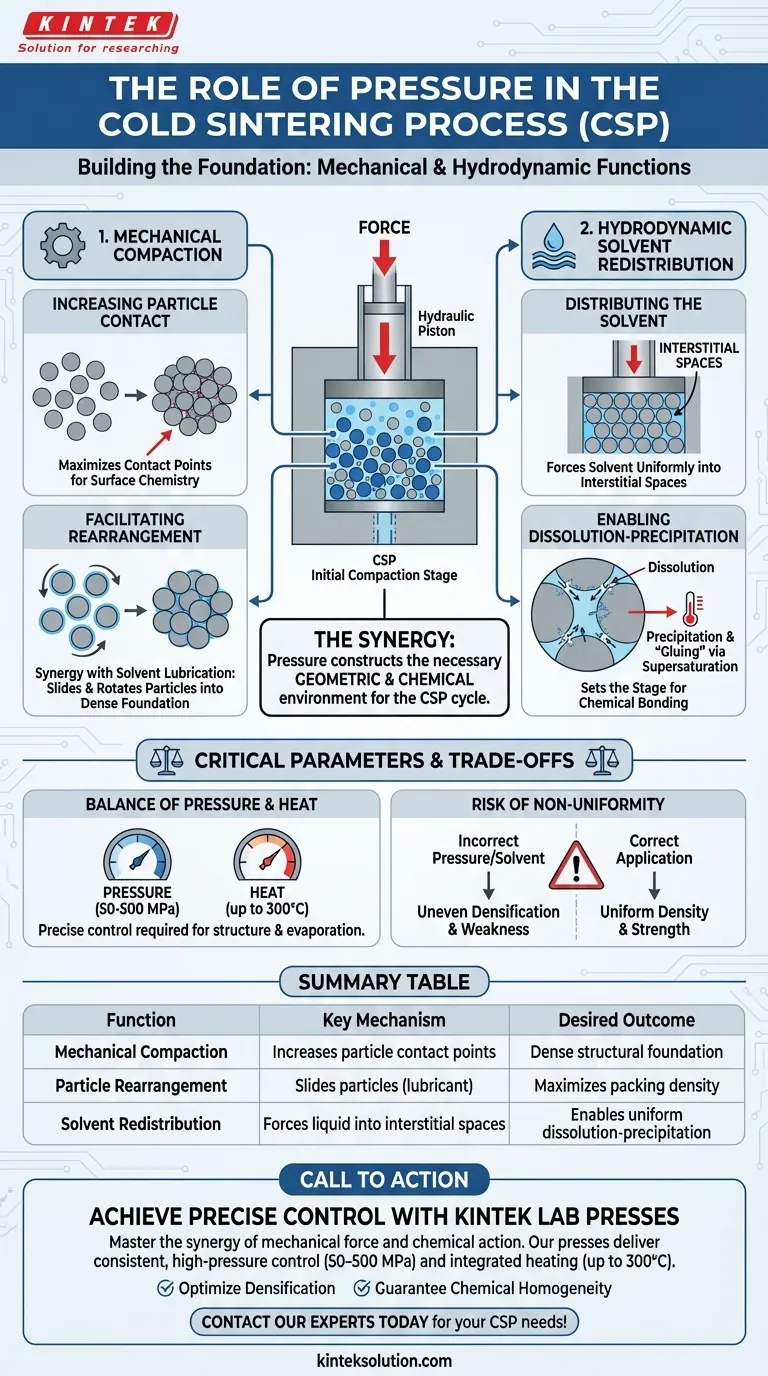
The application of pressure during the initial stage of the Cold Sintering Process (CSP) serves three distinct but interrelated functions: mechanical compaction, solvent redistribution, and particle rearrangement. Specifically, the hydraulic press compacts powder particles to increase contact points, forces the transient aqueous solvent into interstitial spaces, and works with the solvent's lubricating properties to slide particles into a dense structural foundation.
The pressure applied in CSP does not merely squeeze the material; it constructs the necessary geometric and chemical environment. By forcing particles and solvent into intimate contact, pressure creates the physical conditions required for the chemical dissolution-precipitation phase to take over.
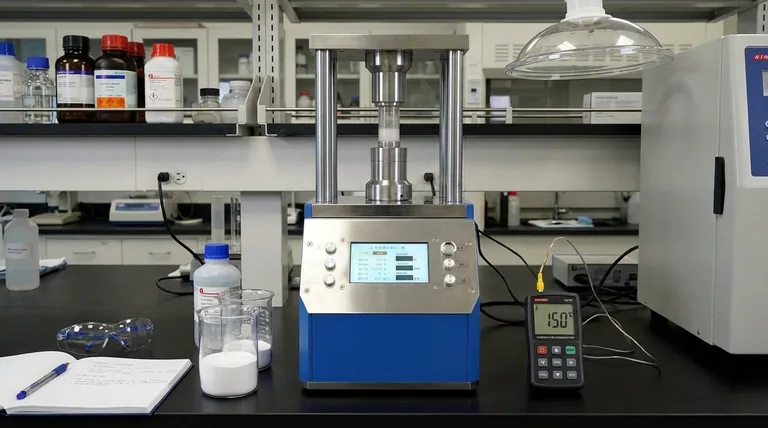
The Mechanical Role of Pressure
Increasing Particle Contact
The primary mechanical function of the hydraulic press is to reduce porosity. By physically compacting the powder, the pressure maximizes the number of contact points between individual particles.
This contact is critical because CSP relies on surface chemistry. The more the particles touch, the more surface area is available for the subsequent chemical reactions.
Facilitating Particle Rearrangement
Pressure does not work in isolation; it works in synergy with the transient aqueous solution. The solution acts as a lubricant between the solid particles.
The applied pressure capitalizes on this lubrication to slide and rotate particles. This rearrangement allows the particles to settle into a tightly packed, dense configuration that serves as the foundation for the final material.
The Hydrodynamic Role of Pressure
Distributing the Solvent
Beyond moving solids, the pressure plays a vital hydrodynamic role. It forces the uniform redistribution of the aqueous solvent.
The pressure drives the liquid into the "interstitial spaces" (the gaps between particles). This ensures that the solvent is not pooled in one area but is evenly accessible to all particle surfaces.
Enabling the Dissolution-Precipitation Cycle
By ensuring the solvent is at the contact points, the pressure sets the stage for the core mechanism of CSP. The uniform distribution of liquid allows the solvent to dissolve surface material.
Once heat is applied, this liquid evaporates to create a supersaturated solution. This supersaturation drives precipitation and crystal growth, "gluing" the densified particles together.
Critical Process Parameters and Trade-offs
The Balance of Pressure and Heat
While pressure establishes the structure, it must be paired with precise temperature control (up to 300°C). Pressure alone provides density, but heat drives the evaporation needed for supersaturation.
A hydraulic press with heating capabilities is essential to manage this balance. The equipment must simultaneously apply 50–500 MPa of pressure while managing the evaporation rate of the solvent.
The Risk of Non-Uniformity
If the pressure is applied incorrectly or without sufficient solvent, the "lubricating" effect fails. This prevents the particles from sliding into a dense arrangement.
Conversely, without the pressure to force the solvent into the interstitial spaces, the liquid phase will not be distributed uniformly. This leads to uneven densification and structural weaknesses in the final sintered part.
Applying These Principles to Your Process
To achieve efficient cold sintering, you must view pressure as a tool for solvent management as much as particle compaction.
- If your primary focus is increasing density: Prioritize the "sliding and rearrangement" phase by ensuring the pressure is high enough (50-500 MPa) to overcome particle friction, aided by the lubricant.
- If your primary focus is chemical homogeneity: Focus on the initial compaction speed and pressure consistency to ensure the solvent is driven uniformly into all interstitial spaces before evaporation begins.
Success in CSP depends on the precise synergy between the mechanical force of the press and the chemical action of the solvent.
Summary Table:
| Function of Pressure | Key Mechanism | Desired Outcome |
|---|---|---|
| Mechanical Compaction | Increases particle contact points | Creates a dense structural foundation |
| Particle Rearrangement | Slides particles using solvent as a lubricant | Maximizes packing density |
| Solvent Redistribution | Forces liquid into interstitial spaces | Enables uniform dissolution-precipitation |
Ready to Achieve Precise Control in Your Cold Sintering Process?
Success in CSP hinges on the precise synergy between mechanical force and chemical action. KINTEK specializes in the lab press machines—including automatic, isostatic, and heated lab presses—that deliver the consistent, high-pressure control (50–500 MPa) and integrated heating (up to 300°C) required to master this balance.
Let our expertise empower your research:
- Optimize Densification: Ensure your pressure is high enough to overcome particle friction and facilitate rearrangement.
- Guarantee Chemical Homogeneity: Achieve uniform solvent distribution for even densification and strong final parts.
Don't let equipment limitations compromise your materials. Contact our experts today to find the perfect press for your laboratory's CSP needs!
Visual Guide
References
- Yu Tong, Hongtao Zhang. Current understanding and applications of the cold sintering process. DOI: 10.1007/s11705-019-1832-1
This article is also based on technical information from Kintek Solution Knowledge Base .
Related Products
- Automatic High Temperature Heated Hydraulic Press Machine with Heated Plates for Lab
- Manual Heated Hydraulic Lab Press with Integrated Hot Plates Hydraulic Press Machine
- Heated Hydraulic Press Machine with Heated Plates for Vacuum Box Laboratory Hot Press
- Laboratory Hydraulic Press 2T Lab Pellet Press for KBR FTIR
- Laboratory Hydraulic Press Lab Pellet Press Machine for Glove Box
People Also Ask
- Function of a Laboratory Hydraulic Press with Heated Platens in SSE? Enhance Battery Density & Conductivity
- What are the requirements for electrode pressing with high-viscosity ionic liquids like EMIM TFSI? Optimize Performance
- How does a laboratory heated hydraulic press facilitate PBN sample prep for WAXS? Achieve Precise X-Ray Scattering
- What are the industrial applications of heated hydraulic presses? Master Heat & Force for Precision Manufacturing
- Why is a laboratory hydraulic press with heating plates required for PLA/TEC films? Achieve Precise Sample Integrity



















