
The cold pressing process serves as the critical assembly mechanism that exploits the unique physical properties of sulfide electrolytes to create high-performance anode-free batteries. By applying precise, uniform mechanical pressure at room temperature, this method forces the electrolyte and current collector into a seamless, tight physical interface without the need for thermal processing.
Core Insight: Cold pressing transforms the inherent plasticity of sulfide electrolytes into a functional advantage. It achieves the high material density and low interfacial resistance necessary for stable lithium cycling while completely eliminating the energy costs and chemical risks associated with high-temperature sintering.
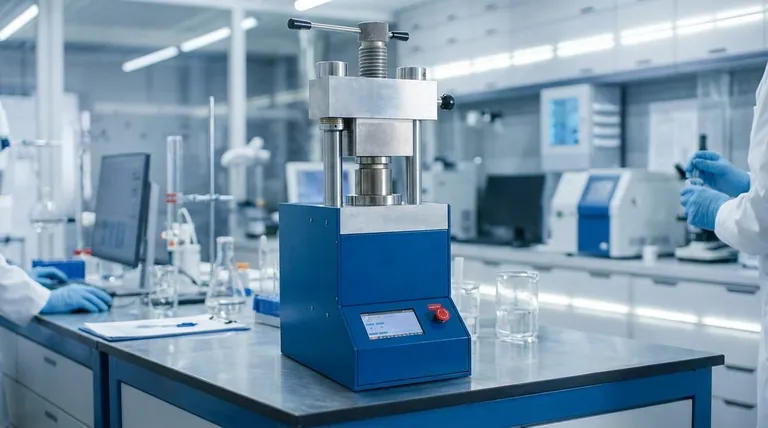
The Mechanics of Cold Pressing
Leveraging Intrinsic Plasticity
Unlike oxide ceramics, which are brittle and hard, sulfide solid-state electrolytes possess excellent plasticity and ductility.
They are inherently soft materials that deform easily under pressure.
Cold pressing utilizes this characteristic to compress the material effectively at room temperature.
Achieving Seamless Contact
The primary mechanical goal is to establish "intimate contact" between the solid electrolyte and the current collector.
The hydraulic press applies sufficient force to merge these layers physically.
This results in a tight, gap-free interface that acts as a single, cohesive unit.
Performance Implications
Minimizing Interfacial Resistance
The physical closeness achieved through cold pressing directly dictates the battery's electrical efficiency.
A tight, seamless interface significantly reduces interfacial resistance.
Low resistance is fundamental for enabling efficient and stable lithium deposition and stripping cycles.
Enhancing Material Density
Beyond the interface, the pressure densifies the bulk electrolyte material itself.
High material density is achieved through simple mechanical pressure, leading to low grain boundary resistance.
This ensures that ions can move freely through the electrolyte without bottling up at internal voids.
Understanding the Process Benefits
Eliminating High-Temperature Sintering
Traditional ceramic processing often requires sintering at very high temperatures to bond materials.
Cold pressing bypasses this requirement entirely, relying solely on mechanical force.
This significantly simplifies the manufacturing workflow.
Preventing Material Degradation
High-temperature treatments can induce unwanted side reactions or material degradation in sensitive battery components.
By operating at room temperature, cold pressing avoids these thermal risks.
This preserves the chemical integrity of the sulfide electrolyte while simultaneously reducing energy consumption during fabrication.
Making the Right Choice for Your Goal
To maximize the effectiveness of cold pressing in your assembly process, consider your primary objectives:
- If your primary focus is Cycle Stability: Prioritize pressure uniformity to ensure the lowest possible interfacial resistance for consistent lithium stripping.
- If your primary focus is Manufacturing Efficiency: Leverage the elimination of sintering to streamline production lines and reduce energy overhead.
The success of an anode-free sulfide battery relies not on heat, but on the precise application of pressure to capitalize on the material's natural ductility.
Summary Table:
| Key Aspect | Role of Cold Pressing |
|---|---|
| Primary Function | Critical assembly mechanism for anode-free sulfide batteries |
| Mechanical Action | Applies uniform pressure to create a seamless, gap-free interface |
| Material Property Used | Exploits the inherent plasticity and ductility of sulfide electrolytes |
| Key Performance Benefit | Minimizes interfacial resistance for stable lithium cycling |
| Manufacturing Advantage | Eliminates high-temperature sintering, simplifying production |
Ready to enhance your battery assembly process with precision cold pressing?
KINTEK specializes in laboratory press machines, including automatic and isostatic presses, designed to deliver the precise, uniform pressure required for advanced battery research and development. Our equipment helps you achieve the high-density, low-resistance interfaces critical for next-generation anode-free batteries, all while streamlining your manufacturing workflow.
Contact our experts today to find the perfect lab press solution for your laboratory's needs and unlock superior battery performance.
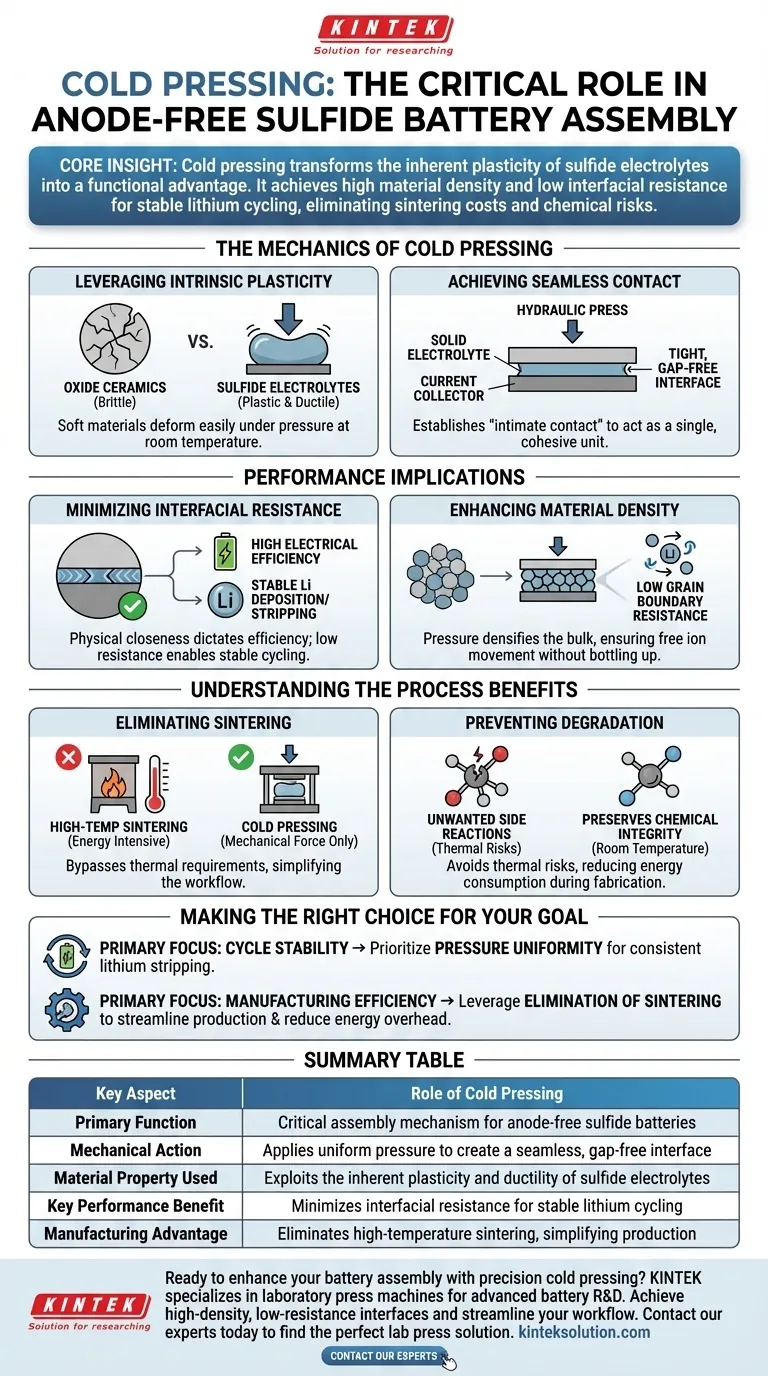
Visual Guide
References
- Yijia Wang, Yang Zhao. Revealing the Neglected Role of Passivation Layers of Current Collectors for Solid‐State Anode‐Free Batteries. DOI: 10.1002/adma.202513090
This article is also based on technical information from Kintek Solution Knowledge Base .
Related Products
- Electric Lab Cold Isostatic Press CIP Machine
- Electric Split Lab Cold Isostatic Pressing CIP Machine
- Automatic Lab Cold Isostatic Pressing CIP Machine
- Manual Cold Isostatic Pressing CIP Machine Pellet Press
- Lab Isostatic Pressing Molds for Isostatic Molding
People Also Ask
- What are the applications of electric lab cold isostatic presses in research settings? Advance Material R&D with High-Pressure CIPs
- What role do electric lab cold isostatic presses play in industrial contexts? Bridge R&D and Manufacturing with Precision
- How does electrical Cold Isostatic Pressing (CIP) contribute to cost savings? Unlock Efficiency and Reduce Expenses
- What are some research applications of electric lab CIPs? Unlock Uniform Powder Densification for Advanced Materials
- What are the characteristics of standard off-the-shelf electric lab CIP solutions? Achieve Immediate, Cost-Effective Processing

















