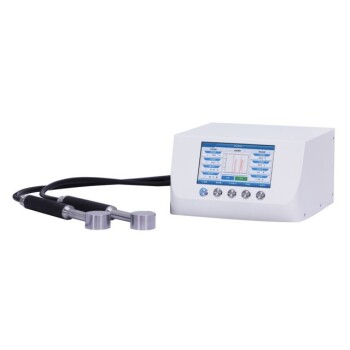
An ionic conductivity tester is the critical diagnostic tool required to quantify the relationship between thermal conditions and electrolyte performance. It allows researchers to monitor specific changes in physicochemical properties, providing the empirical data necessary to explain and optimize prelithiation efficiency.
Core Takeaway The necessity of this device lies in its ability to validate the mechanism behind improved performance. It proves that higher temperatures lower electrolyte viscosity and increase ionic conductivity, directly enabling faster and more uniform prelithiation.
Monitoring Physicochemical Properties
Tracking Electrolyte State
The primary function of an ionic conductivity tester is to provide real-time monitoring of the electrolyte's condition.
It measures how the fundamental physical and chemical properties of the solution shift when subjected to different environments.
Quantifying Viscosity Changes
One of the key metrics the tester helps reveal is the reduction of resistance to flow.
Data from the device confirms that as temperatures increase, the viscosity of the electrolyte decreases significantly.
Connecting Temperature to Performance
The Conductivity Correlation
The tester is essential for establishing the direct link between heat and ionic movement.
It provides the hard data showing that the reduction in viscosity directly correlates to enhanced ionic conductivity.
Explaining Process Efficiency
Without this testing, the benefits of heating are merely observational; with the tester, they are quantifiable.
The device explains why the process improves: higher conductivity facilitates more rapid ion transport.
Optimizing Process Parameters
Achieving Uniformity
Beyond speed, the data assists in understanding the quality of the prelithiation.
The tester validates that the physicochemical changes (lower viscosity) allow for more uniform lithium distribution throughout the material.
Defining Optimal Parameters
The ultimate goal of using this tester is to move from guesswork to precision.
By mapping conductivity against temperature, researchers can define the exact process parameters needed for optimal results.
The Risks of Operating Without Data
The "Black Box" Problem
Without an ionic conductivity tester, prelithiation is treated as a "black box" process.
You may observe that heat speeds up the reaction, but you will lack the data to understand the underlying chemical mechanics.
Missed Optimization Windows
Relying solely on final output metrics ignores the behavior of the electrolyte itself.
Using the tester prevents you from overlooking critical inflection points where viscosity drops and conductivity peaks.
Applying This to Your Project
To effectively use an ionic conductivity tester for prelithiation optimization, consider your specific goals:
- If your primary focus is Speed: Use the tester to identify the temperature threshold where ionic conductivity reaches its maximum peak.
- If your primary focus is Consistency: Use the viscosity data to determine the thermal setting that ensures the most uniform electrolyte distribution.
Accurate thermal profiling of your electrolyte is the difference between a functional process and an optimized one.
Summary Table:
| Key Factor | Role of Ionic Conductivity Tester | Impact on Prelithiation |
|---|---|---|
| Electrolyte State | Monitors real-time physicochemical shifts | Ensures stable and predictable reactions |
| Viscosity | Quantifies reduction in flow resistance | Facilitates deeper and faster material penetration |
| Ionic Movement | Tracks conductivity peaks vs. temperature | Directly correlates heat to ion transport speed |
| Process Quality | Validates uniformity of lithium distribution | Prevents localized imbalances and improves battery life |
| Parameter Mapping | Defines precise temperature thresholds | Transitions from observational to optimized processes |
Unlock Precision in Your Battery Research with KINTEK
Don't let your prelithiation process remain a 'black box.' KINTEK specializes in comprehensive laboratory solutions designed to bridge the gap between observation and optimization. Whether you are scaling battery research or refining material properties, our advanced equipment—including manual, automatic, heated, and multifunctional presses, as well as cold and warm isostatic presses—provides the reliability your lab demands.
Why choose KINTEK?
- Glovebox Compatibility: Seamlessly integrate our tools into your inert environments.
- Comprehensive Pressing Solutions: From battery electrode preparation to isostatic material compaction.
- Data-Driven Success: We provide the hardware that enables precise thermal and physical profiling.
Ready to optimize your electrolyte performance? Contact our laboratory specialists today to find the perfect pressing and testing solutions for your project!
References
- Minji Kang, Cheol-Hwi Ryu. Study on Direct-Contact Prelithiation of Soft Carbon Anodes Using Lithium Foil for Lithium-Ion Capacitors. DOI: 10.3390/en18092276
This article is also based on technical information from Kintek Solution Knowledge Base .
Related Products
- Lab Cylindrical Press Mold for Laboratory Use
- Lab Double Plate Heating Mold for Laboratory Use
- Lab Anti-Cracking Press Mold
- Lab Button Battery Disassembly and Sealing Mold
- Laboratory Hydraulic Split Electric Lab Pellet Press
People Also Ask
- What is the purpose of incorporating cartridge heaters into a lab press mold for MLCC block compression? Optimize Results
- Why is precise cooling management of the lab press mold necessary? Protect Core Integrity in Thermoforming
- What is the function of a pressing tool in thermoplastic panels? Master Precision Shaping & Fusion Bonding
- Why is a high-performance laboratory molding press critical for in-situ electrolyte formation? Unlock Battery Success
- How does the geometry of laboratory molds influence mycelium-based composites? Optimize Density and Strength