The pellet die process is a fundamental technique used to transform loose powder into a solid, stable form for spectroscopic analysis. It involves mixing a sample with a binding agent and subjecting it to immense pressure to create a durable disc that a spectrometer can easily examine.
The core of this process is the transformation of a finely ground sample and potassium bromide into a solid disc through high-pressure hydraulic compression, ensuring a quick and repeatable testing standard.
The Mechanics of Sample Preparation
The goal of the pellet die process is to prepare a sample that is uniform and solid. This ensures that the spectrometer reads the material properties rather than artifacts of the preparation method.
Preparing the Mixture
The process begins by combining the specific sample you wish to analyze with potassium bromide.
These two materials are mixed together thoroughly. They are then ground down until they form a fine powder, ensuring the mixture is homogenous before compression begins.
Utilizing the Pellet Die
Once the powder is prepared, it is transferred into a specialized tool known as a pellet die.
This is a durable container designed to withstand extreme forces. The powder is placed inside this assembly, which includes a plunger mechanism to transmit force.
Applying Hydraulic Pressure
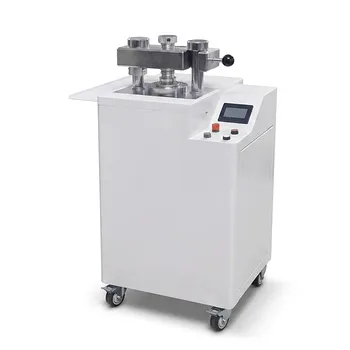
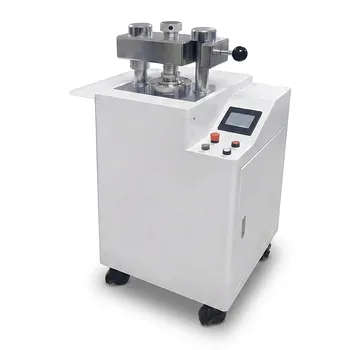
To transform the powder into a solid, the loaded pellet die is placed into a hydraulic press.
The press drives the die's plunger down with a load of several tonnes. This massive force compresses the fine powder, fusing the particles together physically.
The Final Result
After compression, the material emerges as a solid disc.
This disc is cohesive and ready for immediate placement inside a spectrometer. Because the sample is now a fixed solid, the examination process is streamlined and consistent.
Understanding the Trade-offs
While the pellet die method is standard, it is important to recognize the operational requirements involved to ensure success.
Equipment Dependency
This is not a manual process; it requires heavy machinery. You must have access to a hydraulic press capable of exerting tonnes of pressure to achieve the necessary fusion.
Material Preparation Rigor
Success depends heavily on the initial grinding stage. The sample and potassium bromide must be ground to a fine powder; failing to achieve this texture may result in a poor-quality disc that compromises the analysis.
Making the Right Choice for Your Goal
The pellet die process is chosen for its balance of speed and consistency. Here is how to view the method based on your specific analytical needs:
- If your primary focus is Efficiency: This method provides a workflow that is quick and easy, allowing for rapid turnaround of samples.
- If your primary focus is Data Quality: The mechanical compression creates a standardized sample, making the process highly repeatable for verification testing.
By controlling the grind and the pressure, you ensure that every analysis starts with a high-quality foundation.
Summary Table:
| Stage | Action | Key Outcome |
|---|---|---|
| Preparation | Mix sample with KBr & grind to fine powder | Homogeneous mixture for uniform testing |
| Loading | Transfer powder into a durable pellet die | Prepares material for high-pressure fusion |
| Compression | Apply several tonnes of hydraulic pressure | Transforms loose powder into a solid disc |
| Analysis | Place solid disc into the spectrometer | Ensures repeatable, artifact-free data |
Optimize Your Sample Preparation with KINTEK
Achieve the highest quality analytical data with KINTEK’s industry-leading laboratory pressing solutions. Whether you are conducting advanced battery research or routine spectroscopy, we provide a comprehensive range of manual, automatic, heated, and multifunctional presses, alongside specialized isostatic and glovebox-compatible models.
Don't let poor sample preparation compromise your results. Let our experts help you select the perfect press for your specific application.
Contact KINTEK Today to Enhance Your Lab Efficiency
Related Products
- XRF KBR Steel Ring Lab Powder Pellet Pressing Mold for FTIR
- Lab XRF Boric Acid Powder Pellet Pressing Mold for Laboratory Use
- Lab Ring Press Mold for Sample Preparation
- XRF KBR Plastic Ring Lab Powder Pellet Pressing Mold for FTIR
- Lab Infrared Press Mold for No Demolding
People Also Ask
- What considerations are important regarding the die size of an XRF pellet press? Optimize for Your XRF Spectrometer and Sample
- Why are pellets used in XRF analysis, and what is their limitation? Boost Accuracy and Speed in Your Lab
- What is the general process for preparing a sample pellet for XRF? Master Consistency for Accurate Analysis
- What are the differences between manual and automatic XRF pellet presses? Choose the Right Press for Your Lab's Needs
- What are the primary factors to consider when deciding between a manual and an automatic XRF pellet press? Optimize Your Lab's Efficiency