
The primary function of a uniaxial press in the cold sintering process for LLTO composite electrolytes is to drive the "dissolution-precipitation" mechanism through extreme mechanical force. By applying pressures as high as 600 MPa in the presence of a transient solvent (such as DMF), the press forces ceramic particles to rearrange, fracture, and undergo plastic deformation. This mechanical energy significantly enhances the solubility of particle surfaces, allowing the material to densify at remarkably low temperatures (around 125°C) rather than the high temperatures required in traditional sintering.
The uniaxial press acts as a thermodynamic catalyst, substituting mechanical pressure for thermal energy. It enables the densification of ceramic electrolytes at temperatures compatible with polymers and volatile components, bypassing the limitations of conventional high-heat processing.
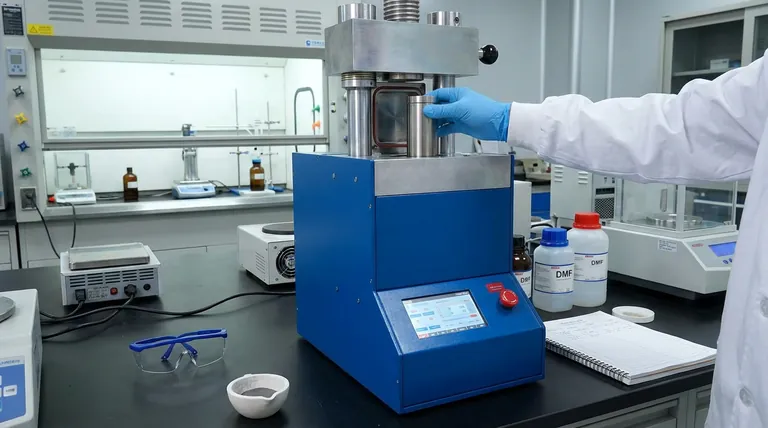
The Mechanics of Pressure-Assisted Densification
To understand why this equipment is critical, one must look beyond simple compaction. The press performs three distinct physical and chemical functions simultaneously.
Forcing Physical Rearrangement
The initial application of high uniaxial pressure eliminates air voids between the loose powder particles. This forces the ceramic particles into an intimate, packed arrangement.
Inducing Plastic Deformation
As pressure increases (up to 600 MPa), the stress at the contact points between particles exceeds the material's yield strength. This causes the particles to fracture and deform plastically, maximizing the surface area of contact between them.
Triggering the Chemical Mechanism
The most critical function of the press is chemical. The high pressure markedly enhances the solubility of the ceramic material in the transient solvent. This drives a dissolution-precipitation process: the solid material dissolves at high-stress contact points and precipitates at low-stress areas, effectively "gluing" the particles together into a dense solid.
Understanding the Synergistic Role of Heat
While the press provides the mechanical force, it typically operates in conjunction with controlled heating, acting as a heated hydraulic press.
The Temperature-Pressure Balance
In cold sintering, the press maintains a specific, moderate temperature (e.g., 125°C to 150°C). This heat is not enough to sinter the ceramic on its own. Instead, it prevents the solvent from evaporating too quickly while accelerating the chemical reaction rates of the dissolution process.
Solvent Interaction
The pressure must be applied while the transient liquid phase (solvent) is active. If the pressure is applied after the solvent has evaporated, the dissolution-precipitation mechanism fails, and the material will not densify.
Common Pitfalls and Trade-offs
When utilizing a uniaxial press for cold sintering, precision is as important as power.
Pressure Uniformity vs. Density Gradients
A uniaxial press applies force in one direction. If the powder bed is not perfectly uniform, or if the pressure is applied too rapidly, it can create density gradients. This results in a pellet that is dense in some areas but porous in others, compromising ionic conductivity.
The Risk of Component Damage
While high pressure is necessary for densification, excessive pressure can crush delicate composite structures or squeeze out the polymer matrix (in composite electrolytes) before it creates a cohesive bond. The pressure must be optimized to balance particle fracture with structural integrity.
Making the Right Choice for Your Goal
The specific settings of your uniaxial press should be dictated by your end-goal for the electrolyte.
- If your primary focus is maximizing ionic conductivity: Prioritize higher pressures (up to 600 MPa) to maximize particle-to-particle contact and minimize porosity, ensuring efficient ion transport channels.
- If your primary focus is composite integrity (e.g., with polymers): focus on the precise control of the heating element (maintaining ~125°C-150°C) to ensure the polymer flows and binds the ceramic fillers without degrading.
Success in cold sintering relies not just on applying force, but on the precise synchronization of pressure, heat, and solvent chemistry to achieve a monolithic structure.
Summary Table:
| Function | Mechanism | Key Parameter |
|---|---|---|
| Physical Rearrangement | Eliminates air voids, forces particle packing | High uniaxial pressure |
| Plastic Deformation | Fractures particles, increases contact area | Pressures up to 600 MPa |
| Chemical Activation | Enhances solubility, triggers dissolution-precipitation | Pressure applied with transient solvent (e.g., DMF) |
| Synergy with Heat | Accelerates reactions without evaporating solvent | Moderate temperature (~125°C–150°C) |
Ready to optimize your cold sintering process with precision pressure control? KINTEK's advanced lab presses—including automatic, isostatic, and heated models—deliver the extreme mechanical force and exact temperature synchronization required for densifying LLTO and other composite electrolytes. Our equipment ensures uniform pressure distribution, prevents density gradients, and maximizes ionic conductivity for your research. Contact our experts today to discuss how a KINTEK press can accelerate your materials development!
Visual Guide

Related Products
- Manual Laboratory Hydraulic Pellet Press Lab Hydraulic Press
- Automatic Laboratory Hydraulic Press for XRF and KBR Pellet Pressing
- Warm Isostatic Press for Solid State Battery Research Warm Isostatic Press
- Laboratory Hydraulic Split Electric Lab Pellet Press
People Also Ask
- What is the primary purpose of manual lab hydraulic pellet presses? Achieve High-Precision Sample Preparation for Spectroscopy
- What is the primary purpose of a manual lab hydraulic pellet press? Ensure Accurate Sample Prep for XRF and FTIR
- What is the primary function of a laboratory hydraulic press in evaluating the ionic conductivity of Li6PS5X (LMSX)?
- What role does a lab hydraulic press play in researching squishy granular matter? Expert Insights into Material Physics
- What is the purpose of initial axial molding using a lab hydraulic press? Optimizing Electrolyte Green Bodies



