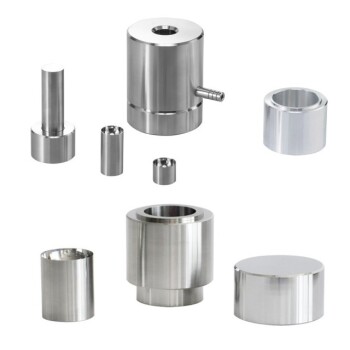
In the Wet-bag Cold Isostatic Pressing (CIP) method, the flexible rubber mold functions primarily as a sealed, deformable interface between the liquid medium and the raw powder. Its critical role is twofold: it serves as an impermeable barrier that prevents the high-pressure liquid from contaminating the powder, while simultaneously acting as a medium to transmit isostatic pressure uniformly from all directions to compact the material.
Core Takeaway The flexible mold is the key to achieving the hydrostatic pressure principle in CIP. By deforming elastically under load, it allows for the uniform densification of complex shapes and large-scale components, ensuring the final part has consistent structural integrity without the density gradients common in rigid die pressing.
The Mechanics of Pressure Transmission
Achieving Isotropic Compression
The rubber mold utilizes its high elastic deformation capability to transfer pressure. Because the mold is flexible, the hydraulic pressure from the surrounding liquid is applied as hydrostatic pressure—meaning it pushes with equal force from every angle.
Eliminating Stress Concentrations
Unlike rigid molds that press from a single axis, the rubber mold compresses the powder inward from all sides. This uniform application prevents stress concentrations and structural defects, allowing the powder to compact evenly regardless of the part's geometry.
Facilitating Particle Rearrangement
As the mold deforms, it forces the internal powder particles (such as metal or ceramic powders) to rearrange and pack tightly. This results in a "green body" with a uniform density distribution, which is essential for consistent behavior during the subsequent sintering phase.
Protection and Integrity
The Barrier Function
The mold acts as a critical seal against the liquid medium (often water or oil) used in the high-pressure vessel. Without this impermeable barrier, the fluid would infiltrate the powder, ruining the chemical purity and structural composition of the material.
Vacuum sealing and Air Removal
To function correctly, the mold is often sealed or used in conjunction with vacuum encapsulation. Removing internal air before pressurization prevents air entrapment voids and utilizes negative pressure to assist in the initial packing of the powder.
Suitability for Complex Manufacturing
Handling Large-Scale Components
The wet-bag method, enabled by these independent rubber molds, allows for the production of very large parts. The mold is filled outside the vessel and then submerged, meaning the size of the part is limited only by the dimensions of the pressure vessel itself.
Enabling Complex Geometries
Because the rubber mold is not a rigid die, it can be shaped into intricate forms. This allows for the manufacturing of complex, near-net-shape components or parts with high aspect ratios (long and slender) that would crack or distort under uniaxial pressing.
Understanding the Trade-offs
Cycle Time Considerations
While the flexible mold allows for versatility, the wet-bag process is generally slower than dry-bag methods. The molds must be filled, sealed, and loaded into the vessel manually or mechanically for each cycle, making it less suitable for high-speed mass production.
Surface Finish and Tolerance
The flexibility that allows for uniform density also means the mold moves during compression. Consequently, the surface finish of the "green" part may require post-process machining to achieve precise final tolerances, unlike parts formed in rigid dies.
Making the Right Choice for Your Goal
- If your primary focus is component complexity: The flexible rubber mold is essential for producing intricate geometries or large parts where uniform density is critical to prevent warping during sintering.
- If your primary focus is material purity: Ensure the mold sealing integrity is flawless, as the mold is the only line of defense preventing the hydraulic fluid from contaminating your powder stock.
- If your primary focus is structural consistency: Rely on the mold's elastic deformation to eliminate the density gradients and internal stresses typically associated with standard uniaxial pressing.
The flexible rubber mold is not merely a container; it is the active transmission tool that converts hydraulic force into structural uniformity.
Summary Table:
| Feature | Primary Function & Benefit |
|---|---|
| Pressure Transmission | Converts hydraulic liquid force into uniform hydrostatic pressure from all directions. |
| Contamination Barrier | Acts as an impermeable seal preventing fluid from infiltrating the raw powder. |
| Structural Integrity | Eliminates density gradients to produce green bodies with consistent structural uniformity. |
| Design Flexibility | Enables the production of complex, near-net-shape geometries and large-scale parts. |
| Deformation Capability | Elastically deforms to allow tight particle rearrangement and air-free compaction. |
Optimize Your Powder Compaction with KINTEK
Take your material research to the next level with KINTEK’s advanced laboratory pressing solutions. Whether you require high-precision manual or automatic presses, heated models, or specialized Cold and Warm Isostatic Presses (CIP/WIP), we provide the tools necessary for superior density and structural integrity in battery research and advanced ceramics.
Our value to you:
- Versatility: Solutions for complex geometries and large-scale components.
- Precision: Expertise in achieving uniform density without structural defects.
- Durability: Reliable equipment compatible with glovebox and high-pressure environments.
Contact KINTEK Today for a Professional Consultation
References
- Takao Fujikawa, Yasuo Manabe. History and Future Prospects of HIP/CIP Technology. DOI: 10.2497/jjspm.50.689
This article is also based on technical information from Kintek Solution Knowledge Base .
Related Products
- Manual Cold Isostatic Pressing CIP Machine Pellet Press
- Automatic Lab Cold Isostatic Pressing CIP Machine
- Lab Isostatic Pressing Molds for Isostatic Molding
- Electric Split Lab Cold Isostatic Pressing CIP Machine
- Electric Lab Cold Isostatic Press CIP Machine
People Also Ask
- Why is Cold Isostatic Pressing (CIP) necessary for SBN ceramics? Achieve High-Density and Crack-Free Sintering
- What are the process advantages of using Cold Isostatic Pressing (CIP) for LSMO? Achieve Defect-Free Density
- Why is Cold Isostatic Pressing (CIP) applied after uniaxial pressing? Optimize Superconductor Precursor Density
- What types of equipment are available for cold isostatic pressing? Explore CIP Solutions for Labs and Production
- What are the technical advantages of cold isostatic pressing equipment compared to uniaxial compression equipment? Learn More!