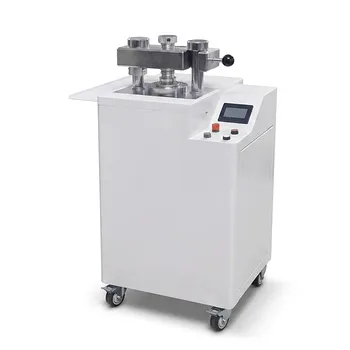
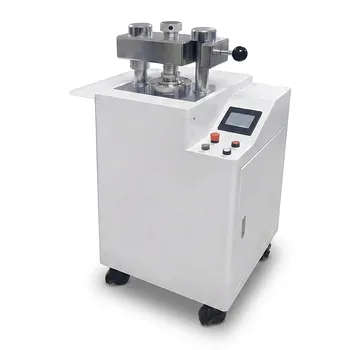
The primary purpose of creating a KBr pellet is to suspend a solid sample within a thin, transparent medium—specifically Potassium Bromide (KBr)—to facilitate transmission Fourier Transform Infrared (FTIR) spectroscopy. By compressing the sample with KBr into a uniform disc, you render the mixture transparent to infrared light, allowing the instrument to accurately characterize the molecular structure without significant interference.
The KBr pellet technique transforms an opaque solid sample into an optical-grade window. This ensures infrared light transmits through the material rather than scattering off the surface, providing high-fidelity spectral data essential for quantitative analysis.
The Role of Transmission in FTIR
Enabling Infrared Transparency
Solid samples on their own are often too dense or opaque for infrared light to penetrate effectively.
Potassium Bromide (KBr) is used as a carrier because it is optically transparent to infrared radiation. By dispersing the sample within a KBr matrix, you create a path for the light to travel through the sample molecules unhindered.
Dilution for Signal Clarity
Direct analysis of pure solids often results in "saturated" signals where absorbance is too high to measure.
The pelletization process involves diluting the sample (typically at a ratio of 1 part sample to 100 parts KBr). This dilution brings the sample concentration within the optimal detection range of the FTIR instrument.
Achieving Quantitative Precision
Controlling Path Length
For accurate quantitative analysis, the path the light travels must be consistent.
A KBr pellet press creates cylindrical pellets with flat ends and uniform thickness. This specific geometry minimizes optical distortion and allows for precise, reproducible measurements of absorbance.
Ensuring Homogeneity
The preparation process involves thoroughly mixing the sample and KBr using a pestle and mortar.
This results in a homogenous mixture that produces consistent spectral data. Uniformity is vital when conducting comparative studies or when reproducibility is a key metric of your analysis.
The Preparation Standard
The Compression Process
To achieve the necessary transparency, the loose powder mixture is placed into a die and compressed using a hydraulic press.
The application of uniform force transforms the powder into a solid, glass-like disc. The target result is a pellet approximately 2 mm thick that appears clear to the naked eye.
Equipment Requirements
Unlike surface techniques, KBr pellet creation requires specific tooling.
You must utilize a Pellet Press Die Set and a mortar (preferably agate to minimize contamination). The quality of your tools directly influences the clarity and stability of the final disc.
Understanding the Trade-offs
Process Sensitivity
While KBr pellets offer superior transmission data, the technique is sensitive to preparation variables.
If the pellet is too thick or the ratio of sample-to-KBr is incorrect, the disc will be opaque. This blocks the beam and results in poor spectral quality, requiring the user to adjust the mixture and repress the pellet.
Modern vs. Classic Techniques
KBr pellet analysis is a classic method that competes with modern techniques like Attenuated Total Reflectance (ATR).
While ATR is often dominant due to its ease of use, KBr remains superior for transmission spectroscopy. However, it requires more manual effort and equipment than simply placing a sample on a crystal.
Making the Right Choice for Your Goal
To determine if KBr pelletization is the right approach for your current project, consider your analytical needs:
- If your primary focus is quantitative analysis: The defined path length and uniform distribution of the KBr pellet provide the most reliable data for calculating concentrations.
- If your primary focus is rapid identification: You may find the KBr process time-consuming compared to ATR, though KBr is often preferred for comparing results against historical spectral libraries.
By mastering the KBr pellet technique, you ensure your solid samples are presented to the FTIR instrument in the optimal state for precise molecular characterization.
Summary Table:
| Feature | Purpose in KBr Pellet Preparation |
|---|---|
| Transparency | KBr is IR-transparent, allowing light to pass through the sample. |
| Dilution | Reduces sample density (1:100 ratio) to prevent signal saturation. |
| Path Length | Standardized pellet thickness ensures accurate quantitative measurements. |
| Homogeneity | Thorough mixing provides uniform molecular distribution and data consistency. |
| Geometry | Flat, uniform surfaces minimize light scattering and optical distortion. |
Elevate Your FTIR Accuracy with KBr Pressing Solutions
Precise spectral data starts with a perfect pellet. KINTEK specializes in comprehensive laboratory pressing solutions, offering a versatile range of manual, automatic, and heated presses designed to create uniform, glass-clear discs for the most demanding research.
Whether you are conducting battery research or material characterization, our equipment—including multifunctional and glovebox-compatible models—ensures consistent path lengths and superior transparency.
Ready to optimize your sample preparation? Contact KINTEK today to find the ideal press for your laboratory!
Related Products
- XRF KBR Plastic Ring Lab Powder Pellet Pressing Mold for FTIR
- Laboratory Hydraulic Press 2T Lab Pellet Press for KBR FTIR
- XRF KBR Steel Ring Lab Powder Pellet Pressing Mold for FTIR
- Automatic Laboratory Hydraulic Press for XRF and KBR Pellet Pressing
- Laboratory Hydraulic Pellet Press for XRF KBR FTIR Lab Press
People Also Ask
- What is the purpose of making KBr pellets for FTIR? Achieve Precise Molecular Analysis with Solid Samples
- What factors should be considered when choosing a lab press for XRF pellet preparation? Ensure Accurate and Consistent Results
- Why are pellets used in XRF analysis, and what is their limitation? Boost Accuracy and Speed in Your Lab
- How are pellets prepared for XRF analysis and what is a potential drawback? Master XRF Sample Prep and Accuracy
- What checklist of factors should be considered when choosing an XRF pellet press? Ensure Accurate Sample Preparation