
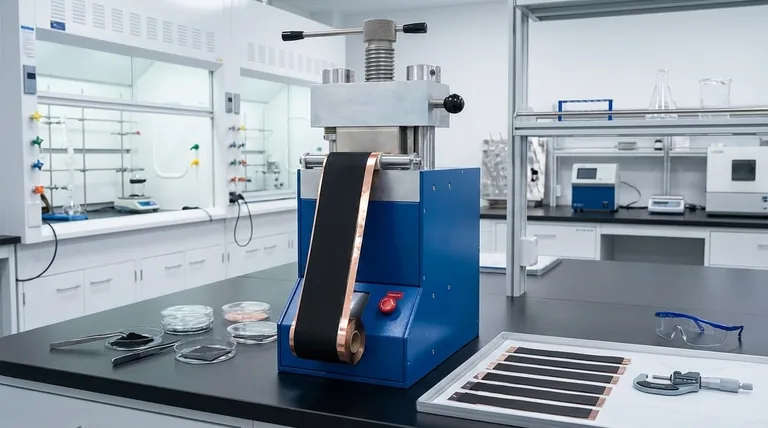
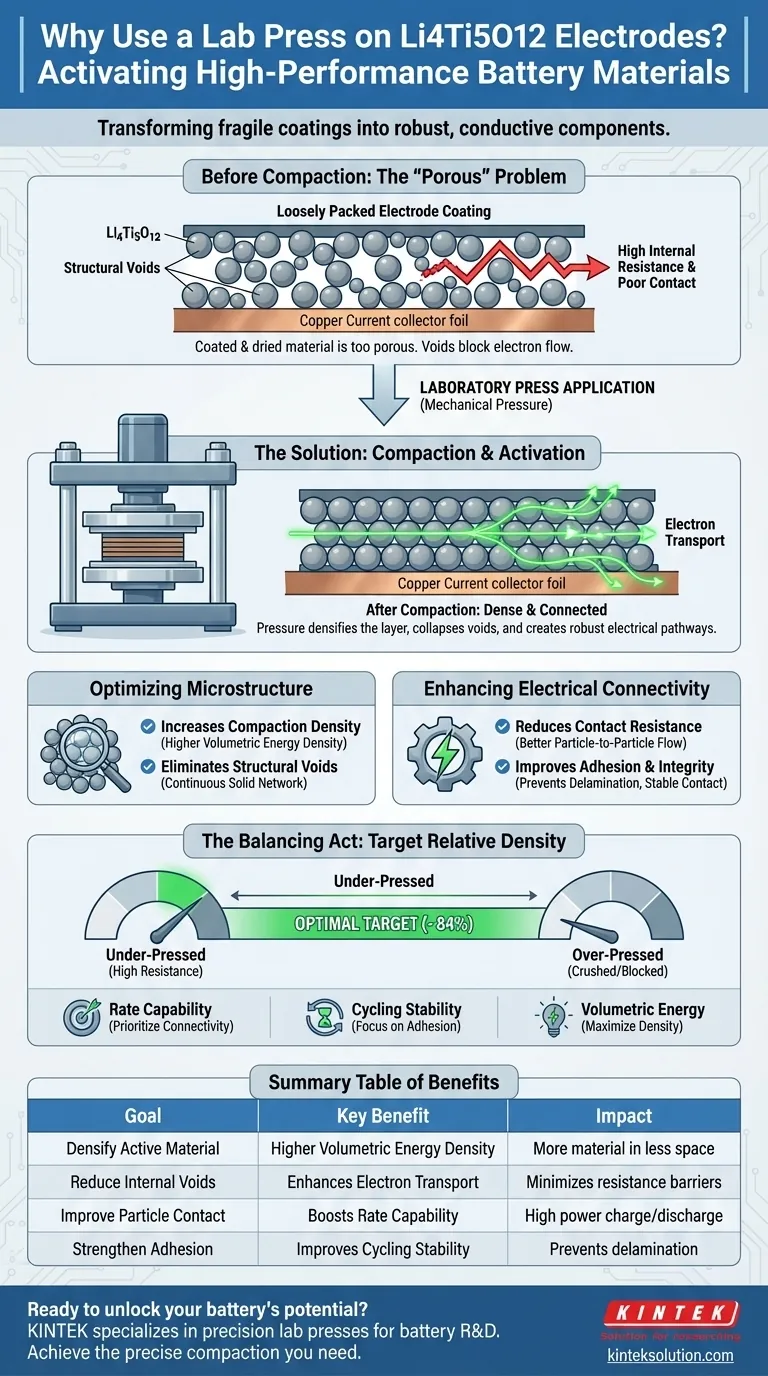
The primary purpose of using a laboratory press machine on Li4Ti5O12 electrodes is to densify the active material layer and establish robust electrical pathways. By applying mechanical pressure to the dried coating, you significantly reduce internal voids, optimize the interface between particles, and ensure firm adhesion to the current collector.
Core Insight Merely coating and drying an electrode is insufficient for high-performance applications; the material remains too porous and loosely connected. Compaction is the activation step that minimizes internal resistance, unlocking the battery's ability to deliver high power (rate capability) and sustain performance over time (cycling stability).
Optimizing Electrode Microstructure
The initial drying process leaves the electrode with a porous structure containing significant voids. The press machine fundamentally alters this microstructure to favor electron transport.
Increasing Compaction Density
The press applies force to pack the active Li4Ti5O12 particles closer together. This process directly increases the compaction density of the electrode coating. By reducing the volume of the electrode while maintaining the same mass, you effectively boost the volumetric energy density.
Eliminating Structural Voids
Dried electrodes naturally contain gaps or "voids" between the active material particles. These voids act as barriers to electron flow. Pressing the electrode mechanically collapses these voids, creating a more continuous solid network that is essential for efficient battery operation.
Enhancing Electrical Connectivity
The chemical potential of Li4Ti5O12 cannot be fully utilized if electrons cannot move freely through the electrode. Compaction addresses the physical barriers to conductivity.
Reducing Contact Resistance
For a battery to function efficiently, electrons must move easily from particle to particle and eventually to the current collector. Compaction enhances the contact area among active material particles and conductive agents. This tighter packing drastically reduces internal contact resistance.
Improving Mechanical Integrity and Adhesion
Pressure plays a vital role in the physical durability of the electrode. It forces the active material layer to adhere more strongly to the current collector foil. This improved adhesion prevents delamination and ensures a stable, low-resistance electrical contact that can withstand the mechanical stresses of repeated charge and discharge cycles.
Understanding the Trade-offs: Porosity vs. Connectivity
While compaction is necessary, it is important to view it as a balancing act rather than a "more is better" scenario.
The Cost of Skipping Compaction If an electrode is not pressed or is under-pressed, the high volume of voids results in excessive internal resistance. This "poor contact" prevents the battery from accurately representing its intrinsic properties, leading to artificially low performance data.
The Goal of "Relative Density" The objective is not to crush the material into a solid block, but to achieve a specific target density (e.g., approximately 84% relative density for certain ionic evaluations). The process is about eliminating unnecessary voids to maximize conductivity without compromising the material's ability to accommodate electrolyte infiltration.
Making the Right Choice for Your Goal
When configuring your laboratory press for Li4Ti5O12 electrodes, your target pressure should align with your specific performance objectives.
- If your primary focus is Rate Capability: Prioritize high compaction to minimize internal resistance, allowing the battery to deliver high capacity at rapid charge/discharge rates.
- If your primary focus is Cycling Stability: Focus on optimizing adhesion to the current collector to ensure the electrode structure retains its integrity over numerous cycles.
- If your primary focus is Volumetric Energy Density: maximize the compaction density to fit more active material into a smaller geometric space.
Ultimately, the laboratory press transforms a fragile, resistive coating into a robust, conductive component capable of high-performance energy storage.
Summary Table:
| Goal of Compaction | Key Benefit | Impact on Electrode |
|---|---|---|
| Densify Active Material | Increases Volumetric Energy Density | Packs more active material into less space |
| Reduce Internal Voids | Enhances Electron Transport | Minimizes barriers to electron flow, reducing resistance |
| Improve Particle Contact | Boosts Rate Capability | Enables high power charge/discharge |
| Strengthen Adhesion | Improves Cycling Stability | Prevents delamination from the current collector |
Ready to transform your electrode coatings into high-performance components?
KINTEK specializes in precision lab press machines (including automatic, isostatic, and heated presses) designed specifically for the demanding needs of battery research and development. Our equipment helps you achieve the precise compaction density, robust adhesion, and low internal resistance critical for evaluating materials like Li4Ti5O12.
Let us help you unlock the true potential of your battery materials.
Contact our experts today to discuss your specific application and find the perfect press for your laboratory.
Visual Guide
Related Products
- Lab Round Bidirectional Press Mold
- Lab Polygon Press Mold
- Lab Cylindrical Press Mold for Laboratory Use
- Square Lab Press Mold for Laboratory Use
- Lab Infrared Press Mold for Laboratory Applications
People Also Ask
- What is the purpose of incorporating cartridge heaters into a lab press mold for MLCC block compression? Optimize Results
- Why is precise cooling management of the lab press mold necessary? Protect Core Integrity in Thermoforming
- What is the function of a pressing tool in thermoplastic panels? Master Precision Shaping & Fusion Bonding
- Why is a high-performance laboratory molding press critical for in-situ electrolyte formation? Unlock Battery Success
- How do the design and geometric precision of pressing molds and mandrels affect the quality of PTFE composite samples?



















