
The primary purpose of using a Cold Isostatic Press (CIP) in the forming stage of Li7La3Zr2O12 (c-LLZO) is to apply uniform, omnidirectional hydrostatic pressure to the ceramic powder. This process creates a "green body" (unsintered compact) with exceptional density homogeneity, effectively resolving the internal density gradients and stress concentrations typically caused by standard uniaxial pressing.
Core Takeaway While uniaxial pressing compacts powder, CIP ensures that compaction is structurally uniform in every direction. This homogeneity is the critical prerequisite for high-temperature sintering, enabling the production of ceramic electrolytes with relative densities up to 90.5% while minimizing the risk of cracking, warping, or low ionic conductivity.
Overcoming the Limitations of Uniaxial Pressing
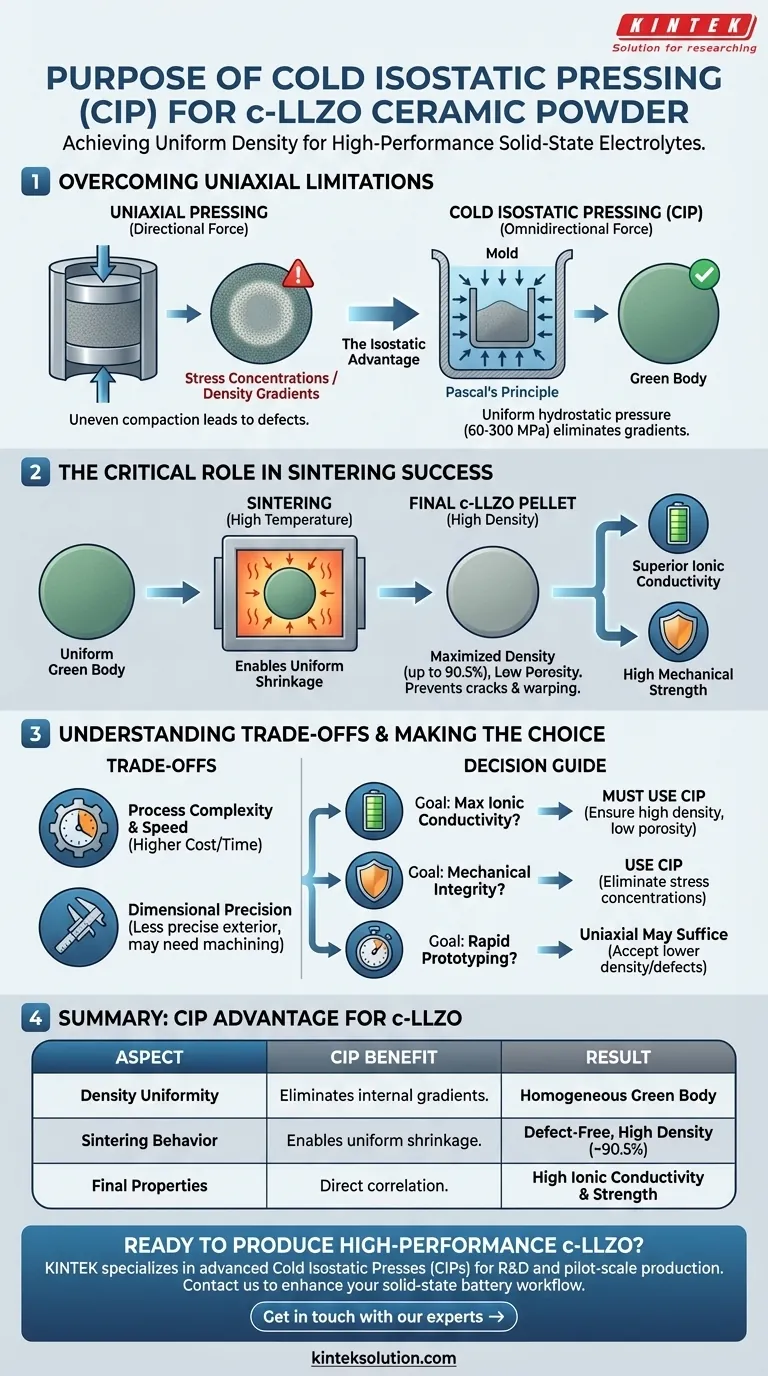
The Challenge of Density Gradients
Standard uniaxial pressing applies force from a single direction (top and bottom).
This often results in uneven compaction, where the center of the pellet is less dense than the edges.
These variations create internal stress concentrations that can lead to defects during subsequent processing.
The Isostatic Advantage
CIP utilizes Pascal’s principle to apply pressure via a liquid medium, ensuring force is exerted equally on the material from all sides.
By subjecting the c-LLZO powder to pressures ranging from 60 MPa to 300 MPa, the process eliminates the voids and gradients inherent in uniaxial pressing.
This results in a microstructure with significantly improved packing density and uniformity.
The Critical Role in Sintering Success
Enabling Uniform Shrinkage
The uniformity achieved during the CIP stage is directly responsible for how the material behaves under heat.
Because the green body has an even density distribution, it shrinks uniformly during the high-temperature sintering phase.
This uniform shrinkage is vital for preventing the formation of cracks and deformation in the final ceramic pellet.
Maximizing Final Density
High contact pressure between particles in the green body facilitates better material transport during sintering.
This "pre-compaction" lays the structural foundation required to achieve low porosity in the final product.
For c-LLZO, high final density is non-negotiable, as it directly correlates to superior ionic conductivity and mechanical strength.
Understanding the Trade-offs
Process Complexity vs. Speed
Incorporating CIP adds a distinct step to the manufacturing workflow, often following an initial uniaxial press.
This increases total processing time and equipment costs compared to using uniaxial pressing alone.
Dimensional Precision
While CIP improves density uniformity, the use of flexible molds means the exterior dimensions of the green body are less precise than rigid-die pressing.
Manufacturers may need to machine or polish the final sintered ceramic to achieve exact geometric tolerances.
Making the Right Choice for Your Goal
When designing your fabrication protocol for c-LLZO electrolytes, consider your specific performance requirements.
- If your primary focus is maximizing ionic conductivity: You must use CIP to ensure high final density and minimize porosity, which hinders ion transport.
- If your primary focus is mechanical integrity: Use CIP to eliminate internal stress concentrations that lead to fracture and cracking during sintering.
- If your primary focus is rapid, low-cost screening: Uniaxial pressing alone may suffice for rough prototyping, provided you accept lower density and a higher risk of defects.
The consistent application of isostatic pressure is the defining factor in transitioning from a loose powder to a high-performance solid-state electrolyte.
Summary Table:
| Aspect | CIP Advantage for c-LLZO |
|---|---|
| Density Uniformity | Eliminates internal gradients and stress concentrations from uniaxial pressing. |
| Sintering Result | Enables uniform shrinkage, preventing cracks and warping; achieves up to 90.5% relative density. |
| Final Property | Directly correlates to higher ionic conductivity and mechanical strength in the solid electrolyte. |
| Typical Pressure Range | 60 MPa to 300 MPa. |
Ready to produce high-performance c-LLZO solid electrolytes with uniform density and superior sintering results?
KINTEK specializes in laboratory press machines, including advanced Cold Isostatic Presses (CIPs) designed for R&D and pilot-scale production of ceramic powders like LLZO. Our equipment ensures the omnidirectional pressure required to eliminate density gradients, providing the critical foundation for high-density, defect-free ceramic components.
Contact us today to discuss how our CIP solutions can enhance your solid-state battery development workflow.
Get in touch with our experts →
Visual Guide
Related Products
- Electric Lab Cold Isostatic Press CIP Machine
- Electric Split Lab Cold Isostatic Pressing CIP Machine
- Automatic Lab Cold Isostatic Pressing CIP Machine
- Manual Cold Isostatic Pressing CIP Machine Pellet Press
- Lab Isostatic Pressing Molds for Isostatic Molding
People Also Ask
- What role do electric lab cold isostatic presses play in industrial contexts? Bridge R&D and Manufacturing with Precision
- What are the applications of electric lab cold isostatic presses in research settings? Advance Material R&D with High-Pressure CIPs
- How does electrical Cold Isostatic Pressing (CIP) contribute to cost savings? Unlock Efficiency and Reduce Expenses
- What are some research applications of electric lab CIPs? Unlock Uniform Powder Densification for Advanced Materials
- What are the characteristics of standard off-the-shelf electric lab CIP solutions? Achieve Immediate, Cost-Effective Processing
















