
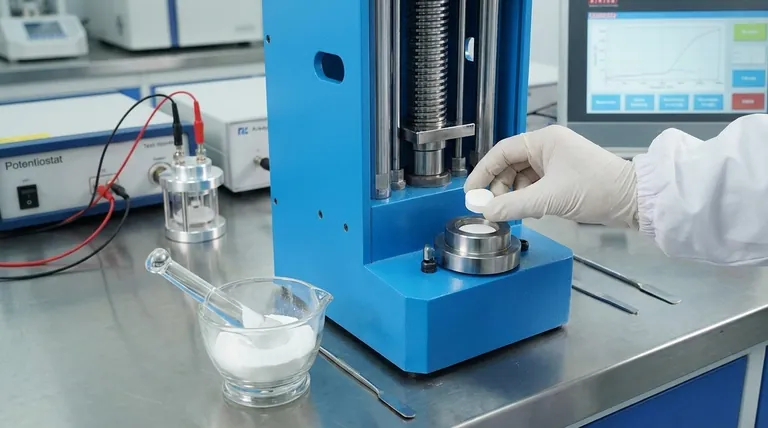
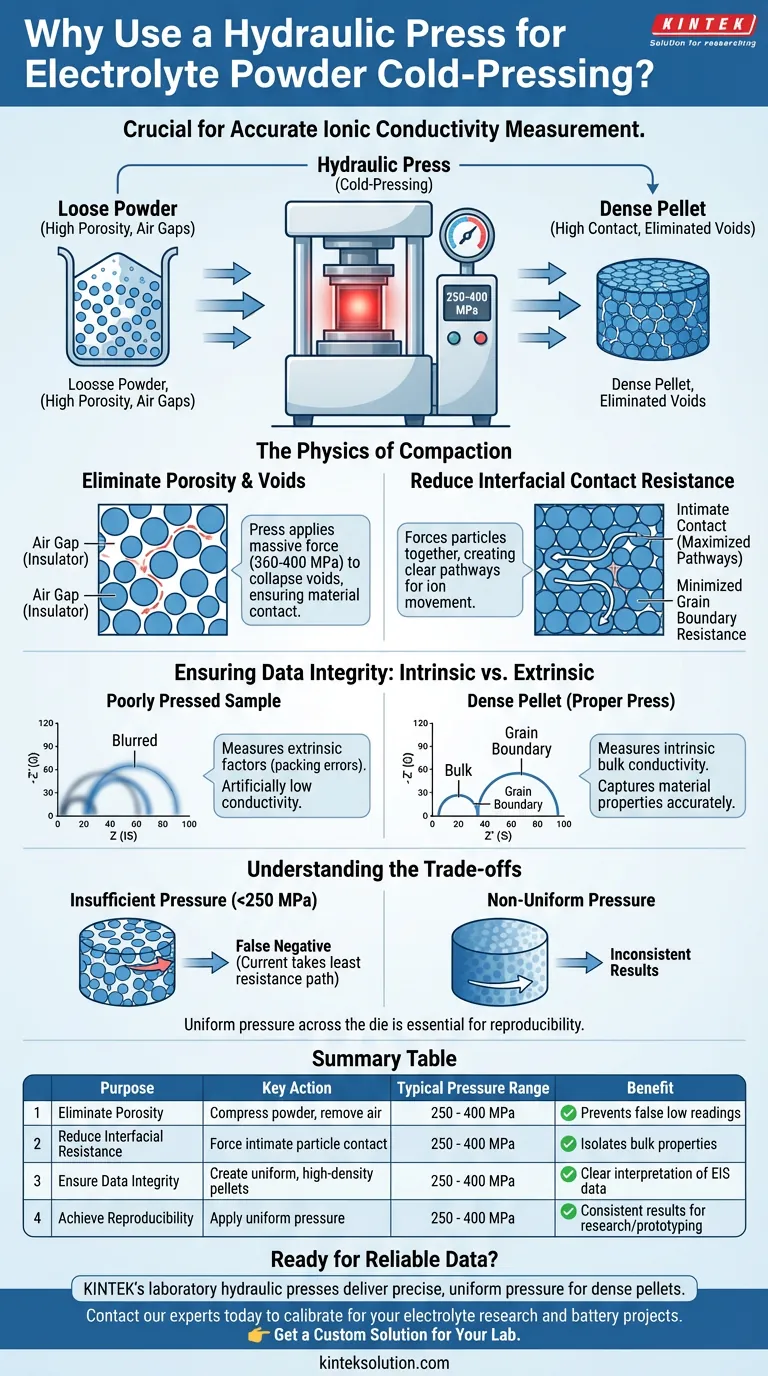
The primary purpose of a laboratory hydraulic press in this context is to mechanically transform loose electrolyte powder into a dense, cohesive solid pellet. By applying high, uniform pressure—often ranging from 250 MPa to 400 MPa—the press eliminates air voids and forces individual particles into intimate physical contact. This densification is the fundamental prerequisite for obtaining valid data, as it ensures the measurement captures the properties of the material itself rather than the resistance of the air gaps between particles.
Core Takeaway: Accurate conductivity measurement requires minimizing the "noise" created by porosity and poor particle contact. Cold-pressing creates a high-density sample where the current travels primarily through the bulk material, allowing you to isolate and measure the intrinsic ionic conductivity without interference from grain boundary resistance.
The Physics of Powder Compaction
Eliminating Porosity and Voids
Loose electrolyte powders naturally contain significant amounts of empty space, or porosity. Air is an electrical insulator, meaning these voids act as barriers to ion transport.
A hydraulic press applies massive force to collapse these voids. References indicate that pressures such as 360 MPa or 400 MPa are often required to achieve a relative density sufficient for testing (e.g., ~84%).
Reducing Interfacial Contact Resistance
Simply packing powder into a tube is insufficient because the particles barely touch. This lack of contact creates high interfacial contact resistance.
By cold-pressing the powder into a pellet, you mechanically force the grain boundaries together. This intimate contact maximizes the pathways available for ions to move from one particle to the next.
Ensuring Data Integrity
Measuring Intrinsic vs. Extrinsic Properties
The goal of material research is to determine the intrinsic bulk conductivity—how well the specific chemical structure conducts ions.
If the sample is not pressed effectively, the measurement will reflect extrinsic factors, such as how loosely the powder was packed. A dense pellet ensures the data reflects the chemistry of the material, not the physical state of the sample preparation.
Interpreting Electrochemical Impedance Spectroscopy (EIS)
Conductivity is typically measured using EIS. To interpret EIS data correctly, you must be able to distinguish between bulk resistance and grain boundary resistance.
A poorly pressed sample blurs these lines, resulting in artificially low conductivity values. High-density compaction minimizes the grain boundary contribution, making the bulk signal clear and quantifiable.
Understanding the Trade-offs
The Consequence of Insufficient Pressure
If the applied pressure is too low (e.g., significantly below the 250-400 MPa benchmarks), the pellet will retain internal porosity.
This leads to "false negatives" in your data. You may incorrectly conclude a material is a poor conductor when, in reality, the material is excellent but the pellet quality is poor.
Uniformity and Reproducibility
The press must apply uniform pressure across the entire die surface (e.g., a 10mm diameter).
Non-uniform pressing creates density gradients within the pellet. This causes the current to take the path of least resistance, leading to inconsistent results that cannot be reproduced in subsequent tests.
How to Apply This to Your Project
The hydraulic press is not just a shaping tool; it is a calibration device for your sample's physical state. Depending on your specific research goals, your approach to pressing may shift slightly.
- If your primary focus is Material Characterization: Prioritize maximum safe pressure (e.g., 360-400 MPa) to eliminate nearly all porosity and measure the absolute limit of intrinsic conductivity.
- If your primary focus is Battery Prototyping: Focus on pressing to create a stable solid-solid interface that mimics the tight integration required between the electrolyte and the electrodes in a full cell.
Ultimately, the validity of your conductivity data is directly proportional to the density of your pellet; without a proper press, you are measuring the gaps, not the material.
Summary Table:
| Purpose | Key Action | Typical Pressure Range | Benefit for Measurement |
|---|---|---|---|
| Eliminate Porosity | Compress loose powder to remove air voids | 250 - 400 MPa | Reduces insulating air gaps, preventing false low conductivity readings |
| Reduce Interfacial Resistance | Force particles into intimate contact | 250 - 400 MPa | Minimizes grain boundary resistance, isolating bulk material properties |
| Ensure Data Integrity | Create uniform, high-density pellets | 250 - 400 MPa | Enables clear interpretation of Electrochemical Impedance Spectroscopy (EIS) data |
| Achieve Reproducibility | Apply uniform pressure across the die | 250 - 400 MPa | Provides consistent, reliable results for material characterization and battery prototyping |
Ready to eliminate measurement errors and achieve reliable ionic conductivity data?
Your research on powdered electrolytes deserves the highest data integrity. KINTEK's laboratory hydraulic presses (including automatic, isostatic, and heated models) are engineered to deliver the precise, uniform pressure (250-400 MPa) required to create dense, cohesive pellets—ensuring you measure the true intrinsic properties of your material, not the artifacts of poor sample preparation.
Contact our experts today to discuss how our lab press solutions can be calibrated for your specific electrolyte research and battery development projects. Let's ensure your conductivity measurements are accurate and reproducible.
👉 Get a Custom Solution for Your Lab
Visual Guide
Related Products
- Laboratory Hydraulic Press 2T Lab Pellet Press for KBR FTIR
- Automatic Laboratory Hydraulic Press for XRF and KBR Pellet Pressing
- Lab Round Bidirectional Press Mold
- Automatic Laboratory Hydraulic Press Lab Pellet Press Machine
- Laboratory Hydraulic Press Lab Pellet Press Machine for Glove Box
People Also Ask
- What is the role of a laboratory pressure machine and KBr in FTIR? Master Sample Preparation for Flame Retardants
- What is the role of a laboratory hydraulic press in high-loading NCM811 cathode prep for solid-state batteries?
- Why is a laboratory hydraulic press necessary for sample preparation? Precise Pelleting for Spiro Heterocyclic Analysis
- What role does a laboratory hydraulic press play in reaction pellets? Optimizing Lunar Soil and Metal Fuel Density
- What are the general applications of a laboratory hydraulic press? Maximize Precision in Material Research



















