Knowledge What is the purpose of using an isostatic lamination process for electrodes infiltrated with a plastic crystal polymer electrolyte? Achieve Superior Solid-State Battery Performance
Author avatar

Tech Team · Kintek Press

Updated 3 days ago

What is the purpose of using an isostatic lamination process for electrodes infiltrated with a plastic crystal polymer electrolyte? Achieve Superior Solid-State Battery Performance


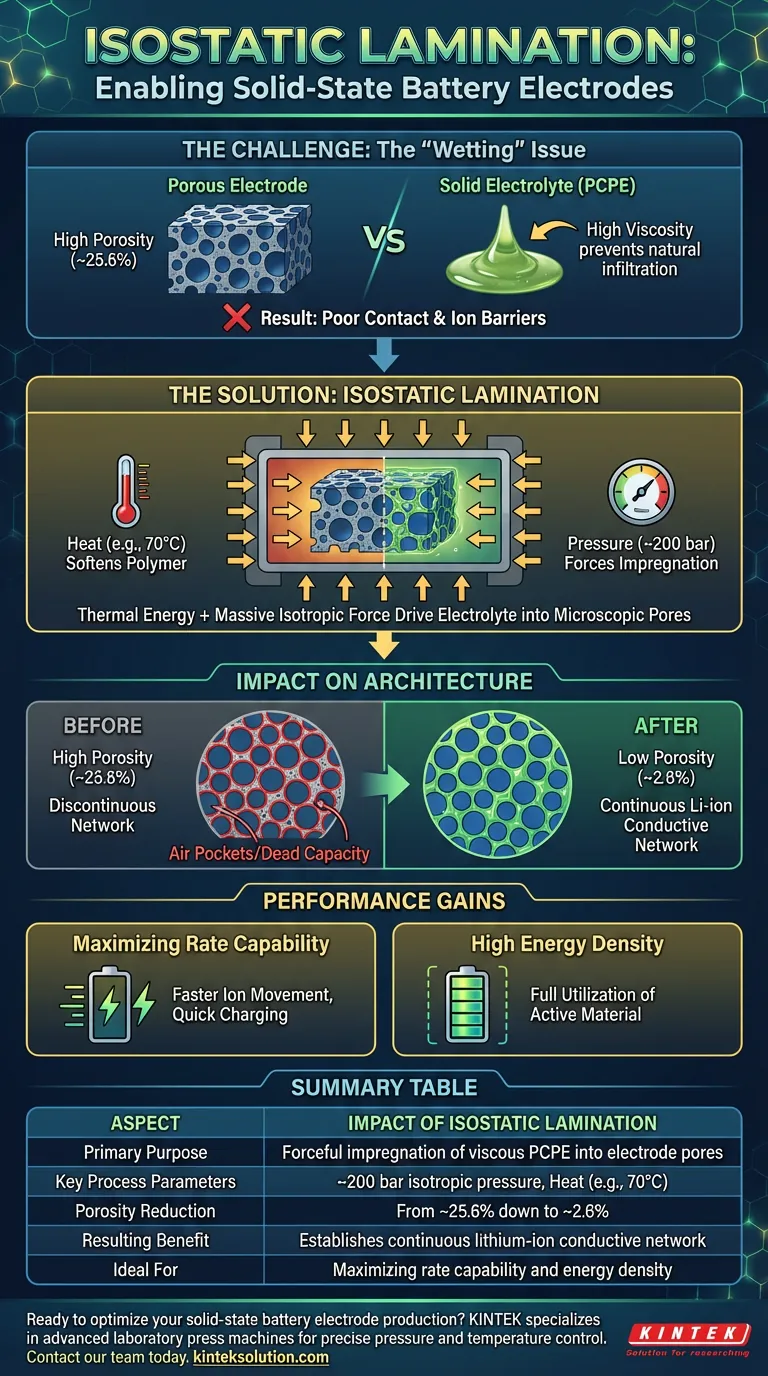
The primary purpose of isostatic lamination is to forcefully impregnate electrode structures with viscous plastic crystal polymer electrolyte (PCPE) to ensure complete physical contact. By applying significant, uniform pressure (often around 200 bar) alongside heat, this process drives the electrolyte melt deep into microscopic pores that viscous polymers cannot penetrate via capillary action alone.

Core Takeaway Solid-state electrolytes often struggle to interface with active materials due to their high viscosity. Isostatic lamination solves this fundamental "wetting" challenge, reducing electrode porosity by nearly 90% to establish the continuous lithium-ion conductive network essential for high-capacity battery performance.
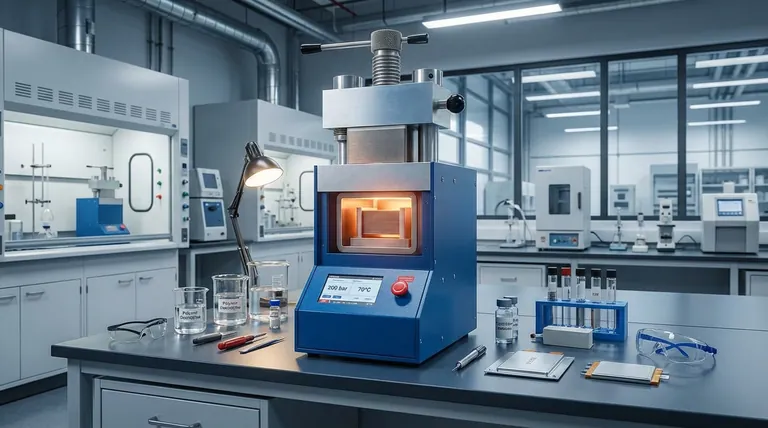
What is the purpose of using an isostatic lamination process for electrodes infiltrated with a plastic crystal polymer electrolyte? Achieve Superior Solid-State Battery Performance

The Mechanics of Infiltration

Overcoming High Viscosity

Unlike liquid electrolytes, PCPE melts are highly viscous. They do not naturally soak into the dense, intricate structures of an electrode.

To overcome this resistance, the isostatic process utilizes thermal energy (e.g., 70°C). This heat softens the polymer, transitioning it into a melt state where flow is possible.

Applying Isotropic Force

Heat alone is insufficient for deep penetration. The process applies a massive isotropic pressure, meaning the force is applied equally from all directions.

At pressures such as 200 bar, the softened electrolyte is mechanically forced into the smallest voids of the electrode. This ensures uniform impregnation throughout the entire volume of the material, rather than just the surface layers.

Impact on Battery Architecture

Drastic Reduction in Porosity

The most measurable impact of this technique is the minimization of residual porosity (empty space/air pockets).

Without this pressure, electrodes retain significant voids which act as barriers to ion movement. Isostatic lamination can reduce the porosity of an NCM electrode from 25.6% down to 2.6%.

Establishing the Conductive Network

By eliminating these voids, the process creates a comprehensive lithium-ion conductive network.

Every particle of the active material becomes fully surrounded by the electrolyte. This intimate contact is the critical factor that improves the rate capability (charging speed) and overall capacity utilization of solid-state batteries.

Operational Considerations

Equipment Intensity

Implementing this process requires specialized equipment capable of maintaining high pressure and temperature simultaneously.

Unlike standard roll-pressing used in liquid electrolyte battery manufacturing, isostatic lamination adds a distinct, energy-intensive step to the production line to ensure the electrolyte "fill" is successful.

Thermal Sensitivity

The process relies on precise thermal control. The temperature must be high enough to melt the polymer for infiltration but controlled enough to avoid degrading the active electrode materials or the polymer itself.

Making the Right Choice for Your Goal

The decision to utilize isostatic lamination is driven by the specific performance requirements of your solid-state cell.

  • If your primary focus is Maximizing Rate Capability: You must use this process to eliminate resistive air gaps and ensure ions have a continuous path to travel.
  • If your primary focus is High Energy Density: You should leverage this technique to maximize the volume of active material utilized, as un-wetted pores result in "dead" capacity.

Isostatic lamination is not merely a manufacturing step; it is the enabling technology that allows viscous solid electrolytes to function effectively within porous electrodes.

Summary Table:

Aspect Impact of Isostatic Lamination
Primary Purpose Forceful impregnation of viscous PCPE into electrode pores
Key Process Parameters ~200 bar isotropic pressure, heat (e.g., 70°C)
Porosity Reduction From ~25.6% down to ~2.6%
Resulting Benefit Establishes a continuous lithium-ion conductive network
Ideal For Maximizing rate capability and energy density in solid-state batteries

Ready to optimize your solid-state battery electrode production? The isostatic lamination process is critical for achieving the complete electrode-electrolyte contact necessary for high performance. KINTEK specializes in advanced laboratory press machines, including isostatic presses and heated lab presses, designed to meet the precise pressure and temperature requirements of cutting-edge battery research and development. Let our expertise help you build a better battery. Contact our team today to discuss your specific needs!

Visual Guide
What is the purpose of using an isostatic lamination process for electrodes infiltrated with a plastic crystal polymer electrolyte? Achieve Superior Solid-State Battery Performance Visual Guide

Related Products

People Also Ask

Related Products

Automatic Lab Cold Isostatic Pressing CIP Machine

Automatic Lab Cold Isostatic Pressing CIP Machine

High-efficiency Automatic Cold Isostatic Press (CIP) for precise lab sample preparation. Uniform compaction, customizable models. Contact KINTEK experts today!

Electric Split Lab Cold Isostatic Pressing CIP Machine

Electric Split Lab Cold Isostatic Pressing CIP Machine

KINTEK Lab Electric Cold Isostatic Press ensures precise sample preparation with uniform pressure. Ideal for material science, pharmaceuticals, and electronics. Explore models now!

Electric Lab Cold Isostatic Press CIP Machine

Electric Lab Cold Isostatic Press CIP Machine

KINTEK's Lab Electric Isostatic Cold Press delivers precision, efficiency, and superior sample quality for advanced research. Explore customizable models today!

Lab Isostatic Pressing Molds for Isostatic Molding

Lab Isostatic Pressing Molds for Isostatic Molding

High-quality isostatic pressing molds for lab presses - achieve uniform density, precision components, and advanced material research. Explore KINTEK's solutions now!

Manual Cold Isostatic Pressing CIP Machine Pellet Press

Manual Cold Isostatic Pressing CIP Machine Pellet Press

KINTEK Lab Manual Isostatic Press ensures superior sample uniformity & density. Precision control, durable construction, and versatile forming for advanced lab needs. Explore now!

Laboratory Hydraulic Press Lab Pellet Press Machine for Glove Box

Laboratory Hydraulic Press Lab Pellet Press Machine for Glove Box

Precision lab press for glove boxes: Compact, leak-proof design with digital pressure control. Ideal for inert atmosphere material processing. Explore now!

Laboratory Hydraulic Press Lab Pellet Press Button Battery Press

Laboratory Hydraulic Press Lab Pellet Press Button Battery Press

KINTEK Lab Press Machines: Precision hydraulic presses for material research, pharmacy, and electronics. Compact, durable, and low maintenance. Get expert advice today!

Manual Laboratory Hydraulic Press Lab Pellet Press

Manual Laboratory Hydraulic Press Lab Pellet Press

KINTEK's Protective Manual Lab Hydraulic Press ensures safe, precise sample preparation with durable construction, versatile applications, and advanced safety features. Ideal for labs.

Laboratory Hydraulic Press 2T Lab Pellet Press for KBR FTIR

Laboratory Hydraulic Press 2T Lab Pellet Press for KBR FTIR

KINTEK 2T Lab Hydraulic Press for precise FTIR sample prep, durable KBr pellet creation, and versatile material testing. Ideal for research labs.

Manual Laboratory Hydraulic Pellet Press Lab Hydraulic Press

Manual Laboratory Hydraulic Pellet Press Lab Hydraulic Press

Boost lab efficiency with KINTEK's precision hydraulic presses—compact, leak-proof, and ideal for spectroscopy. Custom solutions available.

Laboratory Hydraulic Split Electric Lab Pellet Press

Laboratory Hydraulic Split Electric Lab Pellet Press

KINTEK Split Electric Lab Press: Precision sample preparation for research. Compact, versatile, with advanced pressure control. Ideal for material studies.

Automatic Laboratory Hydraulic Press for XRF and KBR Pellet Pressing

Automatic Laboratory Hydraulic Press for XRF and KBR Pellet Pressing

KinTek XRF Pellet Press: Automated sample prep for precise XRF/IR analysis. High-quality pellets, programmable pressure, durable design. Boost lab efficiency today!

Assemble Lab Cylindrical Press Mold for Laboratory Use

Assemble Lab Cylindrical Press Mold for Laboratory Use

Premium lab cylindrical press mold for flawless sample prep. Prevents delamination, ultra-durable Japanese steel. Custom sizes available. Get yours now!

Heated Hydraulic Press Machine with Heated Plates for Vacuum Box Laboratory Hot Press

Heated Hydraulic Press Machine with Heated Plates for Vacuum Box Laboratory Hot Press

KINTEK Heated Hydraulic Lab Press with Vacuum Box ensures precise sample preparation. Compact, durable, and featuring digital pressure control for superior results.

Laboratory Split Manual Heated Hydraulic Press Machine with Hot Plates

Laboratory Split Manual Heated Hydraulic Press Machine with Hot Plates

Boost lab efficiency with KINTEK's heated lab presses—precise temperature control, durable design, and rapid cooling for consistent results. Explore now!

Lab Cylindrical Press Mold with Scale

Lab Cylindrical Press Mold with Scale

KINTEK's Cylindrical Press Mold ensures precision material processing with uniform pressure, versatile shapes, and optional heating. Ideal for labs and industries. Get expert advice now!

Laboratory Hydraulic Pellet Press for XRF KBR FTIR Lab Press

Laboratory Hydraulic Pellet Press for XRF KBR FTIR Lab Press

KINTEK Lab Press Machines: Precision hydraulic presses for sample prep. Automatic, heated, and isostatic models for research labs. Get expert advice now!

Lab Anti-Cracking Press Mold

Lab Anti-Cracking Press Mold

Precision Anti-Cracking Press Mold for lab use. Durable Cr12MoV steel, high-pressure resistant, customizable sizes. Ideal for material testing. Get yours now!

Special Shape Lab Press Mold for Laboratory Applications

Special Shape Lab Press Mold for Laboratory Applications

Special Shape Press Molds for precise lab applications. Customizable, high-pressure performance, and versatile shapes. Ideal for ceramics, pharmaceuticals, and more. Contact KINTEK today!

Automatic Heated Hydraulic Press Machine with Hot Plates for Laboratory

Automatic Heated Hydraulic Press Machine with Hot Plates for Laboratory

KINTEK Automatic Lab Heat Press: Precision heating, programmable control, and rapid cooling for efficient sample preparation. Enhance lab productivity today!


Leave Your Message



















