
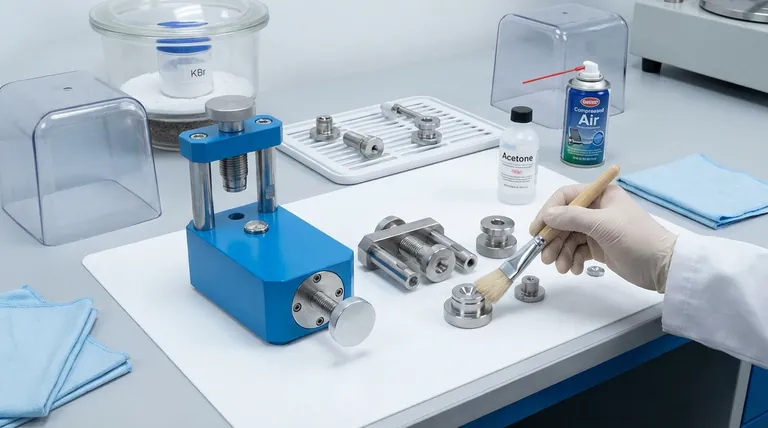
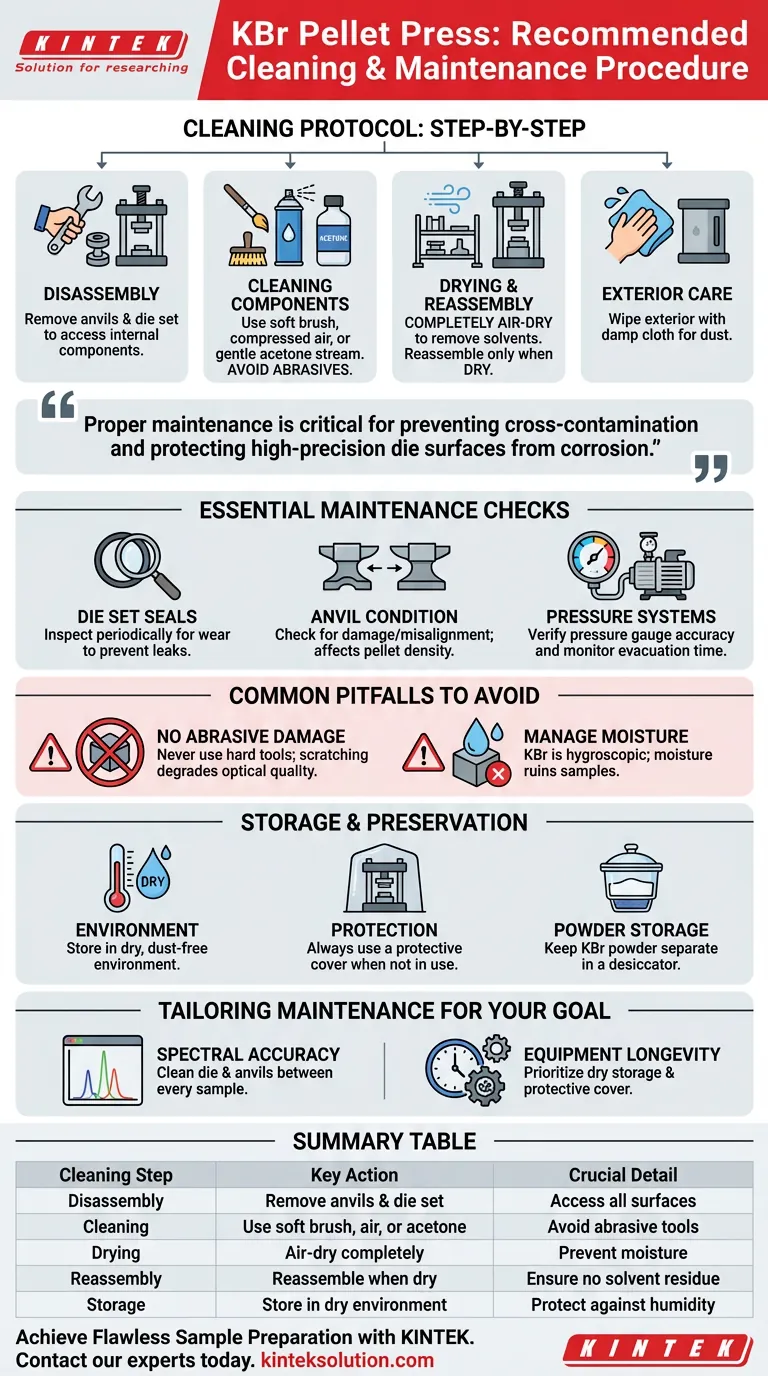
The recommended cleaning procedure for a KBr Pellet Press requires disassembling the unit to remove the anvils and die set, then cleaning these internal components using a soft brush, compressed air, or a gentle stream of acetone. You must ensure all components are completely air-dried to remove any solvents before reassembling the press. For the exterior housing, simply wipe it down with a damp cloth to remove environmental dust.
Proper maintenance is not just about hygiene; it is critical for preventing cross-contamination in spectral analysis and protecting high-precision die surfaces from corrosion.
Detailed Cleaning Protocol
Disassembly and Removal
Begin by disassembling the press to access the internal components. You must remove the anvils and die set to ensure you can reach all surfaces where powder residue may have accumulated.
Cleaning the Components
Once the parts are removed, remove residual powder using a soft brush or compressed air. For more stubborn residues, use a gentle stream of acetone. This solvent is effective for dissolving organic contaminants without damaging the metal surfaces.
Drying and Reassembly
After cleaning, allow all parts to air dry thoroughly. Residual moisture or solvent can compromise future samples or cause rust. Only reassemble the press once you are certain every component is dry.
Essential Maintenance Checks
Inspecting Die Set Seals
Periodically inspect the die set seals for signs of wear or physical damage. Compromised seals can lead to pressure leaks, affecting the quality of your pellets.
Verifying Anvil Condition
Check that the anvils are undamaged and correctly aligned. Misalignment or surface imperfections can lead to uneven pressure distribution, resulting in poor pellet density.
Monitoring Pressure Systems
Verify the accuracy of the pressure gauge regularly. Additionally, monitor the evacuation time during operation; a change in evacuation time often indicates a vacuum leak or pump issue.
Common Pitfalls to Avoid
Avoiding Abrasive Damage
Never use hard tools or abrasive materials to clean the die or anvils. The reference emphasizes using a soft brush; scratching the polished surfaces of the die will permanently degrade the optical quality of your pressed pellets.
Managing Moisture Risks
While a damp cloth is recommended for the exterior, be extremely cautious about introducing moisture to the internal die components. KBr is hygroscopic, and any water residue left inside the die can ruin subsequent KBr powder mixtures.
Storage and Preservation
Environmental Control
Store the KBr Pellet Press in a dry, dust-free environment. Humidity is the enemy of both the press components and the KBr powder itself.
Protective Measures
Always use a protective cover when the press is not in use. This shields the mechanism from accidental impacts and settling dust.
Powder Storage
Keep the KBr powder separate from the press machinery. It must be stored in a desiccator or sealed container to protect it from moisture, heat, and direct sunlight.
Making the Right Choice for Your Goal
To ensure consistent results and equipment longevity, tailor your maintenance routine to your specific operational focus:
- If your primary focus is Spectral Accuracy: Clean the die set and anvils with acetone and compressed air between every distinct sample to eliminate cross-contamination.
- If your primary focus is Equipment Longevity: Prioritize storing the press under a cover in a dry environment to prevent rust and mechanical seizing.
Routine cleaning and strict moisture control are the foundations of reliable spectroscopy and long-term instrument health.
Summary Table:
| Cleaning Step | Key Action | Crucial Detail |
|---|---|---|
| Disassembly | Remove anvils and die set | Access all surfaces for thorough cleaning |
| Cleaning | Use a soft brush, compressed air, or acetone | Avoid abrasive tools to protect die surfaces |
| Drying | Air-dry all components completely | Prevent moisture from ruining hygroscopic KBr powder |
| Reassembly | Reassemble only when fully dry | Ensure no solvent residue remains |
| Storage | Store in a dry, dust-free environment with a cover | Protect against humidity and physical damage |
Achieve Flawless Sample Preparation with KINTEK
Proper maintenance is key to reliable spectroscopy and long-lasting equipment. KINTEK specializes in high-precision lab press machines, including pellet presses designed for durability and ease of maintenance. Our expertise ensures your laboratory operates at peak efficiency with minimal downtime.
Let us help you protect your investment and ensure the integrity of your analysis.
Contact our experts today to discuss your specific lab needs and discover how our reliable equipment and support can benefit your research.
Visual Guide
Related Products
- Laboratory Hydraulic Press 2T Lab Pellet Press for KBR FTIR
- XRF KBR Plastic Ring Lab Powder Pellet Pressing Mold for FTIR
- XRF KBR Steel Ring Lab Powder Pellet Pressing Mold for FTIR
- Laboratory Hydraulic Pellet Press for XRF KBR FTIR Lab Press
- Automatic Laboratory Hydraulic Press for XRF and KBR Pellet Pressing
People Also Ask
- What is the role of a laboratory pressure machine and KBr in FTIR? Master Sample Preparation for Flame Retardants
- What is the role of a laboratory hydraulic press in high-loading NCM811 cathode prep for solid-state batteries?
- What role does a laboratory hydraulic press play in reaction pellets? Optimizing Lunar Soil and Metal Fuel Density
- Why is a laboratory hydraulic press necessary for sample preparation? Precise Pelleting for Spiro Heterocyclic Analysis
- What are some examples of technical parameter options available for laboratory hydraulic presses? Customizing Your Lab



















