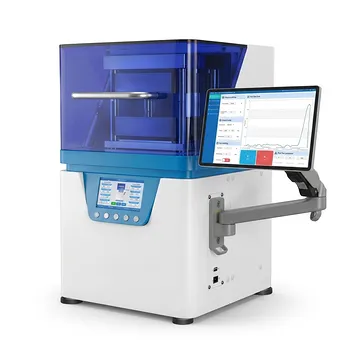
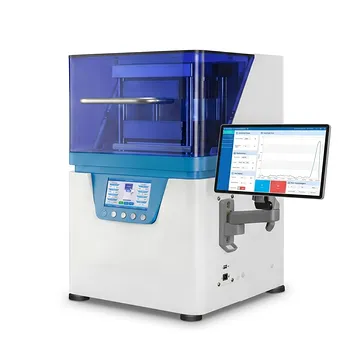
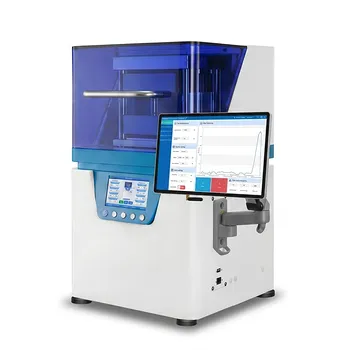
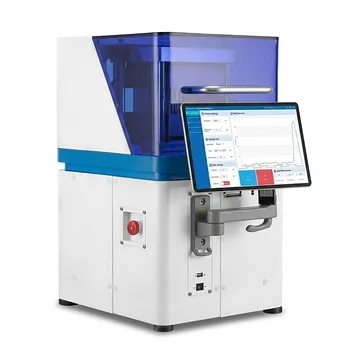
The laboratory hydraulic press is the foundational tool for transforming loose synthesized powders into structured, solid-state specimens known as "green bodies." In the context of strain engineering, this equipment serves as the bridge between chemical synthesis and physical testing. By applying precise, high-pressure loads to powder reagents within a mold, the press creates a high-density foundation that allows researchers to study how a material's physical properties shift under mechanical or lattice-level stress.
Core Takeaway: The role of the hydraulic press is to produce geometrically precise, high-density samples that ensure uniform grain growth and predictable mechanical responses, which are essential for measuring the electrical, optical, and magnetic effects of strain in functional materials.
Creating the Structural Foundation for Strain Analysis
High-Density Compaction of Green Bodies
The hydraulic press is primarily used to compact powder materials into dense green bodies with specific geometric shapes. By applying controlled pressure, the press forces particles into a tight packing arrangement, significantly reducing porosity. This compaction is a prerequisite for subsequent sintering processes, where the material is heated to fuse particles into a bulk solid.
Geometric Precision and Shape Control
In strain engineering, the physical dimensions of a sample are critical for calculating stress and measuring lattice parameter changes. The press allows researchers to use precision molds to create pellets, thin plates, or blocks with preset densities. These standardized shapes ensure that when external strain is applied during testing, the resulting data is reproducible and mathematically sound.
Influence on Macro-Mechanical Stability
The physical compaction process directly determines the stability of the final material’s macroscopic properties. By ensuring a structurally uniform starting specimen, the hydraulic press prevents the formation of internal voids or weak points. This uniformity is vital for functional materials, as it allows the material to withstand the mechanical loads required to study strain-induced phenomena without premature failure.
Facilitating Material Characterization and Performance
Optimizing Grain Growth During Sintering
A well-pressed sample ensures uniform grain growth during the thermal sintering stage. If the initial green body is inconsistent, the final material may exhibit localized variations in density that interfere with strain control experiments. The press provides the stable and adjustable pressure needed to avoid these inconsistencies, resulting in superior electrical, magnetic, or optical performance.
Enhancing Analytical Accuracy
For many functional materials, the hydraulic press is used to create thin flakes or pellets for spectroscopic analysis, such as FT-IR or X-ray fluorescence (XRF). These samples must be free of air pockets to ensure uniform light transmission and accurate results. In electrochemical testing, high-density pressing improves the electrical contact between particles, reducing measurement errors caused by physical form variations.
Sample Preparation for Extreme Environments
Strain engineering often involves testing materials under high pressure or specific temperatures. The hydraulic press ensures the sample is macroscopically stable enough to be handled and mounted into specialized testing rigs. This structural integrity is what allows for the precise measurement of how a material’s lattice responds to the controlled application of strain.
Understanding the Trade-offs and Pitfalls
Pressure Gradients and Internal Stress
One of the primary challenges in powder compaction is the development of pressure gradients within the mold. If the friction between the powder and the mold walls is too high, the center of the pellet may be less dense than the exterior. This non-uniformity can lead to warping or cracking during the sintering process, which compromises the sample's utility for strain engineering.
Risks of Over-Compaction
While high density is generally preferred, applying excessive pressure can lead to mechanical capping or lamination, where the pellet splits into layers upon being ejected from the mold. Furthermore, extreme pressure can occasionally cause unwanted phase transitions in sensitive functional powders before the sintering process even begins. Selecting the "sweet spot" of pressure is a critical technical skill.
Strategic Implementation for Your Research Goals
Making the Right Choice for Your Goal
To achieve the best results in functional material preparation, the application of the hydraulic press should be tailored to the specific end-use of the sample.
- If your primary focus is high-precision strain measurements: Utilize precision-ground molds and slow pressure release cycles to ensure the sample is perfectly symmetrical and free of internal micro-cracks.
- If your primary focus is electrical or magnetic characterization: Prioritize maximizing green body density to ensure the tightest possible particle-to-particle contact, which minimizes resistive losses.
- If your primary focus is spectroscopic or optical clarity: Use highly polished die surfaces and fine-grained powders to produce thin, translucent pellets that optimize light transmission.
The laboratory hydraulic press remains the indispensable starting point for ensuring that the physical state of a functional material is prepared to reveal its true properties under strain.
Summary Table:
| Function | Key Benefit | Research Application |
|---|---|---|
| Powder Compaction | Reduced porosity & high density | Green body formation for sintering |
| Geometric Precision | Uniform stress distribution | Lattice parameter & strain analysis |
| Sample Stabilization | Macro-mechanical stability | Testing in extreme environments |
| Surface Polishing | Optimized light transmission | FT-IR & XRF spectroscopic analysis |
Elevate Your Material Research with KINTEK
Precision is paramount in strain engineering. KINTEK specializes in comprehensive laboratory pressing solutions, offering manual, automatic, heated, multifunctional, and glovebox-compatible models, as well as cold and warm isostatic presses widely applied in battery research. Our high-performance equipment ensures the structural integrity and high density required for breakthrough functional material analysis.
Contact our experts today to find the perfect press tailored to your specific research goals!
References
- D. M. Hoyle, Tom McLeish. Large amplitude oscillatory shear and Fourier transform rheology analysis of branched polymer melts. DOI: 10.1122/1.4881467
This article is also based on technical information from Kintek Solution Knowledge Base .
Related Products
- Laboratory Hydraulic Press Lab Pellet Press Machine for Glove Box
- Laboratory Hydraulic Press 2T Lab Pellet Press for KBR FTIR
- 24T 30T 60T Heated Hydraulic Lab Press Machine with Hot Plates for Laboratory
- Laboratory Hydraulic Press Lab Pellet Press Button Battery Press
- Laboratory Hydraulic Pellet Press for XRF KBR FTIR Lab Press
People Also Ask
- How does a laboratory hydraulic press contribute to the preparation of Li3-3xScxSb samples? Optimize Ionic Conductivity
- What is the function of a laboratory hydraulic press in FT-IR of curcumin-coated MWCNTs? Achieve Optical Clarity.
- Why is a laboratory hydraulic press required for compression molding boron-siloxane? Solve High-Loading Density Challenges
- What role does a laboratory hydraulic press play in the preparation of piezoelectric ceramic discs for DC-PG? | KINTEK
- What role does a laboratory hydraulic press play in reaction pellets? Optimizing Lunar Soil and Metal Fuel Density