
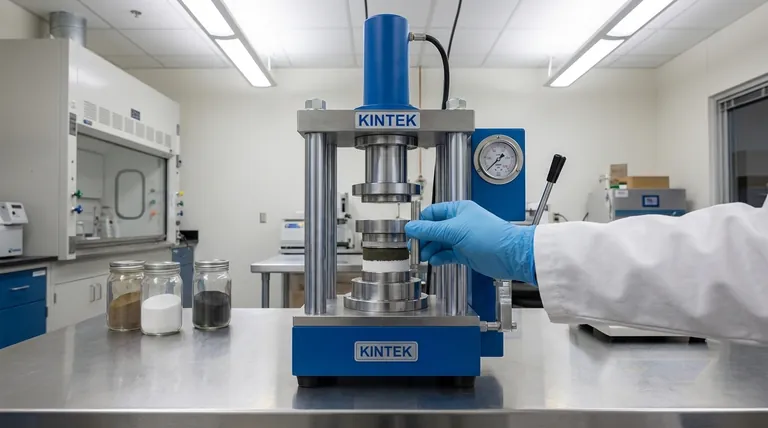
A laboratory hydraulic press functions as the primary interface engineering tool in the assembly of all-solid-state sodium batteries, transforming loose powders and metal sheets into a unified electrochemical system. In a multi-step cold pressing process involving $FeS_2$ (cathode), $Na_3SbS_{3.75}Se_{0.25}$ (electrolyte), and Na (anode), the press applies precise, differential pressures to eliminate voids, leverage material ductility, and minimize interfacial resistance.
Core Insight: The hydraulic press is not merely used for shaping; it replaces the "wetting" action of liquid electrolytes. By applying high pressure (up to 360 MPa) in stages, it mechanically forces solids into intimate atomic contact, creating the low-impedance ion pathways required for the battery to function.
The Mechanics of the Multi-Step Assembly
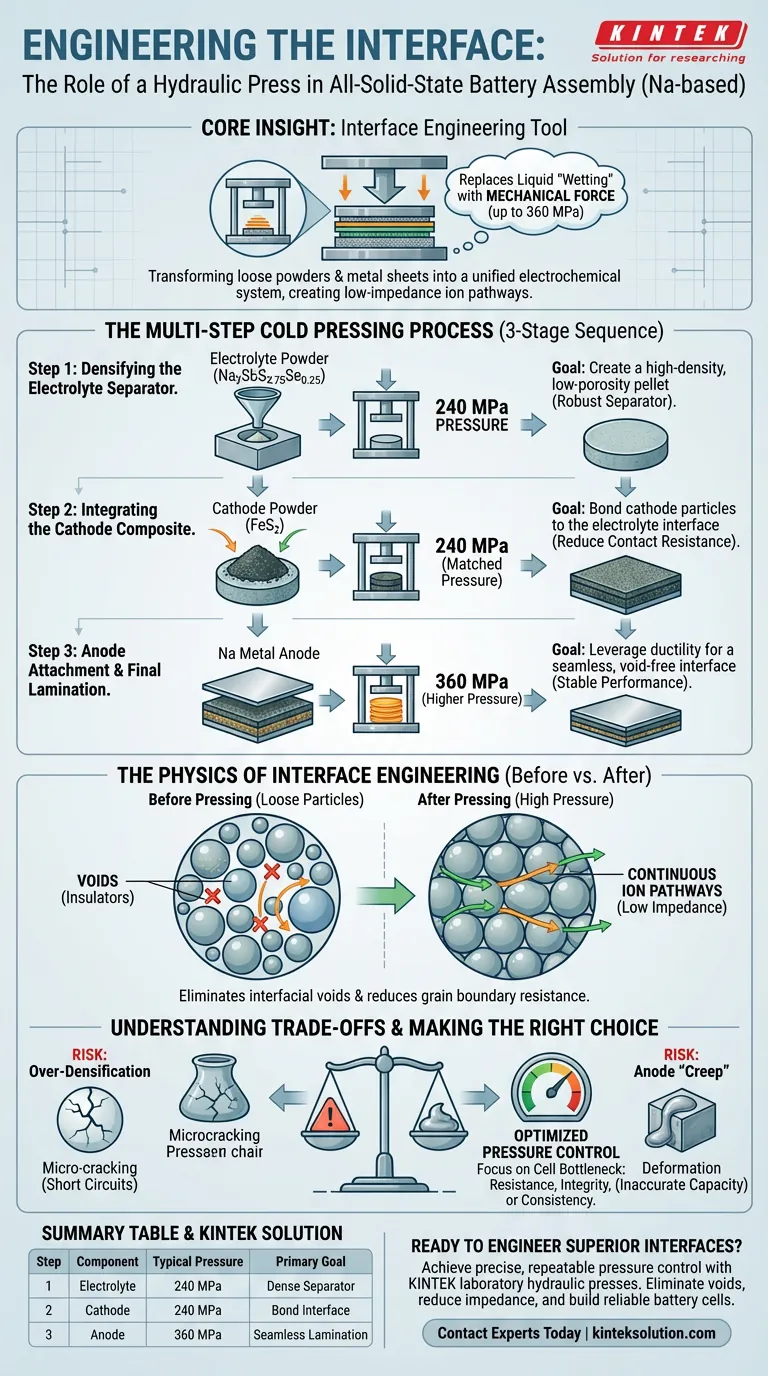
To assemble a functional cell using sodium-based components, the hydraulic press is typically employed in a specific three-stage sequence. This protocol ensures each layer is densified without compromising the structural integrity of the previous layers.
Step 1: Densifying the Electrolyte Separator
The process begins by compacting the solid electrolyte powder (such as $Na_3SbS_{3.75}Se_{0.25}$). The press applies substantial pressure, often around 240 MPa, to this powder within a mold.
The goal is to convert the loose powder into a high-density, low-porosity pellet. This creates a robust physical separator that prevents short circuits while establishing the bulk pathway for ion transport.
Step 2: Integrating the Cathode Composite
Once the electrolyte pellet is formed, the cathode composite powder (containing $FeS_2$) is added onto the separator. The press creates the cathode layer, typically applying the same pressure (approx. 240 MPa) used for the electrolyte.
Matching the pressure prevents damage to the pre-formed electrolyte layer. This step ensures the cathode particles bond intimately with the electrolyte surface, reducing the contact resistance at the cathode-electrolyte interface.
Step 3: Anode Attachment and Final Lamination
The final step involves attaching the sodium ($Na$) metal anode. Because sodium metal is ductile, this step often utilizes higher pressure, such as 360 MPa.
The press leverages the metal's ductility, forcing it to "flow" into surface irregularities. This creates a seamless, void-free interface between the anode and the solid electrolyte, which is critical for stable electrochemical performance.
The Physics of Interface Engineering
The primary challenge in solid-state batteries is the high impedance caused by poor contact between solid particles. The hydraulic press solves two fundamental physical problems.
Eliminating Interfacial Voids
Unlike liquid electrolytes, solids cannot flow into pores. Voids between particles act as insulators, blocking ion movement and increasing internal resistance.
High-pressure cold pressing mechanically collapses these voids. By compacting the $FeS_2$ and $Na_3SbS_{3.75}Se_{0.25}$ particles, the press maximizes the active contact area, facilitating efficient charge transfer.
Creating Continuous Ion Pathways
For a battery to function, ions must move through the bulk material without interruption. Grain boundaries (the edges where particles meet) are often sources of high resistance.
By applying uniform pressure up to 375 MPa, the press forces particles together so tightly that they behave more like a single continuous material. This significantly reduces grain boundary resistance, allowing for accurate measurement of intrinsic ionic conductivity and better overall cell performance.
Understanding the Trade-offs
While pressure is essential, it is a variable that requires careful management. Applying force blindly can lead to failure modes.
The Risk of Over-Densification
Applying excessive pressure to the ceramic-like electrolyte ($Na_3SbS_{3.75}Se_{0.25}$) can cause micro-cracking or fracture. While high density is desired, the material's mechanical limit must be respected to avoid creating internal short circuits.
Anode Deformation "Creep"
Sodium metal is soft. If the final lamination pressure is too high or held for too long, the metal may extrude out of the die or deform excessively. This can alter the geometric area of the electrode, leading to inaccurate calculation of current density and capacity.
Making the Right Choice for Your Assembly
The specific pressures and durations you choose should depend on the specific bottleneck in your cell's performance.
- If your primary focus is Reducing Internal Resistance: Prioritize higher pressures (up to 360 MPa) during the final anode lamination to maximize the sodium metal contact area.
- If your primary focus is Electrolyte Integrity: Cap the initial electrolyte compaction pressure (e.g., at 240-300 MPa) to ensure the separator remains defect-free before adding electrodes.
- If your primary focus is Consistency: Automate the pressure hold times, as the duration of compaction is just as critical as the magnitude for green body uniformity.
Ultimately, the laboratory hydraulic press acts as the defining instrument for cell quality, directly translating mechanical force into electrochemical efficiency.
Summary Table:
| Step | Component | Typical Pressure | Primary Goal |
|---|---|---|---|
| 1 | Electrolyte (Na₃SbS₃.₇₅Se₀.₂₅) | 240 MPa | Create a dense, low-porosity separator pellet |
| 2 | Cathode Composite (FeS₂) | 240 MPa | Bond cathode particles to the electrolyte interface |
| 3 | Anode (Na Metal) | 360 MPa | Create a seamless, void-free anode-electrolyte interface |
Ready to Engineer Superior All-Solid-State Battery Interfaces?
Achieve precise, repeatable pressure control for your multi-step cold pressing processes with a KINTEK laboratory hydraulic press. Our automatic lab presses, isostatic presses, and heated lab presses are engineered to help researchers like you eliminate interfacial voids, reduce impedance, and build reliable battery cells with materials like FeS₂ and Na₃SbS₃.₇₅Se₀.₂₅.
Contact our experts today to discuss how a KINTEK press can become the cornerstone of your battery development lab, delivering the mechanical precision required for breakthrough electrochemical performance.
Visual Guide
Related Products
- Laboratory Hydraulic Press Lab Pellet Press Button Battery Press
- Laboratory Hydraulic Press 2T Lab Pellet Press for KBR FTIR
- Laboratory Hydraulic Press Lab Pellet Press Machine for Glove Box
- 24T 30T 60T Heated Hydraulic Lab Press Machine with Hot Plates for Laboratory
- Automatic Laboratory Hydraulic Press Lab Pellet Press Machine
People Also Ask
- How is a laboratory hydraulic press used for HAP composite gels? Master Mineral Substrate Standardization
- What role does a laboratory hydraulic press play in reaction pellets? Optimizing Lunar Soil and Metal Fuel Density
- What role does a laboratory hydraulic press play in the preparation of piezoelectric ceramic discs for DC-PG? | KINTEK
- Why is a laboratory hydraulic press required for PBAT and PLA sample preparation? Achieve Flawless Characterization
- What role does a laboratory hydraulic press play in the assembly of all-solid-state battery test cells? Expert Guide



















