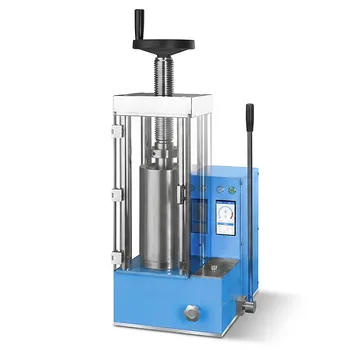
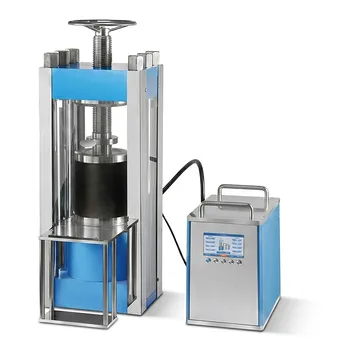
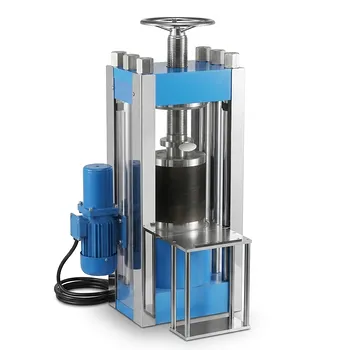
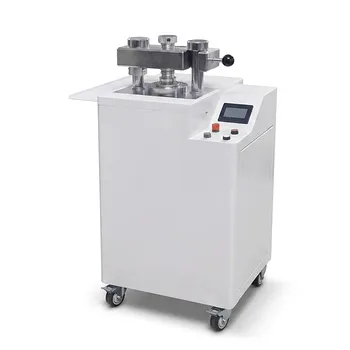
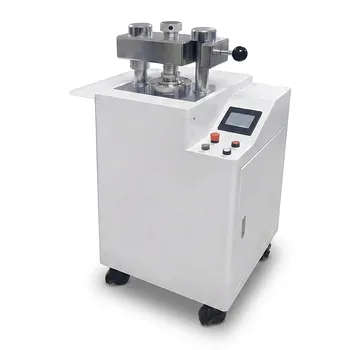
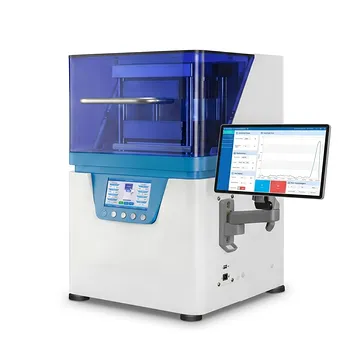
The laboratory static press is the essential bridge between raw material selection and industrial-scale production in the evaluation of Continuous Fiber Reinforced Thermoplastic (CFRT) composites. It provides the critical melting and impregnation power required to force high-viscosity thermoplastic resins into dense fiber architectures, establishing the baseline performance standards needed for subsequent extrusion or injection molding research.
The core role of a laboratory static press is to provide a highly controlled environment for the simultaneous application of heat and pressure. This ensures complete fiber wetting and the elimination of internal voids, creating high-quality specimens that serve as the "gold standard" for material properties.
Achieving Optimal Impregnation and Fiber Wetting
Overcoming Matrix Viscosity
Thermoplastic polymers require significant thermal energy and mechanical force to flow between tightly packed continuous fiber layers. The static press provides the necessary melting power by utilizing heated molds to reach specific processing temperatures, such as 230°C, ensuring the resin reaches its optimal flow state.
Ensuring Full Layer Penetration
Unlike short-fiber composites, CFRTs rely on the matrix fully penetrating multiple layers of glass or carbon fiber fabric. The static press applies constant, uniform pressure that forces the molten polymer into the interstitial spaces of the fabric, ensuring that every filament is encapsulated.
Eliminating Internal Defects
By maintaining rigorous control over the compression cycle, the press effectively discharges residual air and volatiles trapped between layers. This process eliminates internal air bubbles and voids that would otherwise act as stress concentrators and compromise the mechanical integrity of the final part.
Establishing Performance Benchmarks
Creating Reference Standards for Extrusion
The primary role of the static press in an R&D environment is to define what the material is capable of under "perfect" conditions. This data acts as a performance reference standard, allowing researchers to evaluate whether subsequent continuous processes, like extrusion, are achieving the material's theoretical potential.
Precision Control of Physical Properties
Laboratory presses allow for the precise adjustment of pressure—often ranging from 0.7 MPa to 10 MPa or several tons—enabling the production of sheets with uniform thickness and density. This precision is critical for preparing high-quality test specimens used in topology optimization and mechanical characterization.
Managing the Thermal Cycle and Curing
For thermoplastic matrices, the press manages the transition from a molten state to a solid-state; for hybrid or thermoset systems, it guides the precise curing reaction. Staged heating and cooling controls ensure consistent physical properties throughout the composite sheet, preventing warping or residual internal stresses.
Understanding the Trade-offs
Static vs. Dynamic Processing
While a static press is superior for establishing baselines, it does not perfectly replicate the shear forces or material flow dynamics found in continuous extrusion or injection molding. Results obtained in a static environment may show higher mechanical properties than those achieved in high-speed production due to the longer "dwell times" available for impregnation.
Batch Limitations and Scalability
The laboratory press is a batch process tool, meaning it cannot evaluate the effects of continuous throughput or the thermal stability of the resin over long production runs. It is an ideal tool for material verification and specimen preparation, but it cannot replace the need for pilot-scale testing of dynamic manufacturing processes.
How to Apply This to Your Project
Integrating the Press into Your Workflow
To maximize the value of laboratory static pressing in your CFRT evaluation, align your press parameters with your ultimate production goals.
- If your primary focus is Material R&D: Use the static press to determine the absolute maximum mechanical properties achievable for a specific fiber-resin combination.
- If your primary focus is Process Optimization: Use the press to establish the minimum pressure and temperature thresholds required for full impregnation before moving to extrusion.
- If your primary focus is Quality Control: Produce standardized hand-sheets to verify that incoming raw materials meet the morphological and strength requirements for your application.
The laboratory static press remains the definitive tool for stripping away process variables and understanding the true structural potential of continuous fiber reinforced composites.
Summary Table:
| Feature | Role in CFRT Evaluation | Key Benefit |
|---|---|---|
| High Pressure | Forces resin into dense fiber architectures | Ensures full layer penetration and wetting |
| Controlled Heat | Overcomes high thermoplastic matrix viscosity | Eliminates internal air bubbles and voids |
| Static Cycle | Maintains constant temperature/pressure | Creates the "gold standard" for performance |
| Precision Control | Manages heating, cooling, and curing phases | Produces uniform specimen thickness and density |
Elevate Your Composite Research with KINTEK
Precision is paramount in CFRT evaluation and battery research. KINTEK specializes in comprehensive laboratory pressing solutions, offering manual, automatic, heated, multifunctional, and glovebox-compatible models, as well as cold and warm isostatic presses. Our equipment is designed to help you achieve perfect impregnation and establish the rigorous benchmarks required for industrial-scale success.
Ready to optimize your material R&D? Contact KINTEK Experts Today to find the ideal pressing solution for your lab!
References
- Puch Florian, Bastian Richter. Influence of the processing on the properties of continuous fiber reinforced thermoplastic sheets prepared by extrusion. DOI: 10.1063/5.0168183
This article is also based on technical information from Kintek Solution Knowledge Base .
Related Products
- Electric Isostatic Pressing Machine 40 Tons Automatic Laboratory Powder Compacting Press
- Automatic Lab Cold Isostatic Pressing CIP Machine
- Split Hot Isostatic Pressing Machine 150 Ton Laboratory Heated Isostatic Press
- Electric Split Lab Cold Isostatic Pressing CIP Machine
- Electric Lab Cold Isostatic Press CIP Machine
People Also Ask
- What are the key characteristics of the isostatic pressing process? Unlock Uniform Density and Complex Geometries
- Why is vacuum-sealed packaging necessary before isostatic pressing of CuPc thin films? Protect Integrity & Uniformity
- How is pressure applied to the material during isostatic pressing? Master Uniform Density and Complex Geometries
- How does pressure distribute during isostatic pressing of aluminum? Achieve Uniform Density for Your Lab Materials
- What are the applications of isostatic pressing in the automotive industry? Precision Manufacturing for High-Performance Parts