
High pressurization rates are the catalyst for superior material density. In automated Cold Isostatic Pressing (CIP) systems, the ability to rapidly increase pressure—typically within seconds—is critical for efficiently consolidating metal powders. This rapid application of force ensures that particles consolidate uniformly, directly resulting in a more homogeneous microstructure and higher green strength in the final compact.
Rapid pressurization prevents density gradients during consolidation, ensuring that metal powders lock together uniformly to create parts with superior structural integrity and strength.
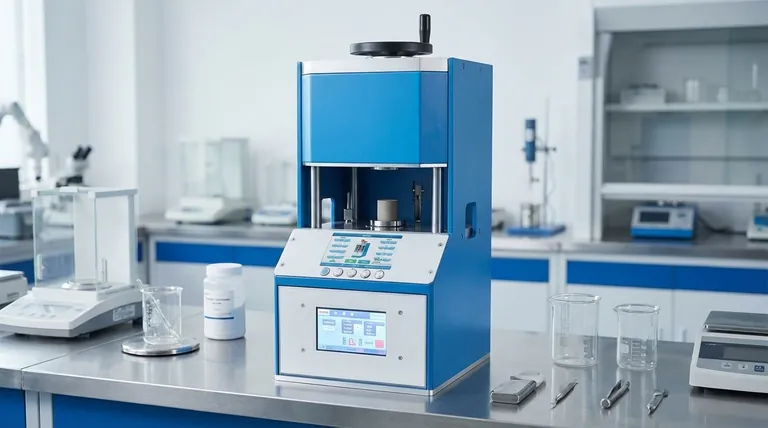
The Impact on Material Properties
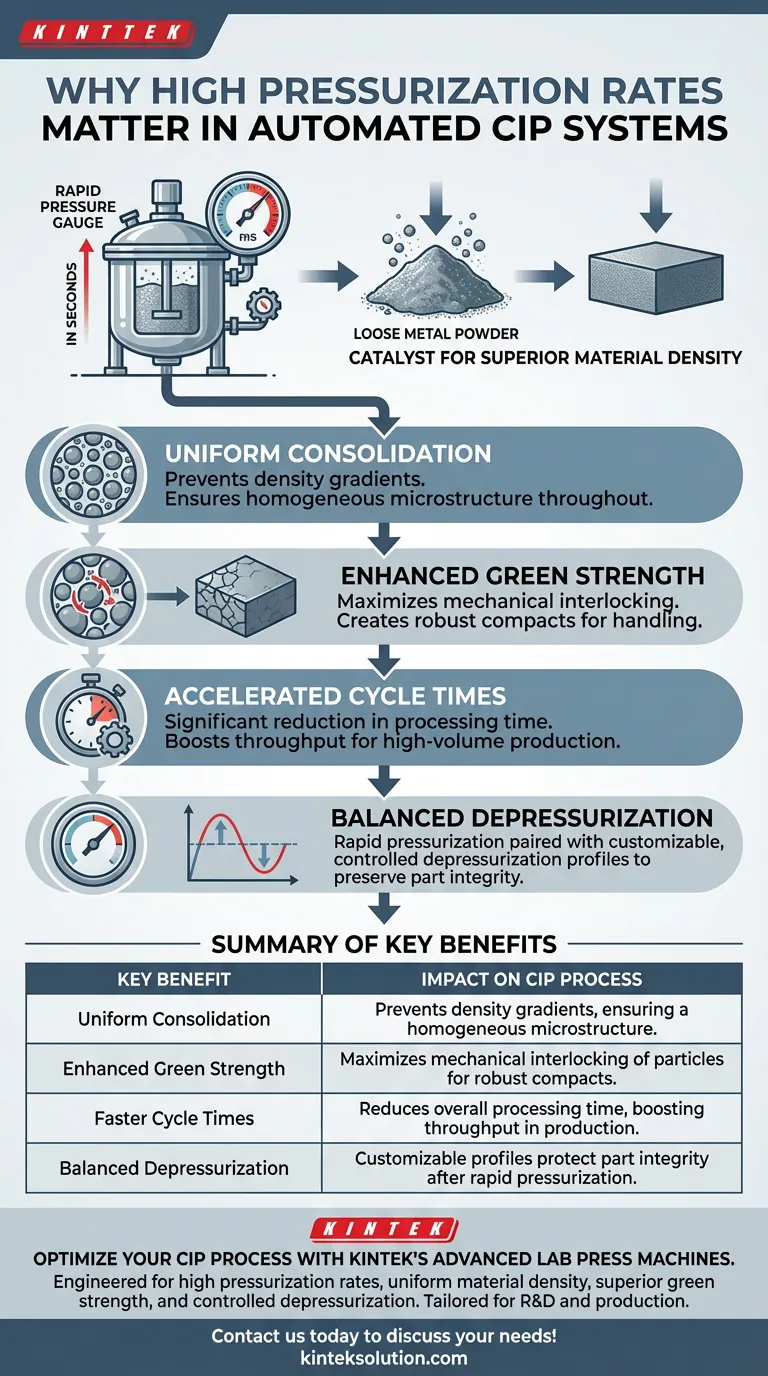
Achieving Uniform Consolidation
The primary goal of CIP is to transform loose powder into a solid shape. High pressurization rates force the powder particles together before they can settle unevenly.
This rapid action ensures the consolidation is uniform throughout the entire volume of the material. Consequently, this leads to a highly homogeneous microstructure, devoid of the density variations that can occur with slower pressure application.
Enhancing Green Strength
"Green strength" refers to the mechanical strength of a compacted powder part before it undergoes sintering. High pressurization rates are essential for maximizing this property.
By rapidly compressing the powder, the system ensures tighter mechanical interlocking between particles. This results in a robust compact that can be handled and processed further without falling apart.
Operational Efficiency
Accelerating Cycle Times
Beyond material quality, pressurization rates are a key factor in process efficiency. Automated systems are designed to reach the required pressure levels in a matter of seconds.
This capability significantly reduces the overall cycle time for each batch. For high-volume production or automated laboratory settings, this speed is vital for maintaining throughput.
Understanding the Process Dynamics (Trade-offs)
The Balance of Depressurization
While high pressurization rates are beneficial for the "up" slope of the cycle, they are not the only factor in success. References indicate that automated systems also feature customizable depressurization profiles.
Rapid pressurization must be balanced with controlled depressurization. If the pressure is released as quickly as it was applied, it could damage the newly formed microstructure. Therefore, the trade-off for high-speed pressurization is the requirement for sophisticated control over the depressurization phase to preserve the part's integrity.
Making the Right Choice for Your Application
To optimize your CIP process, you must balance the need for speed with the specific requirements of your material.
- If your primary focus is Material Quality: Prioritize high pressurization rates to ensure a homogeneous microstructure and maximum green strength.
- If your primary focus is Process Safety: Ensure your high-rate system is paired with customizable depressurization profiles to prevent structural damage during the release cycle.
High pressurization rates are not just about speed; they are the mechanism that guarantees the internal consistency and durability of your metal compacts.
Summary Table:
| Key Benefit | Impact on CIP Process |
|---|---|
| Uniform Consolidation | Prevents density gradients, ensuring a homogeneous microstructure. |
| Enhanced Green Strength | Maximizes mechanical interlocking of particles for robust compacts. |
| Faster Cycle Times | Reduces overall processing time, boosting throughput in production. |
| Balanced Depressurization | Customizable profiles protect part integrity after rapid pressurization. |
Optimize your Cold Isostatic Pressing (CIP) process with KINTEK's advanced lab press machines. Our automated lab presses, including isostatic and heated models, are engineered to deliver the high pressurization rates essential for uniform material density and superior green strength—while ensuring controlled depressurization to safeguard your compacts. Whether you're in R&D or high-volume production, KINTEK's solutions are tailored to enhance your laboratory efficiency and part quality. Contact us today to discuss how our CIP systems can meet your specific material processing needs!
Visual Guide
Related Products
- Automatic Lab Cold Isostatic Pressing CIP Machine
- Manual Cold Isostatic Pressing CIP Machine Pellet Press
- Electric Split Lab Cold Isostatic Pressing CIP Machine
- Electric Lab Cold Isostatic Press CIP Machine
- Automatic Laboratory Hydraulic Press Lab Pellet Press Machine
People Also Ask
- What are the key features of automated laboratory Cold Isostatic Press (CIP) systems? Achieve Precise, High-Pressure Powder Consolidation
- Why is an Isostatic Press (CIP) Necessary After Uniaxial Pressing? Achieve Transparency in Nd:Y2O3 Ceramics
- How does a Cold Isostatic Press (CIP) increase Bi-2223/Ag current density? Boost Superconductivity with Uniform Pressure
- How does a Cold Isostatic Press (CIP) facilitate the preparation of CaO-doped silicon carbide (SiC) green bodies?
- What is the primary function of a Cold Isostatic Press (CIP) in NASICON preparation? Achieve 96% Theoretical Density



















