
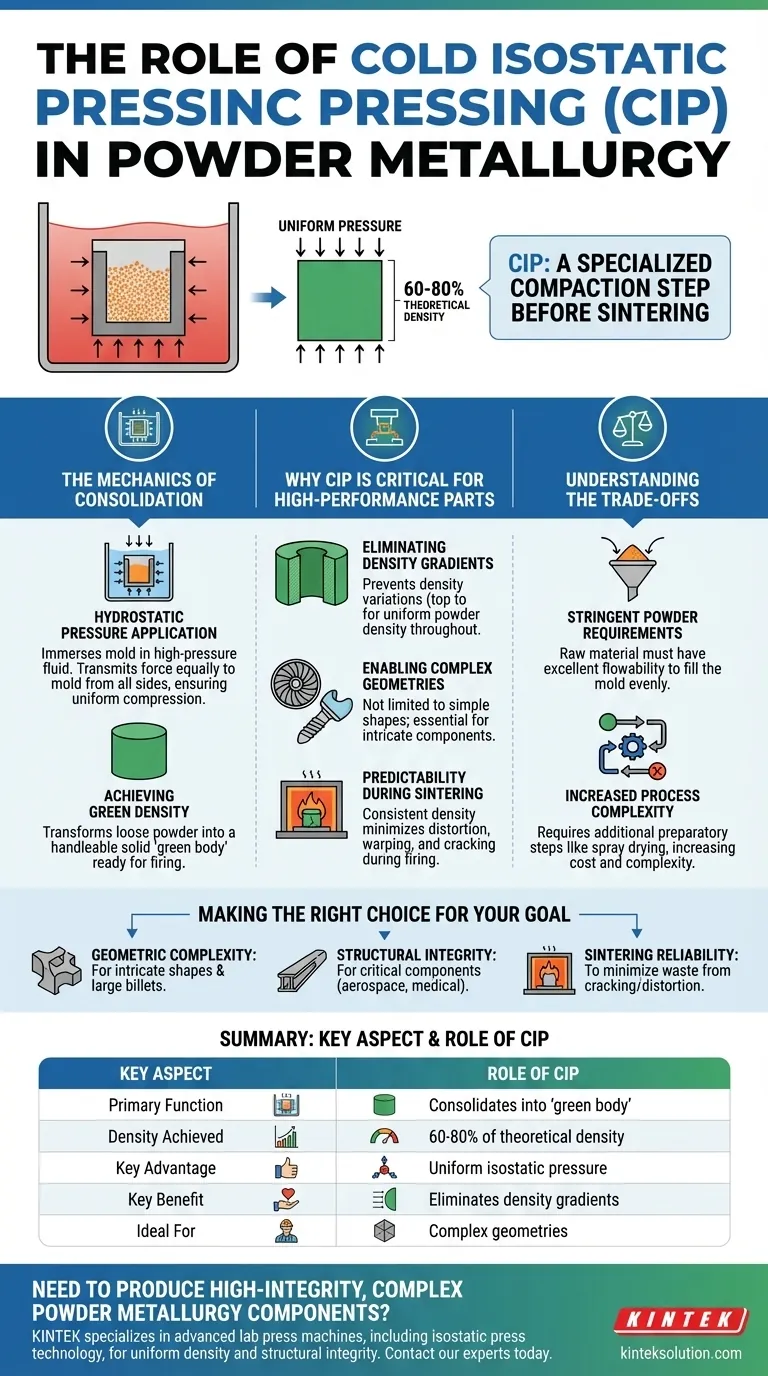
Cold Isostatic Pressing (CIP) functions as a specialized compaction step within the powder metallurgy process, occurring directly before the final sintering phase. Its primary role is to consolidate loose powder into a high-integrity solid, known as a "green body," achieving between 60% and 80% of the material's theoretical density. By utilizing a high-pressure fluid medium, CIP applies force uniformly from every direction, distinguishing it from standard mechanical pressing methods.
Core Takeaway While standard pressing methods often result in uneven density, the definitive advantage of CIP is its ability to apply uniform isostatic pressure to the material. This eliminates density gradients, allowing manufacturers to produce complex shapes that maintain structural integrity and dimensional predictability during the subsequent sintering process.
The Mechanics of Consolidation
Hydrostatic Pressure Application
The process works by immersing a mold filled with powder into a high-pressure fluid medium.
Hydraulic pressure is applied to this fluid, which transmits force equally to the mold from all sides. This "isostatic" application ensures that every part of the component experiences the exact same level of compression.
Achieving Green Density
The goal of this step is to transform loose powder into a solid form ready for firing.
CIP successfully yields parts with 60% to 80% of their theoretical density. These "green" parts possess enough structural strength to be handled and processed further, setting the stage for the final sintering operation.
Why CIP is Critical for High-Performance Parts
Eliminating Density Gradients
In traditional uniaxial pressing, friction can cause the density of the part to vary from top to bottom.
CIP eliminates these pressing pressure gradients because the force is multi-directional and low-friction. This results in uniform powder density throughout the entire billet or preform.
Enabling Complex Geometries
Because the pressure is uniform, CIP is not limited to simple shapes.
It is highly effective for shaping intricate components that would be impossible to mold using rigid dies. This capability is essential for producing complex items like turbine blades for aerospace or biomedical implants.
Predictability During Sintering
The uniformity achieved during CIP pays off during the firing (sintering) stage.
Because the density is consistent, the material shrinks predictably. This minimizes the risk of distortion, warping, or cracking, ensuring high-integrity components.
Understanding the Trade-offs
Stringent Powder Requirements
CIP is not a "dump and press" solution for any powder type; the raw material requires excellent flowability.
If the powder does not flow well, it will not fill the mold evenly, negating the benefits of the process.
Increased Process Complexity
To achieve the necessary flowability, manufacturers often must add preparatory steps.
Processes such as spray drying or mold vibration are frequently required. While effective, these additional steps increase the overall cost and complexity of the production line compared to simpler pressing methods.
Making the Right Choice for Your Goal
Deciding when to implement Cold Isostatic Pressing depends on the specific demands of your final component.
- If your primary focus is Geometric Complexity: Use CIP to produce intricate shapes or large billets that cannot be formed by rigid, uniaxial dies.
- If your primary focus is Structural Integrity: Rely on CIP to create critical components, such as aerospace turbine blades or medical prosthetics, where internal density variations could lead to failure.
- If your primary focus is Sintering Reliability: Choose CIP to minimize waste caused by cracking or distortion during the firing phase.
By prioritizing uniform density over processing speed, CIP delivers the internal consistency required for the most demanding engineering applications.
Summary Table:
| Key Aspect | Role of CIP in Powder Metallurgy |
|---|---|
| Primary Function | Consolidates powder into a "green body" before sintering |
| Density Achieved | 60% to 80% of theoretical density |
| Key Advantage | Applies uniform isostatic pressure from all directions |
| Key Benefit | Eliminates density gradients for structural integrity |
| Ideal For | Complex geometries (e.g., turbine blades, implants) |
Need to produce high-integrity, complex powder metallurgy components?
KINTEK specializes in advanced lab press machines, including isostatic press technology, to help you achieve the uniform density and structural integrity critical for demanding applications in aerospace, medical, and advanced ceramics. Our expertise ensures your sintering process is reliable and predictable.
Contact our experts today to discuss how our isostatic press solutions can enhance your lab's capabilities and product quality.
Visual Guide
Related Products
- Electric Lab Cold Isostatic Press CIP Machine
- Electric Split Lab Cold Isostatic Pressing CIP Machine
- Automatic Lab Cold Isostatic Pressing CIP Machine
- Manual Cold Isostatic Pressing CIP Machine Pellet Press
- Lab Isostatic Pressing Molds for Isostatic Molding
People Also Ask
- What role do electric lab cold isostatic presses play in industrial contexts? Bridge R&D and Manufacturing with Precision
- What are the applications of electric lab cold isostatic presses in research settings? Advance Material R&D with High-Pressure CIPs
- How does electrical Cold Isostatic Pressing (CIP) contribute to cost savings? Unlock Efficiency and Reduce Expenses
- What are some research applications of electric lab CIPs? Unlock Uniform Powder Densification for Advanced Materials
- What are the characteristics of standard off-the-shelf electric lab CIP solutions? Achieve Immediate, Cost-Effective Processing
















