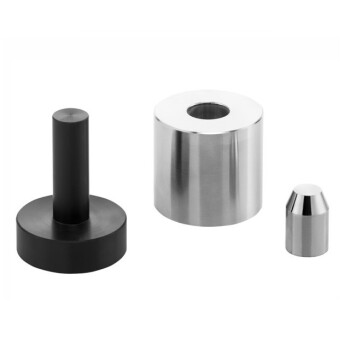
Precision stainless steel molds function as high-strength pressure vessels critical for maintaining structural integrity during the manufacturing of bone repair composites. Their primary role is to ensure uniform pressure distribution across the material while resisting deformation under high-tonnage loads. By maintaining their exact shape under extreme stress, these molds guarantee that the resulting disks achieve the consistent density and geometric precision necessary to function as medical implants.
The rigidity of the mold is the controlling variable for quality; without a mold that resists deformation, it is impossible to replicate the specific mechanical density required to simulate human cortical bone.
The Mechanics of Mold Performance
Acting as a Pressure Vessel
In the pressing process, the mold does more than define shape; it acts as a containment system. It ensures that the force applied by the press is distributed uniformly throughout the composite material.
Resisting High-Tonnage Deformation
Composite laminates often require pressures as high as 20 MPa to cure correctly. Standard molds may warp or bow under this immense load.
Preserving Geometric Accuracy
Precision stainless steel utilizes high-strength material properties to remain rigid under these loads. This rigidity ensures the molded part retains precise dimensions rather than taking on the imperfections of a flexing mold.
Impact on Material Structure
Ensuring Consistent Density
For bone repair applications, the density of the implant must match human cortical bone. The mold’s ability to withstand pressure without yielding allows the manufacturer to compress the material to a highly consistent density every time.
Maintaining Layer Alignment
Composite disks rely on the orderly arrangement of internal structures, such as glass fiber layers. A rigid mold prevents the shifting or distortion of these layers during the high-pressure phase.
Facilitating Heat Transfer
Beyond pressure, curing requires heat. Stainless steel offers high thermal conductivity, facilitating rapid and uniform heat transfer from the lab press to the composite material.
Understanding Process Variables
The Necessity of Tight Tolerances
While high-strength steel prevents deformation, the precision of the mold's initial machining is paramount. Any surface imperfection in the steel will be transferred directly to the composite disk, potentially creating stress concentrators.
Thermal Expansion Management
Stainless steel expands when heated. Designing these molds requires calculating strict tolerances to ensure the mold does not seize or alter the dimensions of the composite part outside of acceptable limits during the heating cycle.
Making the Right Choice for Your Goal
To ensure your composite disks meet the rigorous standards of bone repair, consider the following regarding your tooling:
- If your primary focus is mechanical simulation: Prioritize mold rigidity above all else to ensure the density of the composite exactly mimics human cortical bone.
- If your primary focus is structural integrity: Ensure the mold design accounts for internal fiber alignment by maintaining strict dimensional stability under 20 MPa loads.
- If your primary focus is process efficiency: Leverage the thermal conductivity of stainless steel to reduce cycle times through faster heat transfer.
The quality of your final medical device is directly limited by the stability and precision of the mold that shapes it.
Summary Table:
| Feature | Role in Pressing Process | Benefit for Bone Repair Disks |
|---|---|---|
| Rigidity | Resists high-tonnage deformation | Simulates human cortical bone density |
| Uniformity | Even pressure distribution (up to 20 MPa) | Ensures structural integrity & layer alignment |
| Conductivity | High thermal heat transfer | Facilitates rapid, consistent material curing |
| Precision | Tight machining tolerances | Prevents surface stress concentrators |
Optimize Your Medical Material Research with KINTEK
Precise results in bone repair research start with the right equipment. As a specialist in comprehensive laboratory pressing solutions, KINTEK provides the high-performance tools you need to achieve consistent density and structural integrity. Whether you require manual, automatic, heated, or multifunctional presses, our equipment is designed to meet the rigorous demands of medical implant manufacturing.
Ready to elevate your lab's precision? Contact our experts today to discover how our laboratory presses and precision tooling can enhance your research and production efficiency.
References
- Qingyou Liang, Chunlin Deng. Intensified cross-linking dramatically improved the mechanical properties of hydroxyapatite and cellulose composites for repairing bone segmental defects. DOI: 10.1039/d3ma00974b
This article is also based on technical information from Kintek Solution Knowledge Base .
Related Products
- Lab Polygon Press Mold
- Infrared Heating Quantitative Flat Plate Mold for Precise Temperature Control
- Lab Button Battery Tablet Press Sealing Mold
- XRF KBR Steel Ring Lab Powder Pellet Pressing Mold for FTIR
- Lab Anti-Cracking Press Mold
People Also Ask
- What is the purpose of incorporating cartridge heaters into a lab press mold for MLCC block compression? Optimize Results
- How do the design and geometric precision of pressing molds and mandrels affect the quality of PTFE composite samples?
- What role do precision positioning and pressure molds play in single-lap joints? Ensure 100% Data Integrity
- What are the requirements for pressing molds when using SSCG? Key Materials for Complex Single Crystal Production
- How do industrial-grade pressure molds affect zinc metal pouch cells? Maximize Energy Density & Performance