
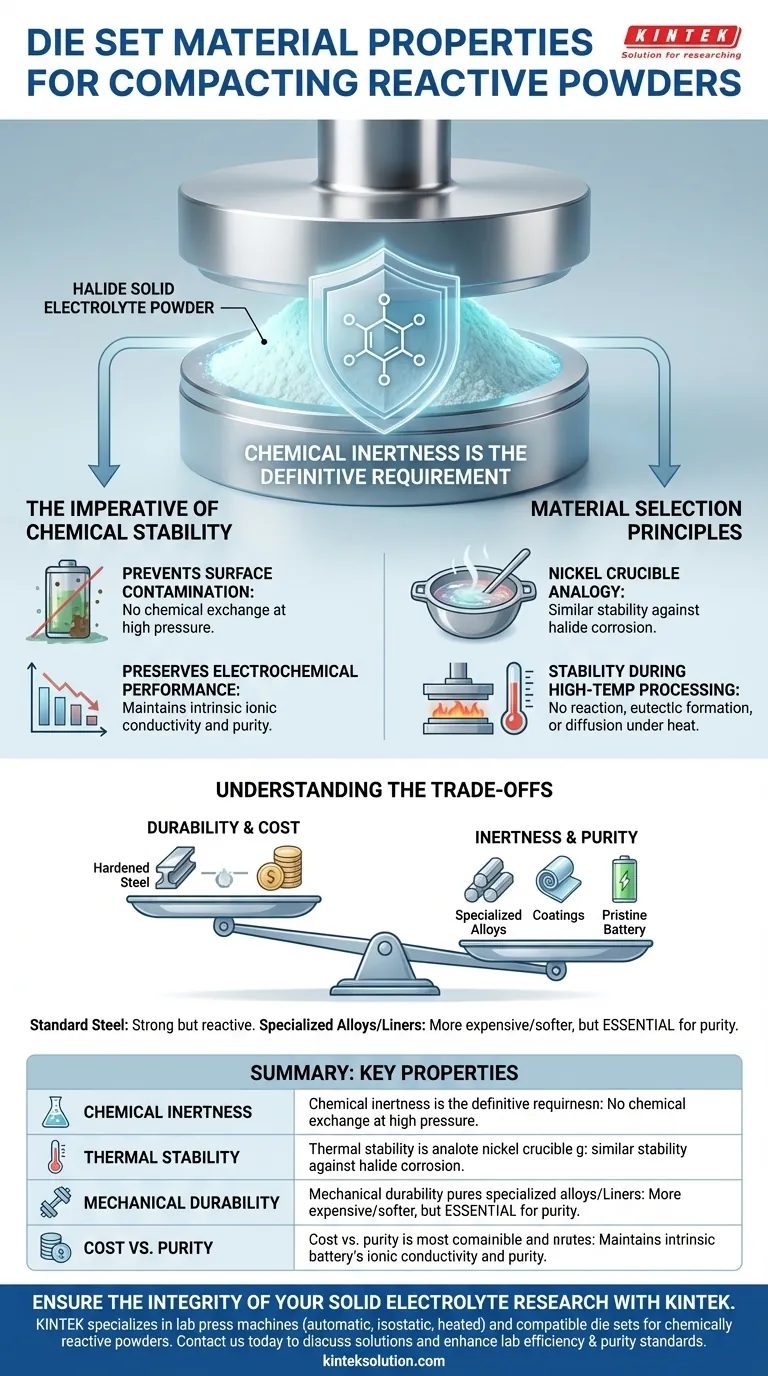
Chemical inertness is the definitive requirement for die sets used to compact reactive powders. When working with sensitive materials like halide solid electrolytes, the die set must possess a surface chemistry that is completely non-reactive to the sample powder. This ensures that the compaction process densifies the material without introducing contaminants that would alter its composition.
The success of your experiment hinges on maintaining absolute purity during the mechanical shaping process. The die set must act solely as a physical mold, resisting any chemical interaction that could degrade the electrochemical performance of the final electrolyte pellet.

The Imperative of Chemical Stability
Preventing Surface Contamination
Halide solid electrolytes are chemically aggressive and highly susceptible to contamination. If the die material is reactive, the high pressure of compaction can force a chemical exchange at the interface between the tool and the powder.
This reaction creates impurities on the surface of the pellet. These impurities often act as resistive layers, impeding ion flow and distorting your impedance spectroscopy results.
Preserving Electrochemical Performance
The primary goal of solid electrolyte research is high ionic conductivity. The references highlight that even minor contamination can compromise the purity required for optimal performance.
A die set that leaches elements into the powder introduces defects. To obtain accurate data on the material's intrinsic properties, the die must remain chemically "invisible" to the sample.
Material Selection Principles
The "Nickel Crucible" Standard
To understand the necessary material properties, consider the analogy of sintering vessels. Researchers select nickel crucibles for sintering because of their specific stability against halide melts.
The die set requires a similar material logic. You must select a die material (or lining) that offers the same resistance to halide corrosion that a nickel crucible provides during thermal processing.
Stability During High-Temperature Processing
Reactivity generally increases with temperature. If your process involves hot pressing, or if the pellet undergoes sintering immediately after compaction, the risk of reaction spikes.
The die material must maintain its inertness even under thermal stress. It must not form eutectics or diffuse into the halide structure when heat is applied.
Understanding the Trade-offs
Durability vs. Inertness
Standard hardened steel dies offer exceptional mechanical strength and longevity, but they are often reactive with halides. Choosing a chemically inert material (such as specific alloys or lined dies) often means accepting a material that may be softer or more brittle than standard tool steel.
Cost vs. Purity
Achieving high chemical inertness often requires specialized materials or custom coatings. These are significantly more expensive than off-the-shelf steel dies. However, the cost of a specialized die is often lower than the cost of wasted time and materials caused by contaminated samples.
Making the Right Choice for Your Goal
To ensure the validity of your research data, evaluate your die set based on your specific experimental needs:
- If your primary focus is intrinsic material properties: Prioritize absolute chemical inertness over die longevity, utilizing specialized alloys or liners to ensure zero contamination.
- If your primary focus is high-throughput screening: Investigate inert coatings on standard steel dies to balance chemical resistance with the mechanical durability needed for repeated use.
The integrity of your final battery cell begins with the purity of the pressed pellet; never let your tooling become the limiting factor in your chemistry.
Summary Table:
| Property | Importance for Reactive Powders | Key Consideration |
|---|---|---|
| Chemical Inertness | Prevents surface contamination and preserves material purity. | Essential for accurate impedance spectroscopy and intrinsic property measurement. |
| Thermal Stability | Maintains inertness during hot pressing or subsequent sintering. | Prevents reactions and diffusion at elevated temperatures. |
| Mechanical Durability | Balances longevity with the need for chemical resistance. | Softer inert materials may be required over standard tool steel. |
| Cost vs. Purity | Specialized materials or coatings ensure purity but at a higher cost. | Investment protects against wasted time and contaminated samples. |
Ensure the integrity of your solid electrolyte research with the right lab press.
KINTEK specializes in lab press machines, including automatic lab presses, isostatic presses, and heated lab presses, designed to meet the stringent demands of laboratory environments. Our expertise in material compatibility ensures that your die sets are optimized for chemically reactive powders like halide solid electrolytes, preventing contamination and delivering accurate, reliable results.
Don't let your tooling compromise your data. Contact us today to discuss how our solutions can enhance your lab's efficiency and purity standards.
Visual Guide
Related Products
- Lab Ring Press Mold for Sample Preparation
- Lab Infrared Press Mold for No Demolding
- Assemble Lab Cylindrical Press Mold for Laboratory Use
- XRF KBR Plastic Ring Lab Powder Pellet Pressing Mold for FTIR
People Also Ask
- What is the purpose of incorporating cartridge heaters into a lab press mold for MLCC block compression? Optimize Results
- What is the role of a laboratory press in COF electrolyte prep? Achieving High-Performance Pellet Densification
- Why is precise cooling management of the lab press mold necessary? Protect Core Integrity in Thermoforming
- What is the function of a pressing tool in thermoplastic panels? Master Precision Shaping & Fusion Bonding
- What impact does a sample preparation press have on testing results when researching MXene as an electrolyte additive?



