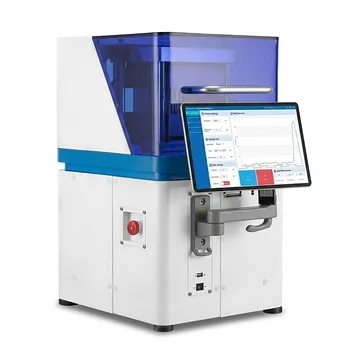
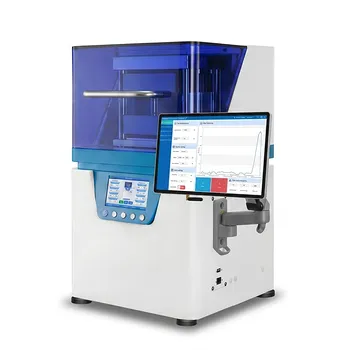
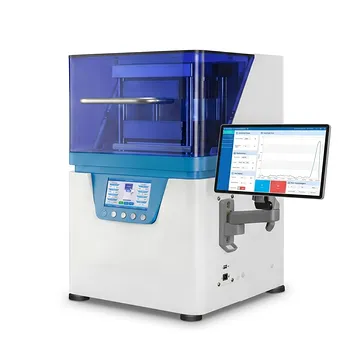
The laboratory press acts as the primary mechanical driver for integrating lignin into the fiber matrix during the initial phase of paper formation. In room-temperature pressing, the machine applies vertical force to embed lignin powder into the handsheet structure while utilizing radial flow to ensure even distribution across the surface. This mechanical phase is essential for establishing the initial physical contact required between fibers and lignin particles before any thermal consolidation occurs.
Room-temperature pressing serves as a mechanical preparation phase that forces lignin into the handsheet structure and distributes it uniformly through pressure-induced radial flow. This process establishes the necessary contact between the lignin and cellulose fibers, creating the structural foundation required for subsequent processing.
Mechanisms of Lignin Integration
Vertical Force and Particle Embedding
The laboratory press exerts precise vertical pressure that drives lignin powder deep into the porous network of the wet handsheet. This action forces the particles to redeposit directly onto the fiber surfaces, preventing the lignin from remaining a loose, external layer.
Pressure-Induced Radial Flow
As pressure is applied to the wet sheet, it generates a radial flow of moisture and particles. This lateral movement is the primary mechanism for achieving a uniform distribution of lignin across the entire surface area of the paper, eliminating localized concentrations.
Establishing Structural Foundations
Initial Contact and Proximity
The primary physical goal of this phase is to minimize the distance between the lignin particles and the cellulose fibers. By creating this initial close contact, the press prepares the material for the strong bonding that occurs during later thermal consolidation.
Simulation of Industrial Dehydration
The laboratory press simulates the dehydration and pressing stages of industrial papermaking. This allows researchers to evaluate how fibers—particularly those that are rigid or have low elasticity—will respond to mechanical stress and whether they will form a stable sheet.
Reduction of Contact Resistance
In applications involving conductive additives, the mechanical pressure ensures tight contact between active material particles. This reduces contact resistance and improves the structural stability of the composite, which is vital for consistent performance.
Understanding the Trade-offs
Uniformity vs. Fiber Damage
Excessive pressure during the room-temperature phase can lead to fiber crushing or irreversible structural damage. It is a delicate balance between applying enough force to achieve lignin redeposition and maintaining the inherent mechanical strength of the fiber network.
Moisture Calibration and Flow
If the moisture content of the wet sheet is too low, the radial flow will be insufficient to distribute the lignin uniformly. Conversely, excessive moisture can lead to "washout" where the lignin is pushed out of the sheet entirely rather than being embedded within it.
Applying These Principles to Your Process
How to Apply This to Your Project
To achieve the best results during the pressing phase, consider your specific material goals:
- If your primary focus is uniform lignin distribution: Calibrate the moisture levels of your handsheet to facilitate optimal radial flow during the pressing cycle.
- If your primary focus is structural integrity: Monitor the vertical pressure limits closely to ensure you are embedding the lignin without crushing rigid cellulose fibers.
- If your primary focus is electrochemical performance: Use the press to maximize the density of the material, ensuring the tightest possible contact between the lignin-derived carbon and the current collector.
Mastering the mechanical dynamics of the room-temperature phase allows for precise control over the final structural and functional properties of lignin-integrated paper.
Summary Table:
| Mechanism | Physical Action | Key Benefit |
|---|---|---|
| Vertical Force | Particle Embedding | Drives lignin into the fiber matrix, preventing loose layers |
| Radial Flow | Lateral Distribution | Ensures uniform lignin spread and eliminates localized concentrations |
| Mechanical Pressure | Dehydration Simulation | Reduces contact resistance and simulates industrial-scale production |
| Structural Control | Matrix Stabilization | Establishes the foundation for successful thermal consolidation |
Elevate Your Material Research with KINTEK
Achieving the perfect balance of lignin distribution and structural integrity requires precision-engineered equipment. KINTEK specializes in comprehensive laboratory pressing solutions designed for rigorous research environments. Our extensive range includes:
- Manual & Automatic Presses for reliable, repeatable force application.
- Heated & Multifunctional Models to transition from room-temperature pressing to thermal consolidation.
- Glovebox-Compatible & Isostatic Presses (Cold/Warm) ideally suited for advanced battery research and sensitive material handling.
Whether you are refining paper composites or pioneering new energy storage technologies, KINTEK provides the tools necessary for high-performance outcomes.
Ready to optimize your pressing process? Contact our experts today to find the perfect solution for your laboratory!
References
- Motasem N. Saidan. Improvement of linerboard compressive strength by hot-pressing and addition of recovered lignin from spent pulping liquor. DOI: 10.2298/ciceq131205012s
This article is also based on technical information from Kintek Solution Knowledge Base .
Related Products
- Laboratory Hydraulic Press Lab Pellet Press Button Battery Press
- Laboratory Hydraulic Press Lab Pellet Press Machine for Glove Box
- Laboratory Split Manual Heated Hydraulic Press Machine with Hot Plates
- Laboratory Hydraulic Pellet Press for XRF KBR FTIR Lab Press
- Laboratory Hydraulic Split Electric Lab Pellet Press
People Also Ask
- How is a laboratory hydraulic press used for HAP composite gels? Master Mineral Substrate Standardization
- What role does a laboratory hydraulic press play in the preparation of piezoelectric ceramic discs for DC-PG? | KINTEK
- What role does a laboratory hydraulic press play in reaction pellets? Optimizing Lunar Soil and Metal Fuel Density
- Why is a laboratory hydraulic press required for PBAT and PLA sample preparation? Achieve Flawless Characterization
- What role does a laboratory hydraulic press play in the assembly of all-solid-state battery test cells? Expert Guide