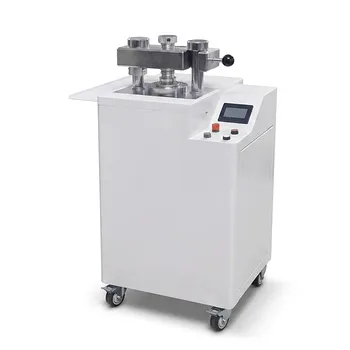
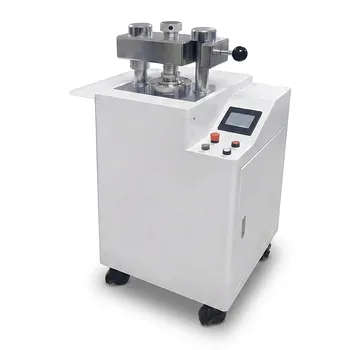
To achieve optimal stability in XRF pelletising, most samples require a compressive force of 25 to 35 tons applied for a duration of 1 to 2 minutes. This specific combination of force and time is necessary to ensure the binder recrystallizes and to eliminate void spaces within the pellet, resulting in a dense, homogeneous sample ready for analysis.
The objective of pressing is not merely to compact the powder, but to alter the physical structure of the mixture. You must apply sufficient pressure to trigger binder recrystallization and complete compression, ensuring no microscopic voids remain to distort your analytical data.
The Mechanics of Proper Compression
Eliminating Void Spaces
The primary goal of applying 25 to 35 tons of pressure is density. You are physically forcing the sample particles together to remove air gaps.
Any remaining void spaces in the finished pellet can lead to erratic XRF signals. A completely compressed sample ensures that the X-rays interact with a consistent volume of material.
Triggering Binder Recrystallization
Pressure does more than just squeeze particles; it activates the binder.
For the pellet to hold its shape, the pressure must be high enough to cause the binder to recrystallize. This chemical and physical change locks the sample matrix together, providing the mechanical strength needed for the pellet to survive handling and analysis.
The Role of Dwell Time
Applying pressure is not an instantaneous event. The sample needs to be held under load for 1 to 2 minutes.
This "dwell time" allows the material to settle and the binder to fully engage. Releasing the pressure too quickly can result in micro-cracks or a pellet that crumbles upon extraction.
Critical Pre-requisites for Success
Particle Size Limitations
Pressure cannot compensate for poor grinding. Before pressing, samples must be ground to a fine powder.
For optimal binding and analytical accuracy, the particle size should be less than 50 micrometers (<50µm). While a size of less than 75 micrometers is technically acceptable, finer particles bind more effectively under pressure.
Binder Dilution and Mixing
The ratio of binder to sample is a critical variable. You must balance the need for structural integrity with the need to maintain a strong analyte signal.
Incorrect dilution ratios can lead to pellets that fail under pressure or samples that are too diluted to detect trace elements accurately.
Common Pitfalls to Avoid
Inconsistent Pellet Thickness
The final thickness of the pellet matters for infinite thickness calculations in XRF. Variations in the amount of sample loaded into the die can lead to inconsistent thickness, even if the pressure applied is constant.
Contamination Risks
High-throughput hydraulic presses are designed for speed and repetitive cycles. While they feature automated ejection systems, this mechanical movement introduces a risk of cross-contamination.
You must ensure that the die surfaces are meticulously cleaned between samples to prevent residue from one pellet affecting the next.
Making the Right Choice for Your Goal
To ensure your XRF analysis is both accurate and reproducible, apply these parameters based on your specific requirements:
- If your primary focus is structural integrity: Ensure you maintain the full 25-35 tons of pressure for at least one minute to guarantee binder recrystallization.
- If your primary focus is analytical precision: Prioritize grinding samples to <50µm before pressing, as smaller particles reduce void spaces more effectively than pressure alone.
- If your primary focus is high throughput: Utilize a hydraulic press with automated ejection, but implement strict cleaning protocols to manage contamination risks.
Consistency in sample preparation is the single most important factor in achieving reliable XRF data.
Summary Table:
| Parameter | Recommended Value | Purpose |
|---|---|---|
| Compressive Force | 25 - 35 Tons | Eliminates void spaces & ensures sample density |
| Dwell Time | 1 - 2 Minutes | Allows binder recrystallization & prevents cracking |
| Particle Size | < 50 µm (Ideal) | Enhances binding and analytical accuracy |
| Binder Ratio | Variable | Balances structural integrity with signal strength |
Elevate Your XRF Accuracy with KINTEK Precision Solutions
Achieve the ultimate in sample homogeneity and stability with KINTEK’s industry-leading laboratory pressing equipment. Whether you are conducting critical battery research or high-throughput material analysis, our manual, automatic, heated, and glovebox-compatible hydraulic presses provide the consistent pressure control needed for perfect pelletising.
Our value to you:
- Versatility: Solutions ranging from standard pellet presses to advanced cold and warm isostatic presses.
- Precision: Maintain exact dwell times and pressure loads (25-35+ tons) to eliminate voids and activate binders.
- Durability: Engineered for high-frequency lab use with minimal maintenance.
Don't let poor sample preparation compromise your data. Contact KINTEK today to find the perfect pressing solution for your lab!
Related Products
- Automatic XRF Pellet Press for Laboratory Spectrometry Sample Preparation
- Automatic Fluorescence Sample Preparation Press 40 Ton Lab Pellet Press for XRF Analysis
- XRF KBR Plastic Ring Lab Powder Pellet Pressing Mold for FTIR
- Lab XRF Boric Acid Powder Pellet Pressing Mold for Laboratory Use
- XRF KBR Steel Ring Lab Powder Pellet Pressing Mold for FTIR
People Also Ask
- How can contamination occur during the preparation of pressed pellets for XRF analysis? Expert Prevention Guide
- How does the sample material influence the required pressing load for making an XRF pellet? Find the Optimal Pressure
- What are the different methods for preparing a sample pellet for XRF analysis? Expert Guide to Superior XRF Results
- What are the advantages of preparing a sample as a dense pellet for XRF? Unlock High-Precision Trace Element Analysis
- What is the primary purpose of using an automatic pellet press? Achieve Precise Geopolymer Analysis Results