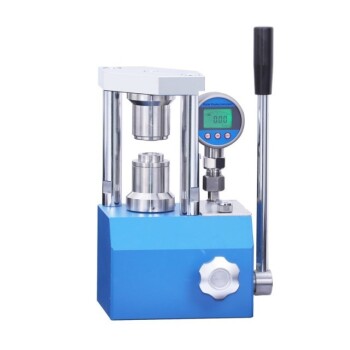
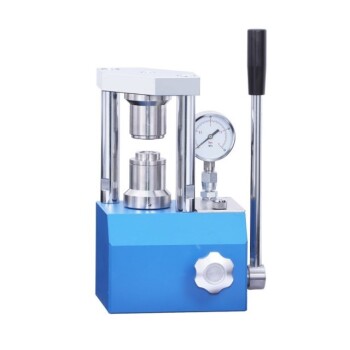
Laboratory hydraulic presses and battery crimping machines are the critical enablers of structural integrity in the assembly of batteries based on Single-Ion Conducting Quasi-Solid Electrolytes (SL-CQSEs). These machines function to apply precise, constant mechanical pressure to compact electrodes and hermetically seal the cell, ensuring tight physical contact between the quasi-solid electrolyte, the lithium metal anode, and the cathode.
Core Takeaway: The fundamental role of this equipment is to overcome interfacial impedance by forcing intimate contact between battery layers. By combining mechanical compression with in-situ polymerization, these machines ensure the accuracy, reproducibility, and long-term stability of electrochemical test data.
The Criticality of Interfacial Contact
Bridging the Gap Between Layers
In SL-CQSE batteries, the electrolyte is not a liquid that naturally wets the electrode surfaces. It is a quasi-solid material that requires mechanical assistance to establish a connection.
Hydraulic presses and crimpers provide the physical force necessary to press the SL-CQSE electrolyte firmly against the lithium metal anode and the cathode.
Reducing Interfacial Impedance
The primary obstacle in solid or quasi-solid battery performance is high resistance at the interfaces where materials meet.
By applying controlled pressure, these machines minimize gaps and voids between layers. This significantly reduces interfacial impedance, creating a continuous path for ion transport.
Specific Functions of the Equipment
Hydraulic Presses: Densification and Compaction
Laboratory hydraulic presses are often used in the pre-assembly or electrode preparation phase to compact materials.
This process eliminates voids between particles and achieves high densification of the electrode layers. A dense structure is essential for establishing continuous ionic and electronic transmission networks.
Crimping Machines: Sealing and Constant Pressure
For coin cell formats (like the 2032), the crimping machine performs the final assembly step.
It applies a consistent mechanical pressure to hermetically seal the battery casing. This ensures that the internal components maintain tight physical contact over the lifespan of the battery, rather than relaxing over time.
Protection from Contamination
Beyond pressure, the crimping process creates a seal that prevents electrolyte leakage.
Critically, it also prevents the infiltration of external air and moisture, which helps maintain the chemical stability of the sensitive lithium metal anode and the SL-CQSE.
Ensuring Data Reliability
Achieving Reproducibility
In experimental settings, inconsistent assembly pressure leads to erratic results.
The use of automated or precise manual presses ensures that every cell is assembled under identical conditions. This guarantees that variations in performance are due to the material chemistry, not assembly errors.
Validating Long-Cycle Stability
The primary reference highlights that this physical compression works in conjunction with in-situ polymerization.
Together, these factors stabilize the battery structure, allowing researchers to obtain accurate data regarding long-cycle stability tests.
Understanding the Trade-offs
The Necessity of Precision Control
The effectiveness of these machines relies entirely on the precision of the pressure applied.
Insufficient pressure will result in poor contact, high impedance, and battery failure. Conversely, excessive pressure (without control) could damage the delicate separator layers or crush the active materials.
Equipment Limitation
While hydraulic presses simulate industrial densification, they are batch-process tools.
They are excellent for evaluating compaction density and interfacial contact in a lab setting, but moving from a static hydraulic press to continuous roll-to-roll manufacturing requires careful calibration to ensure the same pressure metrics are met.
Making the Right Choice for Your Goal
When selecting or utilizing assembly equipment for SL-CQSE batteries, consider your primary objective:
- If your primary focus is reducing internal resistance: Prioritize hydraulic presses that offer high-pressure capabilities (e.g., up to 500 MPa) to maximize particle-to-particle contact and densification.
- If your primary focus is long-term cycle testing: Ensure your crimping machine is calibrated to provide a hermetic, leak-proof seal to prevent atmospheric contamination from skewing your stability data.
Ultimately, the reliability of your SL-CQSE battery data is directly proportional to the precision of the mechanical compression applied during assembly.
Summary Table:
| Equipment Type | Primary Function in SL-CQSE Assembly | Key Benefit |
|---|---|---|
| Hydraulic Press | Electrode densification & material compaction | Minimizes voids and lowers internal resistance |
| Crimping Machine | Hermetic sealing & constant mechanical pressure | Prevents leakage and ensures long-cycle stability |
| Manual/Auto Press | Precise pressure application (up to 500 MPa) | Guarantees data reproducibility across test batches |
Elevate Your Battery Research with KINTEK Precision
Don't let interfacial impedance compromise your research data. KINTEK specializes in comprehensive laboratory pressing solutions designed specifically for advanced battery R&D. Whether you are working with SL-CQSEs or next-generation lithium metal anodes, our equipment ensures the exact mechanical compression required for success.
Our high-performance range includes:
- Manual & Automatic Presses: For precise electrode densification.
- Heated & Multifunctional Models: To support in-situ polymerization processes.
- Glovebox-Compatible Systems: For air-sensitive battery assembly.
- Isostatic Presses (CIP/WIP): For uniform compaction of complex materials.
Achieve superior densification and reliable electrochemical results today. Contact KINTEK for a tailored solution.
References
- Ding Hu, Yuzhong Wang. Competitive Anion Anchoring and Hydrogen Bonding in Multiscale‐Coupling Composite Quasi‐Solid Electrolytes for Fire‐Safety and Long‐Life Lithium Metal Batteries. DOI: 10.1002/advs.202501012
This article is also based on technical information from Kintek Solution Knowledge Base .
Related Products
- Button Battery Sealing Machine for Button Batteries
- Button Battery Sealing Press Machine for Lab
- Manual Button Battery Sealing Machine for Battery Sealing
- Warm Isostatic Press for Solid State Battery Research Warm Isostatic Press
- Laboratory Hydraulic Press Lab Pellet Press Button Battery Press
People Also Ask
- Why is a laboratory hydraulic press or battery sealing machine essential? Ensure Coin Cell Data Integrity
- What role does a laboratory press perform for CR2032 coin cell assembly? Ensure Precision in Battery Research
- Why is a high-pressure manual or automatic coin cell crimper required? Optimize Solid-State Battery Performance
- How does a high-precision lab press or coin cell crimper affect the performance of assembled lithium-metal batteries?
- How does the mechanical pressure provided by a laboratory crimper affect the performance of assembled 2032-type coin cells?