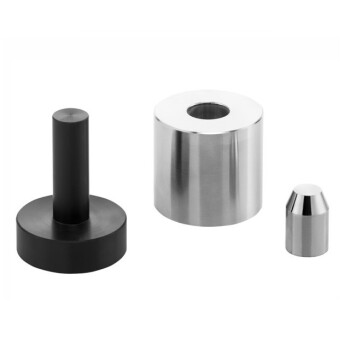
Precision metal molds serve as the critical interface between raw material and verifiable data in the laboratory preparation of composites. Used in conjunction with laboratory hot presses, these molds are responsible for defining the exact geometric dimensions of a sample to meet rigorous testing standards.
Core Takeaway The quality of your test data is directly limited by the quality of your mold. Precision molds do not merely shape the material; they eliminate geometric variables—such as surface unevenness and edge defects—that would otherwise distort mechanical performance evaluations.
The Foundation of Accurate Mechanical Testing
To evaluate a composite material objectively, the sample itself must be standardized. Precision molds provide the physical constraints necessary to achieve this.
Adherence to Testing Standards
Reliable comparison of materials requires strict adherence to international protocols. Precision metal molds are engineered to produce samples that comply with specific standards, such as ASTM D-638 (tensile properties) and ASTM D-790 (flexural properties).
Critical Surface Integrity
The surface quality of the mold directly transfers to the composite. High-quality mold surfaces ensure the flatness of the sample, which is vital for uniform stress distribution during testing.
Prevention of Edge Defects
Defects along the edges of a sample can act as stress concentrators, leading to premature failure. Precision molds produce clean, defect-free edges, ensuring that results for tensile, flexural, and impact strength reflect the material's true properties, not manufacturing flaws.
The Role in Powder Compaction and Densification
For composites starting as mixed raw powders, the mold plays a dynamic role in the material's consolidation.
Establishing the "Green Compact"
When used with a laboratory press, the mold applies unidirectional axial force to raw powders. This compresses the particles into a green compact, a solid entity with a tight spatial arrangement.
Ensuring Handling Strength
The pressure field provided by the mold ensures sufficient physical contact between particles. This creates a pre-form with enough green strength to be handled and moved to subsequent reinforcement processes, such as cold isostatic pressing or sintering.
Operational Efficiency and Consistency
Beyond individual sample quality, precision molds impact the efficiency of the broader experimental workflow.
Batch-to-Batch Consistency
Precision steel molds are characterized by high hardness and wear resistance. They maintain accurate cavity dimensions even under repeated high-pressure cycles, ensuring dimensional consistency across mass production or large experimental batches.
Reduction of Post-Processing
Because the mold achieves the final geometric form accurately, the need for subsequent mechanical machining is significantly reduced. This minimizes the risk of introducing damage to the sample after it has been formed.
Understanding the Trade-offs
While precision molds are essential for high-quality data, they impose specific requirements on the laboratory environment.
Dependence on Press Capability
These molds are not standalone tools; they function effectively only when paired with a compatible laboratory press (such as a hot press or hydraulic automatic press). The press must be capable of delivering a stable pressure field to utilize the mold's precision.
Initial Setup vs. Downstream Savings
Investing in high-precision molds requires significant upfront effort in design and fabrication. However, this is a trade-off against the labor and inaccuracy associated with machining samples from bulk blocks later in the process.
Making the Right Choice for Your Goal
To maximize the value of your equipment, align your mold selection with your specific research objectives.
- If your primary focus is Validating Mechanical Properties: Prioritize molds explicitly designed for ASTM D-638 or D-790 compliance to ensure your tensile and flexural data is publishable and comparable.
- If your primary focus is Powder Metallurgy/Sintering: Focus on molds with high wear resistance that can withstand high-pressure cycling to produce dense, handleable green compacts without variation.
Ultimately, a precision mold converts a variable chemical mixture into a standardized engineering artifact.
Summary Table:
| Feature | Impact on Composite Quality | Role in Lab Preparation |
|---|---|---|
| Geometric Precision | Standardizes dimensions for ASTM D-638/D-790 | Ensures data comparability and repeatability |
| Surface Integrity | Delivers uniform flatness and stress distribution | Minimizes test distortions and surface defects |
| Edge Definition | Eliminates stress concentrators | Prevents premature failure during mechanical tests |
| Wear Resistance | Maintains dimensional consistency over time | Enables reliable batch-to-batch sample production |
| Powder Compaction | Increases green strength and particle contact | Vital for producing handleable pre-forms for sintering |
Elevate your material research with KINTEK’s precision laboratory solutions. From manual and automatic hot presses to advanced cold and warm isostatic systems, we provide the tools needed to convert your raw mixtures into standardized, high-performance artifacts. Specialized in battery research and advanced material synthesis, our equipment ensures your data is always verifiable and compliant. Achieve superior precision—contact KINTEK today!
References
- Zubairu Zulyadain, O.A. Ojo. Effect of Benzoyl Chloride and Fiber Loading on Mechanical Properties and Biodegradation of Poly Lactic Acid/Sugarcane Bagasse Fibre Composites. DOI: 10.59324/ejaset.2023.1(1).05
This article is also based on technical information from Kintek Solution Knowledge Base .
Related Products
- Lab Polygon Press Mold
- Lab Anti-Cracking Press Mold
- Infrared Heating Quantitative Flat Plate Mold for Precise Temperature Control
- Lab Button Battery Tablet Press Sealing Mold
- Special Shape Lab Press Mold for Laboratory Applications
People Also Ask
- What is the purpose of incorporating cartridge heaters into a lab press mold for MLCC block compression? Optimize Results
- How do the design and geometric precision of pressing molds and mandrels affect the quality of PTFE composite samples?
- What role do precision positioning and pressure molds play in single-lap joints? Ensure 100% Data Integrity
- What are the requirements for pressing molds when using SSCG? Key Materials for Complex Single Crystal Production
- How do industrial-grade pressure molds affect zinc metal pouch cells? Maximize Energy Density & Performance