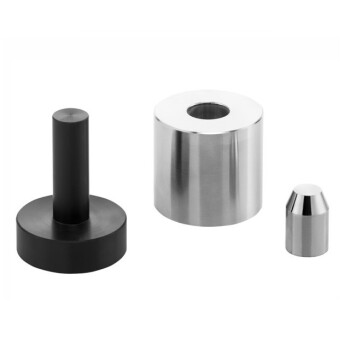
Precision molds serve as the fundamental control mechanism in the fabrication of sustainable insulation boards. They provide rigid, standardized geometric boundaries that shape mixtures of pulp and textile fibers into usable samples. By ensuring exact dimensional control during the formation process, these molds guarantee that every sample meets the strict requirements of international testing standards.
In the development of sustainable materials, geometric consistency is a prerequisite for accurate data. Precision molds eliminate physical irregularities, ensuring that subsequent measurements of thermal or moisture properties reflect the material's true performance rather than manufacturing defects.
The Mechanics of Standardization
Defining Geometric Boundaries
For loose mixtures like pulp and textile fibers, maintaining a consistent shape during formation is difficult without containment. Precision molds constrain these semi-fluid or fibrous mixtures into exact shapes. This prevents the material from spreading unevenly, ensuring the final board has defined edges and a uniform structure.
Enabling International Compliance
To validate a new insulation material, it must undergo rigorous testing. These tests often require samples to meet specific size and thickness protocols defined by international standards. Precision molds allow manufacturers and researchers to produce samples that automatically comply with these regulatory dimensions, streamlining the path from prototype to certified product.
Ensuring Data Reliability
Stabilizing Volume and Surface Area
Reliable insulation depends on consistent density. Molds provide stable support that dictates the exact volume the material occupies. By controlling the volume and surface area, the molds ensure that density remains constant across different production batches.
Guaranteeing Measurement Accuracy
Thermophysical parameter measurements—such as thermal conductivity or moisture resistance—are highly sensitive to thickness and surface quality. If a sample is uneven, the data will be flawed. Precision molds create uniform surfaces, allowing testing instruments to make proper contact and generate reliable, repeatable data.
Understanding the Trade-offs
Precision vs. Scalability
While precision molds are essential for creating testable samples and ensuring data integrity, they represent a static boundary. In a laboratory setting, this rigidity is perfect. However, transitioning from high-precision, fixed-size molds to continuous mass production lines often requires adapting the forming process, which can introduce new variability that must be managed.
Material Constraints
The mold provides external structure, but the internal mixture of pulp and fibers must still be formulated correctly. A precision mold cannot correct a chemically unstable mixture. It only ensures that the physical form is correct, meaning the raw material recipe remains a critical variable that the mold itself cannot fix.
Making the Right Choice for Your Project
To ensure your sustainable insulation meets performance goals, consider how you utilize molding technology:
- If your primary focus is Regulatory Certification: Ensure your molds are machined to the exact dimensions specified by the relevant international testing standards for thermal properties.
- If your primary focus is Research & Development: Prioritize molds with high rigidity to minimize dimensional variance, ensuring that any changes in performance are due to material formulation, not geometric error.
Precision in formation is the foundational step that turns raw sustainable fibers into trusted, high-performance building materials.
Summary Table:
| Feature | Impact on Insulation Board Production | Benefit for Researchers |
|---|---|---|
| Geometric Control | Defines exact boundaries and edges for pulp/fiber mixtures | Ensures compliance with international testing standards |
| Volume Stability | Maintains consistent material volume and surface area | Guarantees uniform density across different sample batches |
| Surface Uniformity | Creates perfectly flat and even sample surfaces | Eliminates measurement errors in thermal conductivity tests |
| Rigid Construction | Minimizes physical variance during the forming process | Ensures data reflects material performance, not defects |
Elevate Your Sustainable Material Research with KINTEK
Precision is the foundation of innovation. At KINTEK, we understand that accurate data starts with perfect sample formation. We specialize in comprehensive laboratory pressing solutions—including manual, automatic, heated, and multifunctional models, as well as specialized cold and warm isostatic presses.
Whether you are refining pulp and textile fiber mixtures or conducting advanced battery research, our equipment ensures your samples meet the most rigorous international standards. Don't let manufacturing defects compromise your research results.
Ready to achieve superior consistency in your lab?
References
- Stefania Liuzzi, Martellotta Francesco. Experimental analysis of building components with paper and textile waste. DOI: 10.1007/s12053-024-10223-y
This article is also based on technical information from Kintek Solution Knowledge Base .
Related Products
- Lab Polygon Press Mold
- Infrared Heating Quantitative Flat Plate Mold for Precise Temperature Control
- Lab Button Battery Tablet Press Sealing Mold
- Lab Anti-Cracking Press Mold
- Special Shape Lab Press Mold for Laboratory Applications
People Also Ask
- What is the purpose of incorporating cartridge heaters into a lab press mold for MLCC block compression? Optimize Results
- How do the design and geometric precision of pressing molds and mandrels affect the quality of PTFE composite samples?
- What role do precision positioning and pressure molds play in single-lap joints? Ensure 100% Data Integrity
- What are the requirements for pressing molds when using SSCG? Key Materials for Complex Single Crystal Production
- How do industrial-grade pressure molds affect zinc metal pouch cells? Maximize Energy Density & Performance