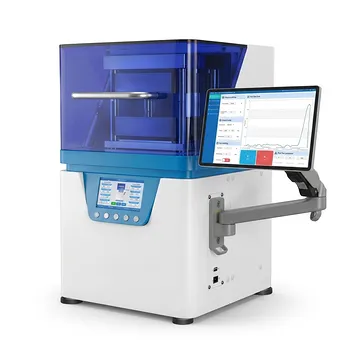
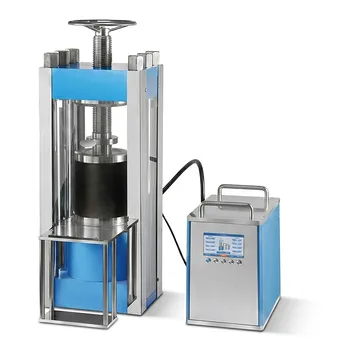
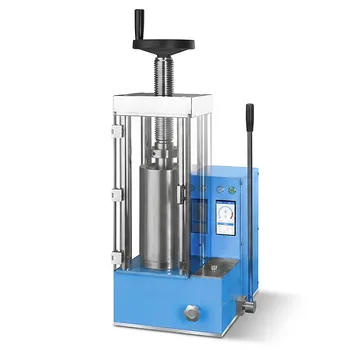
The laboratory electric heating press is the fundamental tool for "curing" Nitrile Butadiene Rubber (NBR) composites, providing the specific thermal energy and mechanical force required to transform raw compounds into functional elastomers. By maintaining high-pressure environments at precise temperatures (often 140°C to 160°C), the press drives the chemical crosslinking reaction—known as vulcanization—which converts the plastic rubber mixture into a stable, three-dimensional network structure.
Core Takeaway: A laboratory electric heating press acts as both a chemical catalyst and a physical mold, using simultaneous heat and pressure to trigger vulcanization while ensuring the final composite is dense, defect-free, and dimensionally consistent.
Driving the Chemical Vulcanization Process
Triggering the Crosslinking Reaction
The press provides a stable high-temperature environment required to activate vulcanizing agents like dicumyl peroxide (DCP). This thermal energy breaks chemical bonds and facilitates the formation of new bridges between rubber chains, transforming the material into a three-dimensional network.
Achieving Optimal Cure Time (t90)
Precise temperature control allows researchers to reach the optimal vulcanization time (t90), ensuring the reaction is complete without over-curing. This precision is vital for determining the final crosslink density, which dictates the material's mechanical strength and thermal stability.
Managing Thermal Energy Distribution
Electric heating elements within the plates ensure that heat is distributed uniformly across the mold. This prevents localized under-curing or "scorching," leading to a composite with homogeneous physical properties throughout the entire sample.
Ensuring Material Integrity and Uniformity
Pressure-Driven Degassing
During the compression molding process, high mechanical pressure (often reaching 14 MPa or higher) forces internal gases and air out of the compound. This degassing phase is critical to prevent the formation of internal voids or surface bubbles that would weaken the finished rubber sheet.
Achieving Dimensional Precision
The press maintains a constant load to ensure the rubber compound fills every corner of the mold cavity. This results in consistent specimen thickness (e.g., 2 mm) and a uniform geometric shape, which are non-negotiable requirements for standardized mechanical testing like tensile and hardness trials.
Density and Structural Consolidation
By applying high pressure—sometimes up to 300 kN depending on the equipment—the press compresses the NBR nanocomposites into a dense sheet structure. This physical compaction eliminates defects and ensures the material achieves its maximum theoretical density and durability.
Enhancing the Composite Interface
Promoting Interfacial Bonding
In NBR-fabric composites, the press ensures the rubber compound makes intimate contact with reinforcing fibers, such as polyester. The high-pressure environment drives the rubber to penetrate the surface of the fibers, significantly increasing interfacial peel strength.
Chemical and Physical Interlocking
The combination of heat and pressure promotes both chemical bonding and physical interlocking at the molecular level. This ensures that the NBR matrix and the reinforcing fillers or fabrics act as a unified composite material rather than separate layers.
Understanding the Trade-offs
Temperature vs. Material Degradation
While higher temperatures speed up the vulcanization process, excessive heat can lead to thermal degradation of the NBR polymer. Finding the balance between rapid production and maintaining the integrity of the rubber chains is a constant challenge in composite molding.
Pressure vs. Mold Wear
High pressure is necessary to eliminate voids, but excessive force can cause mold deformation or lead to "flash" (excess material leaking from the mold). Calibration is required to ensure enough pressure is applied to achieve density without damaging the precision-machined laboratory molds.
How to Apply This to Your Project
Making the Right Choice for Your Goal
- If your primary focus is mechanical performance testing: Ensure your press settings are calibrated for precise thickness and uniform degassing to produce standardized, defect-free test plates.
- If your primary focus is NBR-fabric adhesion: Prioritize high-pressure settings to force the rubber into the fiber interstices, maximizing the interfacial bond strength.
- If your primary focus is chemical research (nanocomposites): Focus on high-precision temperature control to accurately track how different fillers affect the vulcanization kinetics and t90 times.
By mastering the balance of thermal energy and mechanical compression, the laboratory heating press ensures that NBR composites transition from raw mixtures into high-performance engineering materials.
Summary Table:
| Function | Key Mechanism | Material Impact |
|---|---|---|
| Vulcanization | Controlled thermal energy | Converts raw rubber into a stable 3D network |
| Degassing | High mechanical pressure | Eliminates internal voids and surface bubbles |
| Dimensional Precision | Constant load application | Ensures uniform thickness and geometric consistency |
| Interfacial Bonding | Physical & chemical interlocking | Increases peel strength in NBR-fabric composites |
Elevate Your Composite Research with KINTEK Precision
Unlock the full potential of your material science projects with KINTEK’s industry-leading laboratory pressing solutions. Whether you are optimizing NBR vulcanization or advancing battery research, our equipment provides the precise thermal and mechanical control necessary for defect-free results.
Our Comprehensive Range Includes:
- Manual & Automatic Presses: For versatile load management.
- Heated & Multifunctional Models: Perfect for complex molding cycles.
- Glovebox-Compatible & Isostatic Presses: Specialized solutions for sensitive environments and uniform compaction.
Ready to achieve superior material integrity? Contact our experts today to find the perfect press for your laboratory needs!
References
- A. Abdel‐Hakim, S. F. Halim. Effect of poly (acrylamide-co-acrylic acid salt) on anti-aging properties and adhesion between acrylonitrile butadiene rubber and polyester fabric. DOI: 10.1007/s10965-023-03499-8
This article is also based on technical information from Kintek Solution Knowledge Base .
Related Products
- Cylindrical Lab Electric Heating Press Mold for Laboratory Use
- Automatic Large Format Laboratory Heated Hydraulic Press 400x400mm Plate Capacity
- 24T 30T 60T Heated Hydraulic Lab Press Machine with Hot Plates for Laboratory
- Automatic Heated Hydraulic Lab Press Machine 200x200 Plate Size for Battery Research and Materials Science
- Automatic Heated Hydraulic Press Machine with Hot Plates for Laboratory
People Also Ask
- What role does a laboratory electric heated press play in polymer composite fabrication? Key for Standardized Specimens
- How does a laboratory electric heated press ensure sample quality? Optimize SiR-EPDM vulcanization and molding.
- Why is a laboratory electric heating press required for PP/EPDM molding? Achieve Superior Specimen Integrity
- What is the purpose of incorporating cartridge heaters into a lab press mold for MLCC block compression? Optimize Results
- Which lab press parameters are critical for PLA sheet quality? Master Temperature, Pressure & Cooling