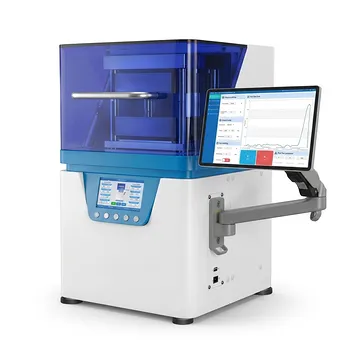
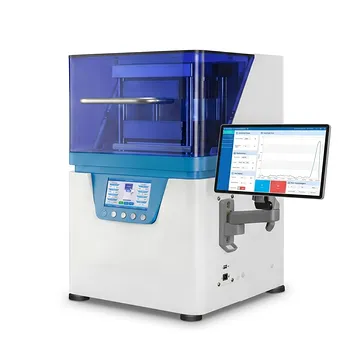
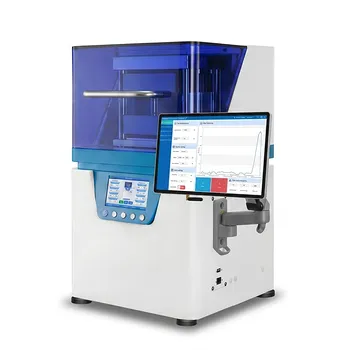
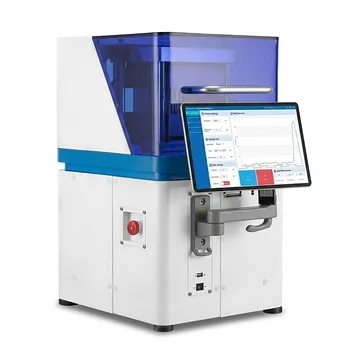
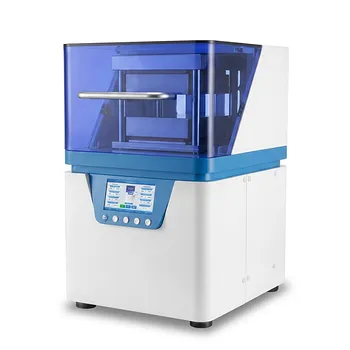
The laboratory heated hydraulic press acts as the critical consolidation point in the production of PLA/MCC composites, transforming loose mixtures into standardized, high-density test specimens. By simultaneously applying regulated thermal energy and high hydraulic pressure, the press eliminates structural defects such as air bubbles and internal voids while ensuring the composite achieves a uniform thickness and smooth surface finish.
The primary role of the heated hydraulic press is to transition PLA/MCC materials from a bulk or pelletized state into a homogenous, isotropic solid. This process is essential for removing internal pores and controlling the material's microscopic morphology, which directly determines the reliability of subsequent mechanical and thermal analysis.
Structural Consolidation and Defect Elimination
Removal of Internal Voids and Air Bubbles
During the initial mixing or extrusion of polylactic acid (PLA) and microcrystalline cellulose (MCC), air often becomes trapped within the material. The hydraulic press applies extreme pressure—often reaching levels between 10 MPa and 100 MPa—to force these gases out, preventing internal pores that would otherwise act as stress concentrators.
Improving Bulk Density and Surface Quality
By forcing the polymer melt to flow and pack tightly around the MCC fibers, the press ensures a consistent bulk density throughout the sheet. This high-pressure environment results in a smooth, uniform surface that is vital for accurate measurements in physical property characterization.
Facilitating Material Flow through Pre-heating
The process typically begins with a pre-heating phase where the material is softened without pressure. This allows the PLA to reach its melting point or glass transition temperature, ensuring it can flow effectively once the hydraulic load is applied to fill the mold completely.
Standardization for Material Characterization
Ensuring Uniform Specimen Thickness
To obtain valid data from tensile testing or Dynamic Mechanical Thermal Analysis (DMTA), specimens must have a standardized thickness (often ranging from 0.3 mm to 2.5 mm). The press uses precision-machined molds and spacers to maintain dimensional stability across the entire surface of the composite sheet.
Creating Isotropic Material Properties
The stable, uniaxial load provided by the hydraulic system helps create isotropic or pre-oriented samples. This uniformity ensures that the mechanical data collected during testing is representative of the material's intrinsic properties rather than a result of processing inconsistencies.
Precision Control of Thermal Environment
Laboratory presses offer exact temperature regulation, often between 180°C and 220°C for PLA composites. This precision is necessary to achieve a full melt of the PLA matrix without causing the thermal degradation of the organic MCC fibers.
Controlling Microscopic Morphology
Influencing Crystallization Behavior
The rate at which the heated plates cool, combined with the pressure held during that cooling, dictates the crystallization behavior of the PLA. Researchers use this control to study how the microscopic structure of the composite changes under specific processing conditions.
Managing Phase Separation
In complex composites, the press helps manage the phase separation structure between the polymer and the filler. Proper pressure ensures that the MCC is well-distributed and bonded within the PLA matrix, preventing delamination or cracking during the final cooling stage.
Understanding the Trade-offs
The Risk of Thermal Degradation
While heat is necessary for flow, prolonged exposure to high temperatures in the press can lead to the depolymerization of PLA. It is a delicate balance to ensure the material is hot enough to remove voids but not so hot that the polymer chains begin to break down, weakening the final product.
Pressure-Induced Fiber Damage
Applying excessive pressure (e.g., exceeding 100 MPa) can potentially damage the structural integrity of the MCC fibers. If the pressure is too high, it may crush the reinforcing cellulose particles, leading to a decrease in the composite's overall mechanical performance.
Applying This Process to Your Research
When utilizing a heated hydraulic press for PLA/MCC composites, your approach should vary based on your specific analytical goals:
- If your primary focus is mechanical strength testing: Prioritize the elimination of internal voids by using higher pressure (400 bar/40 MPa) and ensuring a thorough pre-heating phase to achieve maximum density.
- If your primary focus is studying crystallization or morphology: Focus on the precise control of the cooling rate and plate temperature distribution to observe how the PLA matrix organizes around the MCC.
- If your primary focus is rapid prototyping of thin films: Utilize stable, moderate pressure at temperatures near 190°C to produce uniform 0.3 mm sheets while minimizing the duration of thermal exposure.
By mastering the balance of heat and pressure, you ensure that the resulting PLA/MCC composite is a true representation of the material's potential.
Summary Table:
| Key Process Role | Critical Parameter | Research Benefit |
|---|---|---|
| Structural Consolidation | 10 MPa - 100 MPa Pressure | Eliminates air bubbles and internal voids |
| Precision Heating | 180°C - 220°C Temperature | Ensures matrix flow while preventing degradation |
| Standardization | 0.3 mm - 2.5 mm Thickness | Guarantees dimensional stability for tensile testing |
| Morphology Control | Regulated Cooling Rate | Optimizes PLA crystallization and phase distribution |
Elevate Your Material Research with KINTEK Precision
Take the guesswork out of composite fabrication. KINTEK specializes in comprehensive laboratory pressing solutions tailored for high-stakes research. Whether you are developing PLA/MCC composites or advancing battery research, our equipment provides the exact thermal and pressure control necessary for isotropic, defect-free samples.
Our versatile range includes:
- Manual & Automatic Heated Presses for streamlined sample preparation.
- Multifunctional & Glovebox-Compatible Models for sensitive environments.
- Cold and Warm Isostatic Presses for specialized density requirements.
Ready to achieve superior sample reliability? Contact KINTEK today to find the perfect press for your laboratory!
References
- Teerapa Semachai, Pravitra Chandranupap. Preparation of Microcrystalline Cellulose from Water Hyacinth Reinforced Polylactic Acid Biocomposite. DOI: 10.1051/matecconf/201818702003
This article is also based on technical information from Kintek Solution Knowledge Base .
Related Products
- 24T 30T 60T Heated Hydraulic Lab Press Machine with Hot Plates for Laboratory
- Automatic Large Format Laboratory Heated Hydraulic Press 400x400mm Plate Capacity
- Automatic Heated Hydraulic Lab Press with Programmable Touch Screen Controls and Precision Temperature Regulation
- Automatic Heated Hydraulic Press Machine with Hot Plates for Laboratory
- Automatic Heated Hydraulic Lab Press 120x120mm Plate Fully Automated Material Research Press
People Also Ask
- Function of a Laboratory Hydraulic Press with Heated Platens in SSE? Enhance Battery Density & Conductivity
- Why is a laboratory hydraulic press with heating plates required for PLA/TEC films? Achieve Precise Sample Integrity
- What role does a laboratory heated hydraulic press play in LTCC? Essential for High-Density Ceramic Lamination
- Why reduce load when applying composite strengthening tabs? Protect Specimen Integrity and Data Accuracy
- Why is a laboratory heated hydraulic press required? Ensure Precise Vulcanization for NBR/EPDM Nanocomposites