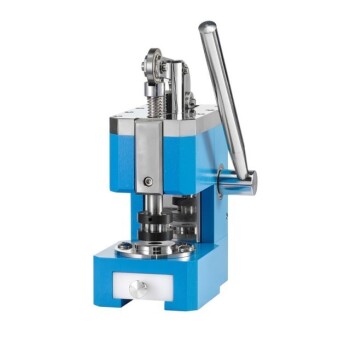
A laboratory high-precision grinding machine serves as the critical geometric equalizer in specimen preparation. Its primary function is to machine the end faces of the composite specimen until they are perfectly flat and strictly perpendicular to the longitudinal axis of the stainless steel tube. This mechanical leveling ensures that when force is applied, both the external steel tube and the inner concrete core engage the load simultaneously and uniformly.
By eliminating surface irregularities, high-precision grinding prevents eccentric loading and premature local buckling. It guarantees that axial pressure is distributed evenly across the entire cross-section, which is essential for generating valid, reproducible structural data.
The Mechanics of Surface Preparation
Achieving Geometric Perfection
The raw ends of a cast concrete specimen are rarely smooth or perfectly aligned. The grinding machine abrades these surfaces to remove high spots and irregularities.
This process ensures the end faces are perfectly flat, preventing point-loading where force is concentrated on a single protrusion rather than the whole surface.
Simultaneously, it ensures the face is perpendicular to the tube's axis. This is vital to ensure the load is applied straight down the center (axially) rather than at an angle.
Synchronizing Material Engagement
In a tube-confined specimen, you are testing two materials with different properties: the stainless steel shell and the lightweight aggregate concrete core.
If the concrete sticks out slightly further than the steel, it will crush before the steel is engaged. If the steel protrudes, it may buckle before the concrete takes the load.
High-precision grinding creates a flush surface, forcing the steel and concrete to act as a unified composite from the very first moment of loading.
Preventing Premature Failure
Uneven surfaces create uneven stress distribution. This can lead to local buckling of the stainless steel tube at the edges.
If the tube buckles locally due to a surface imperfection, the confinement effect is lost, and the test data becomes invalid. Grinding removes the geometric flaws that trigger these premature failure modes.
The Impact on Experimental Data
Eliminating Eccentric Loading
When a specimen's top surface is slanted, the testing machine applies force off-center. This is known as eccentric loading.
Eccentric loading introduces unwanted bending moments into a compression test, skewing the results. A ground, perpendicular surface ensures the physics of the test match the theoretical model of pure axial compression.
Enhancing Pre-loading Effectiveness
Before the actual test, a hydraulic press typically applies a small load (under 10% of capacity) to settle the specimen.
While the press removes physical gaps, it cannot correct a slanted specimen. Grinding is the prerequisite that allows this pre-loading phase to successfully establish a linear initial segment for the load-displacement curve.
Common Pitfalls to Avoid
The Risk of Relying on Capping
Some technicians attempt to level uneven specimens using capping materials (like high-strength gypsum or sulfur) instead of grinding.
For high-strength or confined concrete, capping is often insufficient. The capping material may crush or flow under high pressure, introducing "soft" layers that distort the stiffness data of the composite specimen.
Over-Grinding the Specimen
While flatness is key, one must be careful not to grind away too much material.
Excessive processing can significantly shorten the specimen, altering the aspect ratio (height-to-width ratio). This can unintentionally change the confinement physics and make results difficult to compare with standard samples.
Making the Right Choice for Your Goal
To ensure your experimental setup yields scientifically reliable data, apply the grinding process based on your specific testing objectives:
- If your primary focus is determining ultimate bearing capacity: Ensure the steel tube and concrete core are ground absolute flush so the composite action begins immediately upon loading.
- If your primary focus is analyzing elastic stiffness: Prioritize perpendicularity to prevent eccentric moments that will distort the linear portion of your stress-strain curves.
Precision grinding is not merely an aesthetic step; it is the fundamental baseline required to validate the structural integrity of your research.
Summary Table:
| Preparation Challenge | Impact of Precision Grinding | Benefit to Test Data |
|---|---|---|
| Surface Irregularity | Achieves perfectly flat end faces | Prevents point-loading and stress concentration |
| Misalignment | Ensures perpendicularity to the longitudinal axis | Eliminates eccentric loading and bending moments |
| Material Mismatch | Creates a flush surface for steel and concrete | Synchronizes composite action from start of loading |
| Premature Failure | Removes geometric flaws at specimen edges | Prevents local buckling and invalid failure modes |
Maximize the Precision of Your Laboratory Results
At KINTEK, we understand that structural integrity research demands absolute geometric accuracy. As specialists in comprehensive laboratory pressing and sample preparation solutions, we offer a diverse range of equipment—including manual, automatic, heated, and multifunctional models, as well as cold and warm isostatic presses—engineered to meet the rigorous standards of battery research and material science.
Don't let surface imperfections compromise your data. Our advanced grinding and pressing solutions ensure your specimens are perfectly prepared for every load.
Contact KINTEK Experts Today to find the ideal equipment for your laboratory needs.
References
- Ruiqing Zhu, Haitao Chen. A Study of the Performance of Short-Column Aggregate Concrete in Rectangular Stainless Steel Pipes under Axial Compression. DOI: 10.3390/buildings14030704
This article is also based on technical information from Kintek Solution Knowledge Base .
Related Products
- Lab Polygon Press Mold
- Automatic High Temperature Heated Hydraulic Press Machine with Heated Plates for Lab
- Automatic Laboratory Hydraulic Press Lab Pellet Press Machine
- Laboratory Hydraulic Press Lab Pellet Press Machine for Glove Box
- Laboratory Split Manual Heated Hydraulic Press Machine with Hot Plates
People Also Ask
- What is the purpose of incorporating cartridge heaters into a lab press mold for MLCC block compression? Optimize Results
- How do the design and geometric precision of pressing molds and mandrels affect the quality of PTFE composite samples?
- What role do precision positioning and pressure molds play in single-lap joints? Ensure 100% Data Integrity
- What are the requirements for pressing molds when using SSCG? Key Materials for Complex Single Crystal Production
- How do industrial-grade pressure molds affect zinc metal pouch cells? Maximize Energy Density & Performance