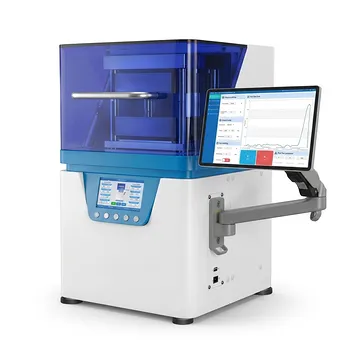
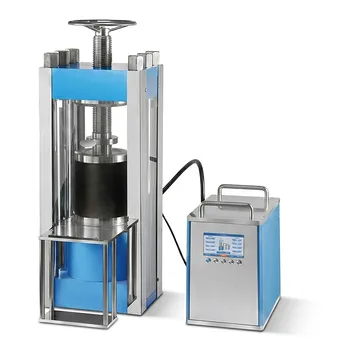
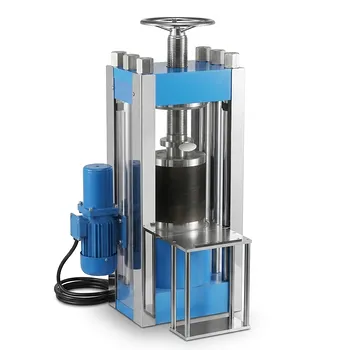
The laboratory hot press is the critical instrument for transforming raw PPS materials into high-performance composites by providing synchronized thermal and mechanical energy. It establishes a controlled environment where the Polyphenylene Sulfide (PPS) resin melts and flows under high-precision pressure, ensuring microscopic impregnation into carbon fiber reinforcements while defining the material’s final crystalline structure.
Core Takeaway: A laboratory hot press serves as the bridge between raw material and functional composite by precisely managing the interplay of temperature and pressure to eliminate internal defects and optimize the polymer's crystalline morphology.
The Mechanics of Secondary Molding in PPS Composites
Thermal Management and PPS Melting
The hot press provides the high-temperature environment—often exceeding 280°C to 300°C—required to reach the melting point of PPS. This thermal energy induces thermal rheology, allowing the semi-crystalline polymer to transition into a liquid state capable of movement.
Pressure-Driven Microscopic Impregnation
High-precision pressure is applied to force the molten PPS resin into the interstitial spaces of the fiber reinforcement. This mechanical force ensures thorough wetting of the fibers and establishes a strong interfacial bond, which is the foundation of the composite's mechanical integrity.
Degassing and Void Elimination
As the material is compressed, the hot press facilitates pressurized degassing, effectively forcing out trapped air and volatiles. By eliminating internal air bubbles and micro-voids, the equipment produces a dense microstructure with extremely low porosity.
Defining Material Performance Through Controlled Cooling
Crystallization and Morphology Control
The cooling cycle of a laboratory hot press is as critical as the heating phase because it dictates the self-nucleation behavior of the PPS matrix. Precise control over the cooling rate allows researchers to manipulate the crystal morphology, which directly influences the toughness and chemical resistance of the final part.
Achieving Uniformity and Standardization
By maintaining a constant pressure and a uniform temperature field across the mold surface, the hot press produces samples with consistent thickness and uniform physical properties. This repeatability is essential for generating standardized specimens required for accurate interlaminar and mechanical performance testing.
Bridging Laboratory Data to Industrial Scale
The laboratory hot press acts as a pilot-scale simulator for industrial production. It allows engineers to translate thermal analysis data into viable processing windows, optimizing dwell times and pressure gradients before moving to large-scale manufacturing.
Understanding the Trade-offs and Pitfalls
Thermal Degradation vs. Incomplete Melting
Setting the temperature too high can lead to the oxidative degradation of the PPS resin, compromising its molecular weight and strength. Conversely, insufficient heat results in high melt viscosity, leading to "dry" spots where the resin failed to impregnate the fibers.
Pressure Gradients and Internal Stress
While high pressure is necessary for densification, excessive or uneven pressure can cause fiber misalignment or "washout." Furthermore, rapid cooling under high pressure can lock in significant internal processing stresses, which may lead to warping or premature failure of the composite.
How to Apply This to Your Project
Making the Right Choice for Your Goal
To achieve the best results with PPS secondary molding, align your hot press parameters with your specific performance requirements.
- If your primary focus is Maximum Mechanical Strength: Prioritize high-precision pressure control and extended dwell times to ensure zero porosity and total fiber wetting.
- If your primary focus is Chemical or Thermal Resistance: Focus on the cooling cycle to maximize the crystallinity of the PPS matrix, as higher crystallinity improves environmental stability.
- If your primary focus is Industrial Process Scaling: Use the hot press to map the "processing window" by varying temperature and pressure increments to find the most efficient cycle time.
By mastering the synchronization of heat and pressure, the laboratory hot press transforms PPS from a simple thermoplastic into a sophisticated, high-performance structural composite.
Summary Table:
| Stage | Key Function | Desired Outcome |
|---|---|---|
| Heating | Thermal rheology (280°C-300°C) | Transition PPS to a liquid state for flow |
| Pressuring | Microscopic impregnation | Strong interfacial bonding and fiber wetting |
| Degassing | Void and bubble elimination | Dense microstructure with low porosity |
| Cooling | Managed crystallization | Optimized toughness and chemical resistance |
| Standardization | Uniform pressure/temp field | Consistent specimen thickness and properties |
Elevate Your Material Research with KINTEK Precision
Unlock the full potential of your PPS composites and battery research with KINTEK’s comprehensive laboratory pressing solutions. We specialize in providing the high-precision tools necessary for advanced secondary molding, ensuring your materials meet the most rigorous standards.
Our Versatile Range Includes:
- Manual & Automatic Hot Presses: For precise thermal and mechanical control.
- Heated & Multifunctional Models: Tailored for complex material processing.
- Glovebox-Compatible Presses: Specialized solutions for sensitive environments.
- Cold & Warm Isostatic Presses (CIP/WIP): Ideal for isotropic density in advanced battery research.
Whether you are mapping processing windows or scaling up for industrial production, KINTEK offers the reliability and expertise your lab requires. Contact us today to find the perfect pressing solution for your application!
References
- Ren Yi, Muhuo Yu. The Influence of Thermal Parameters on the Self-Nucleation Behavior of Polyphenylene Sulfide (PPS) during Secondary Thermoforming. DOI: 10.3390/ma17040890
This article is also based on technical information from Kintek Solution Knowledge Base .
Related Products
- 24T 30T 60T Heated Hydraulic Lab Press Machine with Hot Plates for Laboratory
- Laboratory Split Manual Heated Hydraulic Press Machine with Hot Plates
- Heated Hydraulic Press Machine with Heated Plates for Vacuum Box Laboratory Hot Press
- Automatic Heated Hydraulic Press Machine with Hot Plates for Laboratory
- Laboratory Manual Heated Hydraulic Press Machine with Hot Plates
People Also Ask
- Function of a Laboratory Hydraulic Press with Heated Platens in SSE? Enhance Battery Density & Conductivity
- Why is a laboratory hydraulic press with heating plates required for PLA/TEC films? Achieve Precise Sample Integrity
- What role does a laboratory heated hydraulic press play in LTCC? Essential for High-Density Ceramic Lamination
- What is the primary function of a laboratory heated hydraulic press? Mastering Thermoplastic Carbon Fiber Composites
- Why reduce load when applying composite strengthening tabs? Protect Specimen Integrity and Data Accuracy