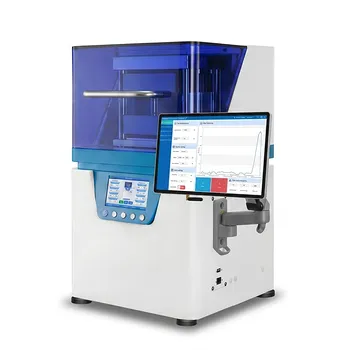
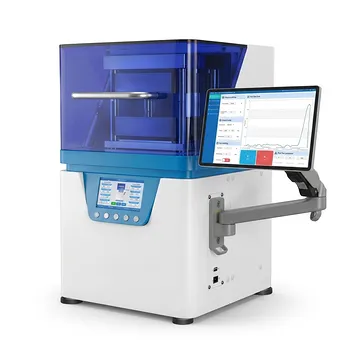
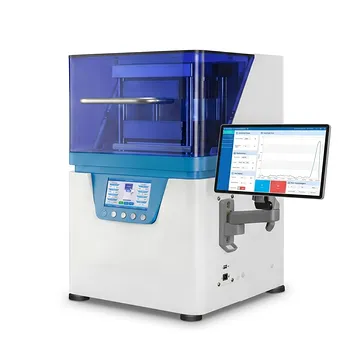
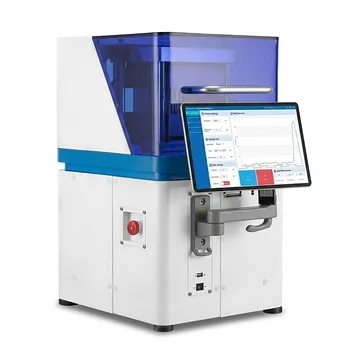
The laboratory hydraulic press is the critical instrument used to transform loose TiB2-TiC reaction powders into dense, cylindrical "green bodies" of specific dimensions. This pre-pressing stage provides the necessary compaction to achieve preliminary densification and establishes a precise spatial arrangement of reactants. By reducing internal voids, the press ensures efficient heat transfer and the stable propagation of the combustion wave during the synthesis process.
The laboratory hydraulic press acts as the physical foundation for composite synthesis by converting powder mixtures into high-density compacts. This process is essential for controlling the thermal conductivity and chemical reactivity required for successful high-temperature sintering and material formation.
Achieving Structural Integrity and Density
The Formation of the Green Body
The primary role of the press is to apply axial pressure to uniformly mixed powders within a mold to create a "green body." This compact has a predefined shape and sufficient mechanical strength to be handled during subsequent synthesis stages.
Inducing Particle Rearrangement and Plastic Deformation
High-pressure loads, often ranging from 600 MPa to 900 MPa, drive the rearrangement of particles to fill large internal voids. As pressure increases, the mechanical energy induces plastic deformation, forcing particles into closer contact and increasing the relative density of the material.
Minimizing Internal Porosity
By effectively reducing the space between powder particles, the hydraulic press minimizes porosity. This reduction is vital for creating a continuous physical medium that supports the high-precision requirements of aerospace and automotive applications.
Optimizing the Synthesis Environment
Facilitating Heat Transfer and Combustion Waves
In TiB2-TiC synthesis, the spatial arrangement of reactants dictates how energy moves through the sample. A well-pressed green body allows for stable propagation of the combustion wave, ensuring the reaction occurs uniformly throughout the material.
Creating the Foundation for Atomic Diffusion
The tight packing achieved during pre-pressing establishes the physical contact points necessary for atomic diffusion. This facilitates the densification process during subsequent high-temperature vacuum sintering, leading to a more homogenous final structure.
Ensuring Uniform Component Distribution
Precise pressure control ensures that reinforcing particles and matrices are distributed uniformly across the compact. This prevents localized clusters of material, which could otherwise lead to structural weaknesses or inconsistent thermal properties in the final composite.
Understanding the Trade-offs
Balancing Density with Gas Escape
While high density is generally preferred, excessive pressure can lead to over-compaction. If the green body is too dense, it may trap reaction gases, leading to internal cracking or "bloating" during the high-temperature synthesis phase.
Pressure Limits and Material Integrity
Applying pressure beyond the point where density stabilizes—often around 800 MPa—yields diminishing returns. Pushing the equipment or the material beyond these limits can cause die wear or induce micro-cracks in the green body that compromise the final product's integrity.
Precision vs. Throughput
Using a manual press allows for tactile feedback but lacks the repeatability of digital monitoring systems. High-precision presses with digital recording are necessary for identifying the exact point of density stabilization, though they require more complex setup and calibration.
Applying This to Your Material Synthesis
Making the Right Choice for Your Goal
To achieve the best results in TiB2-TiC composite synthesis, the pressing parameters must be tailored to the specific powder characteristics and the intended final use.
- If your primary focus is maximizing mechanical strength: Apply pressures at the higher end of the 600-800 MPa range to ensure maximum particle contact and plastic deformation.
- If your primary focus is stable combustion wave propagation: Focus on achieving high uniformity in the green body's density rather than absolute maximum pressure to ensure consistent heat transfer.
- If your primary focus is minimizing internal defects: Utilize a digital monitoring system to identify the precise pressure where density stabilizes, avoiding the risks of over-compaction.
The laboratory hydraulic press is not merely a molding tool, but a precision instrument that determines the thermal and structural viability of the final composite material.
Summary Table:
| Process Stage | Key Function | Impact on Synthesis |
|---|---|---|
| Compaction | Converts powder to "green bodies" | Provides mechanical strength for handling |
| Densification | Reduces porosity (600-900 MPa) | Ensures stable propagation of combustion waves |
| Particle Alignment | Induces plastic deformation | Establishes contact points for atomic diffusion |
| Pressure Control | Uniform component distribution | Prevents structural weaknesses and clusters |
Optimize Your Material Synthesis with KINTEK
Achieve unmatched precision in your research with KINTEK’s comprehensive laboratory pressing solutions. Whether you are synthesizing advanced TiB2-TiC composites or conducting cutting-edge battery research, our equipment provides the structural integrity and density control your projects demand.
Our diverse range includes:
- Manual & Automatic Models for tailored pressure application.
- Heated & Multifunctional Presses for complex material transformations.
- Glovebox-Compatible Systems for air-sensitive synthesis.
- Cold & Warm Isostatic Presses for uniform densification.
Don't let inconsistent density compromise your results. Contact KINTEK today to find the perfect pressing solution for your laboratory!
References
- Gigo Jandieri, David Sakhvadze. Controlled Synthesis of TiB2-TiC Composite: Substantiation of the Homogenizing Joule Thermostatting Efficiency and Improvement of SHS-Compaction Technology in a Vacuum. DOI: 10.21272/jes.2024.11(2).c2
This article is also based on technical information from Kintek Solution Knowledge Base .
Related Products
- 24T 30T 60T Heated Hydraulic Lab Press Machine with Hot Plates for Laboratory
- Automatic Heated Hydraulic Press Machine with Heated Plates for Laboratory
- Laboratory Hydraulic Press 2T Lab Pellet Press for KBR FTIR
- Automatic Heated Hydraulic Press Machine with Hot Plates for Laboratory
- Automatic Laboratory Hydraulic Press Lab Pellet Press Machine
People Also Ask
- Function of a Laboratory Hydraulic Press with Heated Platens in SSE? Enhance Battery Density & Conductivity
- Why is a laboratory hydraulic press with heating plates required for PLA/TEC films? Achieve Precise Sample Integrity
- What role does a laboratory heated hydraulic press play in LTCC? Essential for High-Density Ceramic Lamination
- What is the primary function of a laboratory heated hydraulic press? Mastering Thermoplastic Carbon Fiber Composites
- What is the critical role of a laboratory heated hydraulic press? Mastering PVC Sample Prep for Testing