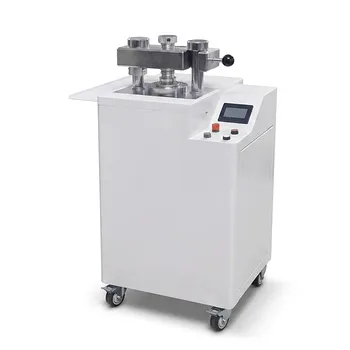
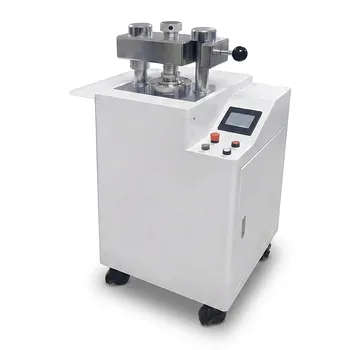
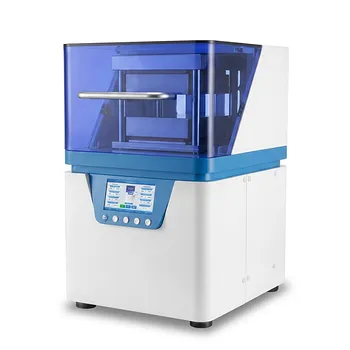
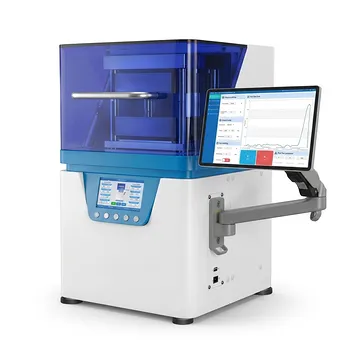
The laboratory hydraulic press is the critical tool used to transform opaque glass powder into a transparent "KBr pellet" suitable for infrared analysis. By applying high pressure (typically around 70 MPa) to a mixture of ground glass and potassium bromide (KBr), the press induces plastic flow to create a thin, cohesive disc. This process ensures the sample is transparent enough for an infrared beam to pass through with minimal scattering, allowing for the capture of accurate molecular structural data.
Core Takeaway: The hydraulic press serves as the bridge between raw solid material and a spectroscopically viable sample by eliminating air pockets and internal pores, resulting in a uniform, transparent medium that maximizes the signal-to-noise ratio in FT-IR analysis.
The Mechanics of Solid-State Sample Preparation
Inducing Plastic Flow in the Mixture
A hydraulic press applies several tons of stable, uniform force to a mixture of glass powder and KBr within a precision die. This extreme pressure causes the KBr—a material transparent to infrared light—to undergo plastic flow, effectively "welding" the particles together into a solid disc.
Achieving Optimal Sample Dilution
Glass samples are often too refractive or concentrated to be analyzed in their pure solid form. The press allows the glass to be diluted within the KBr matrix, creating a pellet that falls within the detection range of the FT-IR instrument while maintaining the structural integrity of the sample.
Ensuring Disc Uniformity
Standardization is vital for repeatable results. The press ensures that the resulting pellet has a uniform thickness, which is necessary for quantitative analysis and the acquisition of a clear vibrational spectrum.
Optimizing Optical Clarity for Infrared Transmission
Elimination of Internal Pores and Air Pockets
The primary obstacle to accurate FT-IR transmission is light scattering caused by air trapped between powder particles. The high-pressure environment of the hydraulic press eliminates internal pores, creating a dense, continuous medium that allows the infrared beam to penetrate effectively.
Reduction of Scattering Interference
When the sample and KBr are not properly bonded, the infrared beam reflects off particle boundaries rather than passing through them. By creating a homogeneous pellet, the press minimizes this scattering, resulting in a high signal-to-noise ratio and clear spectral peaks.
Transforming Refractive Solids into Transparent Films
Many glass materials are naturally refractive, which can distort spectral data. The press effectively transforms these materials into a transparent film-like state, which is the fundamental requirement for obtaining the molecular framework's "fingerprint" via transmission spectroscopy.
Understanding the Trade-offs and Challenges
The Risk of Moisture Absorption
Potassium bromide (KBr) is highly hygroscopic, meaning it readily absorbs moisture from the air. If the pressing process is too slow or the environment is humid, water can become trapped in the pellet, leading to unwanted "O-H" peaks in the infrared spectrum that obscure sample data.
Material Contamination and Die Wear
The use of precision dies under high pressure introduces the risk of cross-contamination if the equipment is not meticulously cleaned between samples. Additionally, extremely hard glass particles can eventually cause microscopic wear on the die surfaces, affecting the surface quality of the pellets.
Pressure Limits and Pellet Cracking
Applying too little pressure results in an opaque, fragile pellet that scatters light, while excessive pressure or rapid decompression can cause the pellet to crack or "cloud" after being removed from the die. Finding the specific pressure balance (often around 5 to 10 tons) is essential for glass-KBr mixtures.
How to Apply This to Your Project
Recommendations Based on Your Analysis Goals
- If your primary focus is high-quality transmission data: Use an automatic hydraulic press to ensure consistent, repeatable pressure cycles that minimize human error and pellet variability.
- If your primary focus is rapid, qualitative screening: A manual hydraulic press is a cost-effective solution that provides sufficient force for creating standard KBr pellets.
- If your primary focus is analyzing moisture-sensitive samples: Perform the pressing process in a controlled environment or use a vacuum-equipped die to remove air and moisture before compression.
The laboratory hydraulic press remains the definitive standard for preparing solid glass samples, providing the physical transformation necessary to unlock detailed molecular insights through infrared spectroscopy.
Summary Table:
| Feature | Function in FT-IR Prep | Benefit to Analysis |
|---|---|---|
| High Pressure (~70 MPa) | Induces plastic flow in KBr/Glass mixture | Creates a solid, cohesive, transparent disc |
| Pore Elimination | Removes internal air pockets | Minimizes light scattering for clear peaks |
| Uniform Compression | Ensures consistent pellet thickness | Provides repeatable quantitative results |
| Vacuum Capability | Removes moisture and air before pressing | Prevents O-H peak interference from humidity |
Elevate Your Spectroscopy with KINTEK Precision
Achieving the perfect KBr pellet requires more than just force—it requires precision and reliability. KINTEK specializes in comprehensive laboratory pressing solutions designed to meet the rigorous demands of material science and battery research.
Whether you need a manual, automatic, heated, multifunctional, or glovebox-compatible model, or are looking for cold and warm isostatic presses, our equipment ensures optimal sample uniformity and optical clarity.
Ready to optimize your FT-IR sample preparation? Contact KINTEK today to find the perfect press for your lab!
References
- Fathy Abdel-Wahab, Heba Abdelmaksoud. Investigation of oxygen defects in chromium-doped borosilicate glass co-doped with alkali metal (Na2O) and transition metal (ZnO) for photonic applications. DOI: 10.1007/s00339-024-08114-1
This article is also based on technical information from Kintek Solution Knowledge Base .
Related Products
- Laboratory Hydraulic Press 2T Lab Pellet Press for KBR FTIR
- Laboratory Hydraulic Pellet Press for XRF KBR FTIR Lab Press
- Automatic Laboratory Hydraulic Press for XRF and KBR Pellet Pressing
- Manual Laboratory Hydraulic Pellet Press Lab Hydraulic Press
- Automatic Laboratory Hydraulic Press Lab Pellet Press Machine
People Also Ask
- What is the role of a laboratory pressure machine and KBr in FTIR? Master Sample Preparation for Flame Retardants
- What is the role of a laboratory hydraulic press in high-loading NCM811 cathode prep for solid-state batteries?
- What role does a laboratory hydraulic press play in reaction pellets? Optimizing Lunar Soil and Metal Fuel Density
- Why is a laboratory hydraulic press necessary for sample preparation? Precise Pelleting for Spiro Heterocyclic Analysis
- What is the role of a laboratory hydraulic press in the preparation of Covalent Organic Framework (COF) precursors?