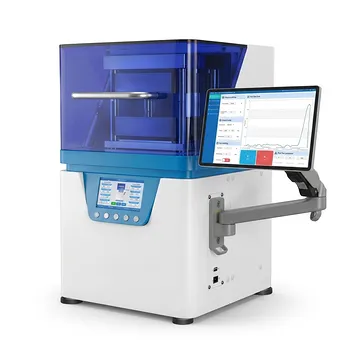
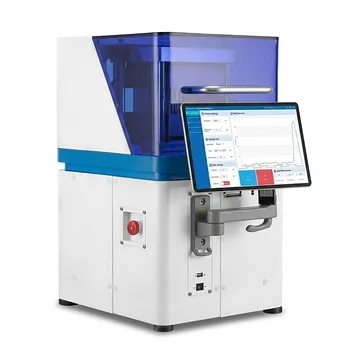
The application of a laboratory hydraulic press significantly improves Tungsten Trioxide (WO3) electrode performance by maximizing particle contact and minimizing internal resistance. Through the application of precise, uniform pressure, the press compacts the WO3 particles, conductive agents, and binders onto the current collector. This structural densification lowers ohmic resistance and optimizes the diffusion pathways for ions, directly resulting in higher energy density and improved electrochemical stability.
Core Takeaway: The laboratory hydraulic press serves as a critical tool for architectural control, transforming loose WO3 material into a dense, cohesive electrode sheet. By precisely regulating compaction, researchers can balance the trade-off between electrical conductivity and ionic permeability to maximize the electrode's overall efficiency.
Enhancing Electrical Conductivity and Ohmic Efficiency
Reducing Interfacial and Contact Resistance
The primary benefit of using a hydraulic press is the increase in contact density between the active WO3 particles and the conductive agents. This compaction ensures that the active material is in intimate contact with the current collector, which drastically reduces the electrode's overall ohmic resistance.
Strengthening the Electron Transport Network
By applying constant pressure, the press eliminates gaps between individual particles, creating a continuous and robust electron transport network. This allows for faster electron movement throughout the electrode layer, which is essential for maintaining performance during high-rate discharge cycles.
Improving Adhesion to the Current Collector
The hydraulic press facilitates a tight bonding between the WO3 mixture and the substrate (such as nickel foam or foil). This mechanical interlocking prevents the active material from delaminating or shedding during volume changes that occur during ion intercalation.
Optimizing Microstructure and Energy Density
Increasing Volumetric Energy Density
A hydraulic press effectively eliminates excess internal voids and air pockets within the electrode sheet. By increasing the volumetric density of the WO3, more active material can be packed into a smaller space, significantly increasing the energy stored per unit volume.
Controlling Electrode Porosity
While density is important, the press allows for the precise control of porosity, which determines how easily an electrolyte can penetrate the electrode. Proper compaction ensures the pore structure is optimized to provide the shortest possible diffusion paths for lithium or other ions without sacrificing structural integrity.
Managing High Mass Loading Conditions
For electrodes with high loading levels—often exceeding 10 mg/cm²—a hydraulic press is vital for maintaining a uniform thickness. It ensures that even "thick" electrodes maintain low interfacial resistance and high areal capacitance by distributing the active material evenly across the collector.
Understanding the Trade-offs of Compaction
The Risk of Over-Compaction and Pore Closure
Applying excessive pressure can lead to "over-densification," where the internal pores are completely closed. This prevents the electrolyte from "wetting" the internal surfaces of the WO3, leading to high polarization and reduced ion mobility.
Potential Damage to Material Morphology
Tungsten Trioxide often features specific hierarchical structures or morphologies that are critical for its performance. If the hydraulic press is used without calibrated pressure, it can crush these microstructures, potentially reducing the surface area available for electrochemical reactions.
Mechanical Stress on the Current Collector
High-pressure compaction can sometimes induce mechanical strain or deformation in thin current collectors. This can lead to micro-cracking or warping of the electrode sheet, which compromises the long-term structural durability of the battery or supercapacitor cell.
How to Apply Compaction to Your Project
When utilizing a laboratory hydraulic press for WO3 electrode preparation, your pressure settings should align with your specific performance objectives.
- If your primary focus is High Power Density: Use moderate pressure (e.g., 2-4 MPa) to ensure a strong electron network while leaving sufficient porosity for rapid ion transport.
- If your primary focus is Volumetric Energy Density: Optimize for higher pressure to eliminate voids and maximize the amount of WO3 within the fixed volume of the cell.
- If your primary focus is Long Cycle Life: Focus on the "cold pressing" technique to ensure maximum adhesion to the current collector, preventing material shedding over hundreds of cycles.
Properly calibrated compaction is the bridge between theoretical material capacity and practical, high-performance electrode execution.
Summary Table:
| Improvement Area | Key Benefit for WO3 Electrodes |
|---|---|
| Electrical | Reduces ohmic resistance and builds a robust electron transport network. |
| Mechanical | Ensures tight bonding with current collectors and prevents delamination. |
| Energy Density | Increases volumetric density by eliminating internal voids and air pockets. |
| Microstructure | Enables precise control over porosity for faster ion diffusion paths. |
Elevate Your Battery Research with KINTEK
Achieving the perfect balance of conductivity and porosity is essential for high-performance WO3 electrodes. KINTEK specializes in comprehensive laboratory pressing solutions tailored for advanced battery research. Whether you need manual, automatic, heated, multifunctional, or glovebox-compatible models, or require cold and warm isostatic presses, we provide the precision tools necessary to optimize your electrode architecture and material efficiency.
Ready to maximize your electrode performance? Contact us today to find the ideal pressing solution for your lab!
References
- Rabia Khatoon, Muhammad T. Sajjad. Breaking the Capacity Limit for WO <sub>3</sub> Anode‐Based Li‐Ion Batteries Using Photo‐Assisted Charging. DOI: 10.1002/adfm.202501498
This article is also based on technical information from Kintek Solution Knowledge Base .
Related Products
- Laboratory Hydraulic Press Lab Pellet Press Button Battery Press
- Laboratory Hydraulic Press 2T Lab Pellet Press for KBR FTIR
- Laboratory Hydraulic Press Lab Pellet Press Machine for Glove Box
- 24T 30T 60T Heated Hydraulic Lab Press Machine with Hot Plates for Laboratory
- Automatic Laboratory Hydraulic Press Lab Pellet Press Machine
People Also Ask
- How is a laboratory hydraulic press used for HAP composite gels? Master Mineral Substrate Standardization
- What role does a laboratory hydraulic press play in the preparation of piezoelectric ceramic discs for DC-PG? | KINTEK
- What role does a laboratory hydraulic press play in reaction pellets? Optimizing Lunar Soil and Metal Fuel Density
- What role does a laboratory hydraulic press play in the assembly of all-solid-state battery test cells? Expert Guide
- Why is a laboratory hydraulic press required for PBAT and PLA sample preparation? Achieve Flawless Characterization